


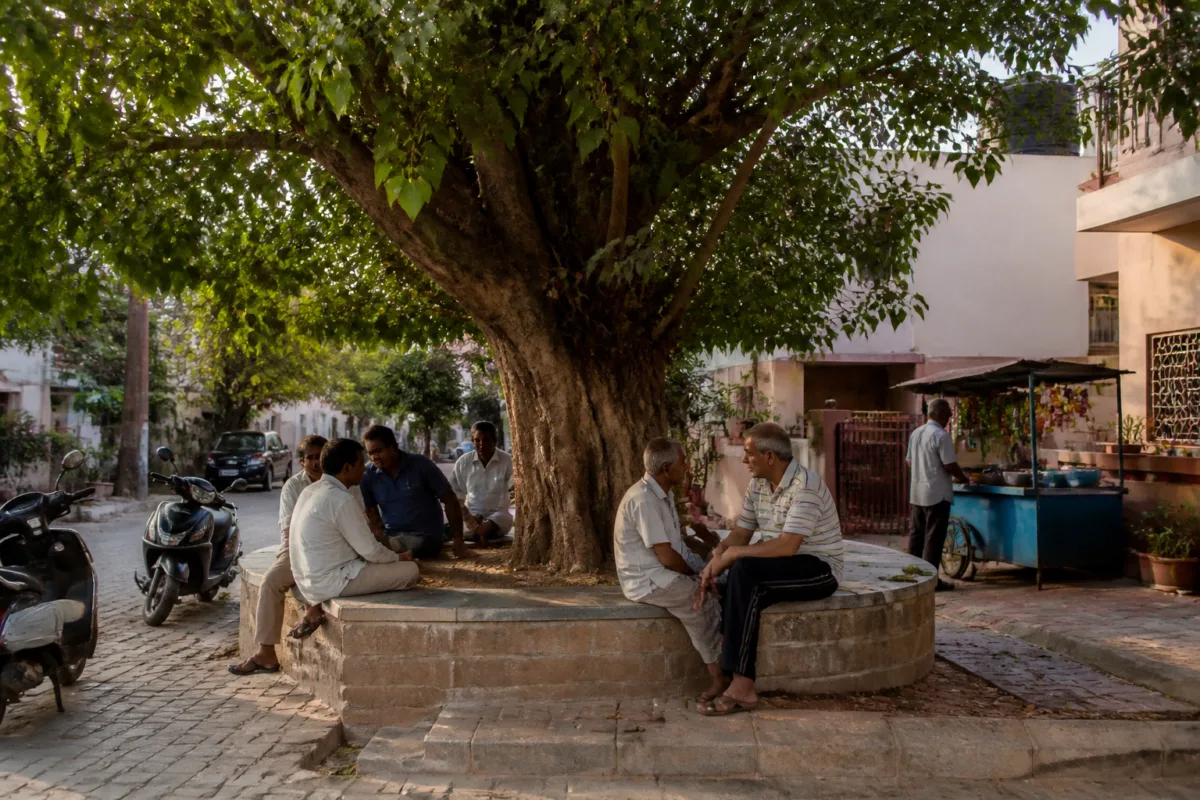
Ashwatha kattes in Bengaluru—platforms built around peepal trees—continue to function as neighbourhood public spaces, even as rapid development and some beautification projects threaten their accessibility and character, according to research examining 20 such sites and nearly 400 interviews.
The findings are presented in The City Beneath the Tree, a book by urban designer Kiran Keswani and IIM-Bangalore professor Suresh Bhagavatula, published by Permanently Black. The researchers argue that the kattes should be understood not only as religious or heritage structures, but also as living urban commons.
A katte can provide a place for neighbours to exchange news, children to spend time and informal commerce to operate. These everyday interactions help create what the researchers describe as social capital: the trust and relationships that connect people within a neighbourhood.
Keswani said the research began with the assumption that kattes belonged largely to Bengaluru’s past. Studying them, however, led the researchers to conclude that they remain relevant to the contemporary city. Bhagavatula described them as public spaces that support gathering, local economic activity and collective memory.
Their relevance is partly connected to what they offer in a city increasingly shaped by elevated transport corridors, commercial buildings and screen-based activity. Unlike spaces designed primarily for movement or consumption, a katte allows people to pause without needing to buy anything or travel elsewhere.
The researchers say many kattes are under pressure from urban development. Some have been displaced, while others have been altered through steel fencing and extensive tiling. Such interventions may be presented as beautification, but the researchers argue that a katte’s social function depends on more than the survival of the tree or platform itself.
The surrounding space must remain accessible for people to sit, meet and pass through. If fencing, paving or other changes make the area difficult to approach, the interactions that sustain the katte can weaken even when the physical structure remains.
This places the kattes within a wider planning question: whether public-space policy should measure value only through movement, formal programming or visual improvement, or also through informal and recurring community use. The researchers advocate for an urban-planning model that incorporates natural elements and shared spaces such as kattes into the expanding city.
Bhagavatula said Bengaluru’s future public spaces should create opportunities for people to meet and build relationships, and argued that the city’s identity should include shade and trees alongside glass and steel. Keswani connected the argument to Metro systems, last-mile connectivity and walkability, describing kattes as potential pause points and social connectors within those networks.
That framing gives the platforms a practical role in transport-oriented urbanism. A walkable route is not only a path between destinations; it also depends on whether people encounter places to rest, orient themselves and interact. Tree-shaded community spaces can make neighbourhood connections more usable, although the source does not provide a citywide assessment of how many kattes currently perform this function.
The research does not suggest that every katte should be preserved unchanged or treated solely as a heritage object. Its central argument is that planning and maintenance should recognise the social activity around these spaces. Protecting the tree while restricting access, or resurfacing the platform without considering how people use it, may preserve an image of the katte while reducing its public value.
For Bengaluru, the issue is therefore not simply whether individual Ashwatha kattes survive. It is whether the city’s redevelopment and public-realm decisions leave room for low-cost, informal places where people can stop, meet and belong. The book’s findings position these platforms as small but significant pieces of social infrastructure—rooted in existing neighbourhoods and dependent on both trees and public access.

