


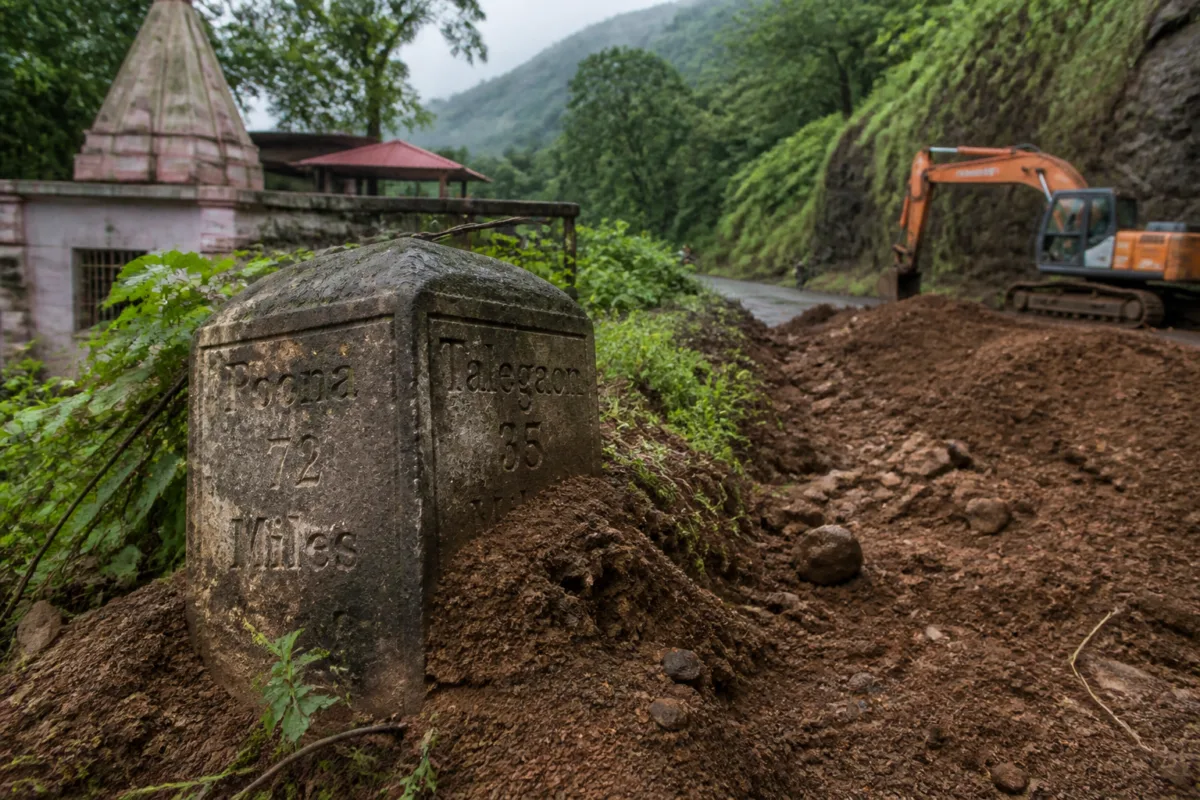
A 169-year-old British-era milestone near Varandha Ghat in Maharashtra is lying partly buried under soil and weeds, while road-widening work in the area has raised concerns about its possible damage or removal.
The stone stands on the left side of the road before Waghjai Temple and Pawar Hotel on the route connecting Bhor taluka in Pune district with Mahad in Raigad district. Its inscriptions, carved on two faces, record distances in miles to four locations: “MAHAD 19” and “WARANDHA 8” on one side, and “LONAND 47” and “HIRDوشI 6” on the reverse. The lower portions are becoming harder to see as soil and moss cover the stone.
The milestone dates to the period when the Varandha Ghat road was developed for commercial movement between the Konkan coast and the Deccan plateau. According to the report, construction of the British-era road began in 1851 and it was opened to bullock-cart traffic in 1857. The marker reflects the road system of that period, when authorities used hand-carved stones showing distances in miles to guide travellers and traders through the mountain pass.
The route’s historic importance was linked to trade between Mahad, Bhor, Phaltan and Pune. Historical records from 1881 cited in the report recorded goods worth about Rs 1.54 lakh moving annually from Mahad through Varandha Ghat towards Bhor, Phaltan and Pune, while commodities valued at Rs 70,000 moved back towards Mahad. The goods included grains, salt, jaggery, cloth, oil, tobacco and other agricultural and household products.
Mangesh Ashok Navghane, a life member of the Bharat Itihas Sanshodhak Mandal, said such historical slabs were valuable primary sources for understanding earlier trade networks, transport systems, administration and socio-economic life. His comments place the marker within the wider history of the route rather than treating it as only an old roadside object.
Local residents are concerned that continued exposure to monsoon runoff and nearby excavation could further bury or damage the stone. Rajesh Deshmukh, a resident and regular traveller on the Bhor-Mahad route, said the milestone could be crushed or discarded as road-expansion work proceeds.
An official from Maharashtra’s Directorate of Archaeology and Museums said the department had taken cognisance of the reports. The official said a technical team would be deputed to inspect the site, record the milestone’s exact coordinates and coordinate with the Public Works Department to preserve it in situ without obstructing road-widening work.
The proposed inspection is the immediate institutional response reported so far. Heritage conservationists have also called for a protective barricade and an information plaque before further construction activity reaches the marker. The case highlights a practical challenge for road projects in historically layered landscapes: even a small roadside structure can carry evidence of earlier transport networks, but its protection depends on identifying it before construction alters the corridor.

