


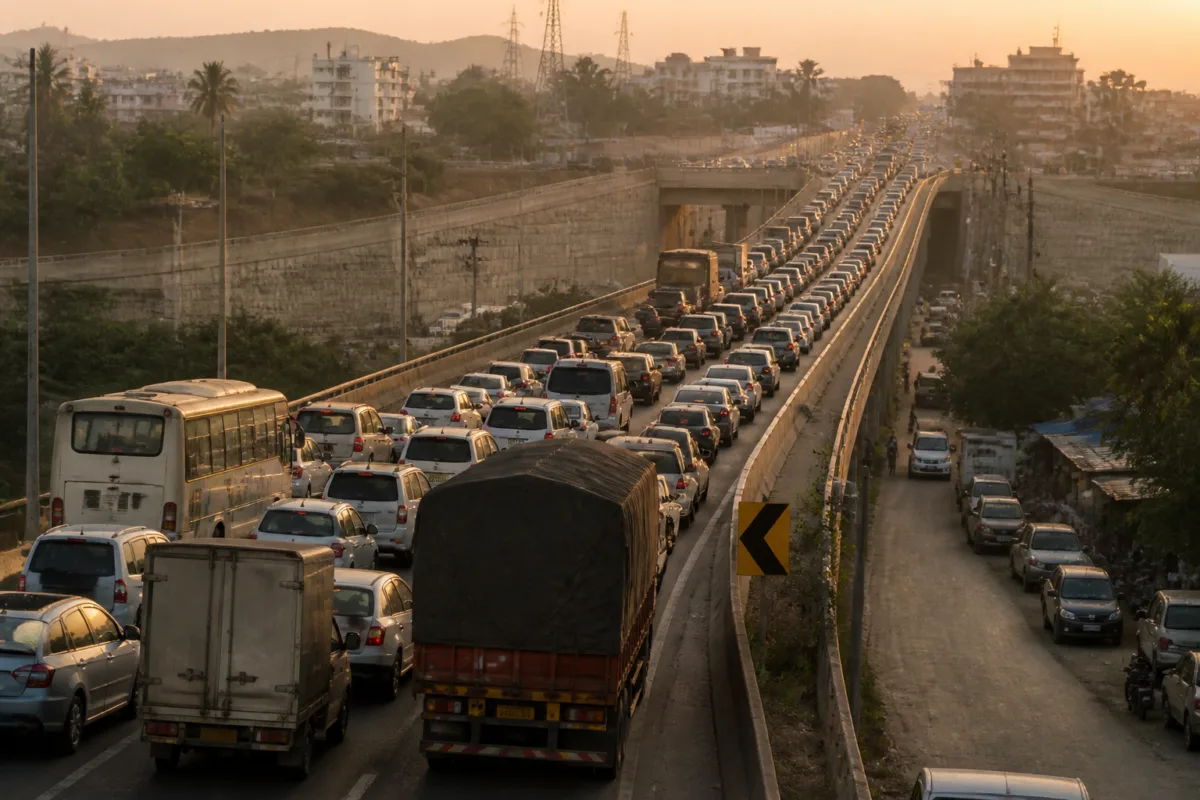
Weekend traffic on the Mumbai-bound carriageway of the Mumbai–Bengaluru National Highway near Pune’s Navale Bridge is stretching for up to two kilometres, according to a report by Pudhari. The congestion is most severe on Sunday evenings, when vehicles queue from the selfie point near the new Katraj tunnel towards Warje Bridge.
The affected stretch includes the selfie point, Bhumkar Chowk, Navale Bridge and Vadgaon Bridge before reaching Warje. Pudhari reported that a journey which normally takes 10 to 15 minutes can take between 45 minutes and an hour during the weekend peak. The report also said ambulances and other essential-service vehicles are sometimes caught in the congestion.
According to the newspaper’s on-ground inspection on Saturday and Sunday, the problem is linked to several overlapping factors. Vehicles were reportedly parked on both service roads and the edges of the highway, including cars stopping on the main carriageway to pick up or drop off passengers. Customers’ vehicles near hotels, roadside eateries, garages and other local businesses were also reported to be occupying service-road space. Heavy vehicles were seen parked along the road edge, the report said.
The account points to a capacity and management problem rather than a single obstruction. Service roads that are intended to separate local access from through traffic are being used for parking and roadside commercial activity, while the main corridor is carrying heavy weekend volumes between Pune, Mumbai and the wider region.
Traffic patterns vary by day. Pudhari reported that Saturday mornings and afternoons see a high volume of vehicles leaving Pune for destinations including Lonavala, Khandala, Mahabaleshwar, the Konkan region and people’s home towns. On Sunday evenings, traffic rises in the Mumbai-bound direction as visitors and residents return after the weekend, including vehicles travelling from the Satara side towards Mumbai.
The congestion follows safety work carried out on the same corridor. The report said the National Highways Authority of India and Pune city traffic police introduced measures on the steep section near Navale Bridge and the selfie point, which had earlier been associated with serious crashes involving heavy vehicles and brake failures. These measures included white-and-yellow rumble strips, speed guns, closed-circuit television cameras and large warning and guidance signs.
Pudhari reported that the number of crashes in the area has fallen after these interventions. However, the safety improvements have not resolved the recurring weekend congestion. The contrast highlights two distinct management requirements on the corridor: controlling vehicle speed and crash risk on the descent, while preserving usable road space and managing peak-hour demand across the bridge and service-road network.
The reported parking and encroachment issues also raise questions about enforcement around roadside businesses and passenger pick-up activity. If vehicles continue to stop on the highway or occupy service roads, even a corridor with improved traffic monitoring and warning systems can lose effective capacity during predictable weekend peaks.
The report does not cite a new traffic-management plan or a confirmed timetable for addressing the congestion. For commuters, visitors and emergency services, the immediate concern remains the reliability of the Pune–Mumbai route during Sunday evening return traffic. A durable response would require the responsible highway and traffic authorities to address parking, service-road access and roadside commercial activity alongside the safety measures already installed.

