


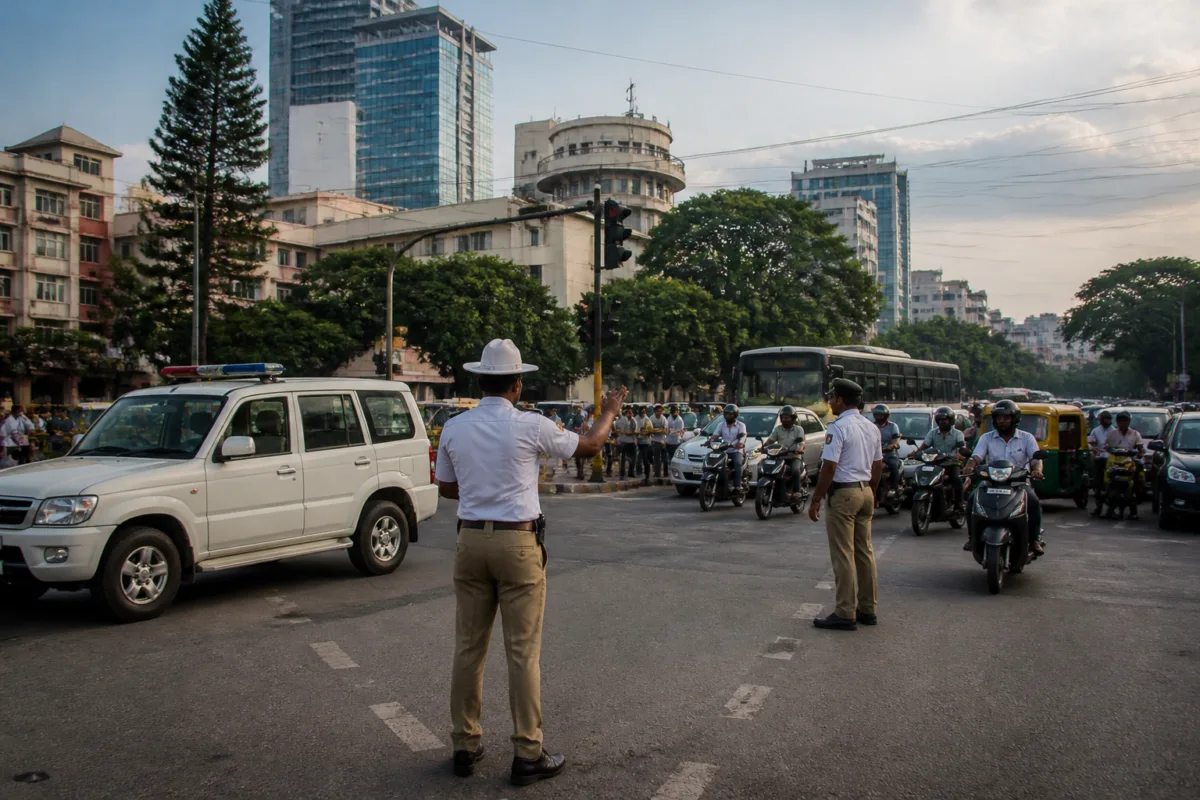
Karnataka’s decision to divide Bengaluru City Police into five commissionerates has created a layered command structure in which the new zonal commissioners will operate under a citywide Chief Commissioner, while traffic policing remains under a separate Commissioner of Police (Traffic). The arrangement is intended to decentralise administration, but the Government Order and officer postings have raised questions about overlapping authority.
According to the order cited in a Deccan Herald report, the Chief Commissioner of Police will exercise control over the five zonal commissioners and the Commissioner of Police (Traffic). This differs from the structure in Hyderabad, where independent commissionerates report directly to the Director General of Police, the report said.
The five zonal commissioners have the rank of Inspector General of Police. Deputy Inspector General of Police C Vamsi Krishna is holding concurrent charge of the South Commissionerate. The Chief Commissioner and the Traffic Commissioner are both Additional Directors General of Police, creating a seniority structure in which officers with different ranks and overlapping responsibilities will operate across the same metropolitan area.
The order states that the Chief Commissioner and all five zonal commissioners will function as Commissioners of Police under Section 7 of the Karnataka Police Act, 1963. They will also remain under the superintendence and control of the Director General and Inspector General of Police, who is the head of the police force in Karnataka.
This places the five commissioners within territorial jurisdictions while retaining a statewide police hierarchy and a citywide supervisory office. The report said the arrangement could produce disagreements over operational control, although the concerns were attributed to serving officers and a former Karnataka Director General of Police rather than to an official assessment of the restructuring.
The Chief Commissioner’s jurisdiction extends across Bengaluru. The zonal commissioners have defined territorial limits, and their orders under the Karnataka Police Act can be superseded by the Chief Commissioner. The Chief Commissioner can also issue urgent orders relating to nuisance or apprehended danger under Section 163 of the Bharatiya Nagarik Suraksha Sanhita, 2023, a power the zonal commissioners do not have, according to the report.
The new offices have also been notified as additional district magistrates under Section 14(2) of the BNSS, the Karnataka Police Act and other applicable laws. Their responsibilities include functions connected with the Arms Act, 1959, the Arms Rules, 2016, the Explosives Act, 1884, the Explosives Rules, 2008, and the Petroleum Rules, 2002. These powers extend the restructuring beyond routine policing into licensing, public-order administration and regulation of potentially hazardous materials.
Traffic administration is a separate pressure point. The five traffic Deputy Commissioners of Police will be placed under the respective zonal commissioners while continuing to remain under the concurrent supervision of the Commissioner of Police (Traffic). Officers cited in the report said this could produce conflicts over immediate operational priorities and leadership approaches.
For residents, the structure could affect how complaints, traffic interventions, emergency restrictions, licences and public-order measures are handled across Bengaluru. A decentralised model may allow decisions to be taken closer to individual zones, but the order’s overlapping lines of authority could make it less clear which office is responsible when a matter crosses zonal boundaries or involves both traffic and law-and-order functions.
A former Karnataka DGP, speaking anonymously, described the arrangement as a series of bureaucratic complications and said clashes could occur without a clearly defined command structure. Other officers cited in the report supported decentralisation, while some expressed concern that the split could weaken the idea of Bengaluru as a unified administrative and policing area.
The restructuring’s effectiveness will therefore depend on how the hierarchy works in daily operations, particularly when citywide orders, zonal policing and traffic management require coordinated action. The available report does not establish whether formal protocols have been issued to resolve such conflicts or how performance will be assessed across the five commissionerates.

