

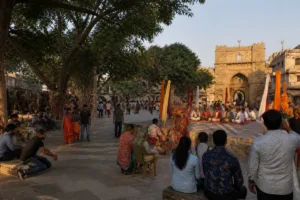
Maidan-e-Shah, the historic open square outside Ahmedabad’s Bhadra Fort, has returned to public attention with the second edition of the Bhadra Festival after a 12-year hiatus. The cultural programme, held on Thursday, brought performances and traditions to a space that is now better known as part of a busy commercial marketplace than as a former royal ground.
Historical accounts describe Maidan-e-Shah as a landscaped expanse lined with palm, tamarind, citron and orange trees. The square included fountains and was used for royal courts, military reviews, visiting delegations and horse polo, according to accounts cited by historian Rizwaan Kadri. Its connection with everyday commerce developed later.
Kadri said the Friday flea market, known as Shukravari or Khaas Bazaar, operated between Teen Darwaza and Bhadra before evolving into Ahmedabad’s Sunday flea market, or Ravivari. The former royal ground now lies within a commercial stretch linking Manek Chowk, Teen Darwaza and Bhadra, where trading activity and daily movement shape how the public experiences the precinct.
The festival’s stated objective is to reconnect visitors with the site’s layered history through cultural performances. Birwa Qureshi, founder and artistic director of Crraft of Art, said the programme was intended to bring together the precinct’s architecture, theatre, music, traditions and everyday life, allowing people to rediscover spaces they may have known without experiencing them in that wider historical context.
The event also brings attention to the tension between heritage presentation and everyday public use. The Ahmedabad Municipal Corporation’s Bhadra Plaza development project, undertaken in 2017, sought to improve access while retaining the historic character of the precinct. The festival demonstrates how a temporary cultural programme can reveal the architectural and civic value of the square, but it does not by itself resolve how that value should be maintained throughout the year.
Kadri said Maidan-e-Shah should remain an accessible public space where people can spend time, learn about its history and understand its significance beyond occasional cultural events. That places the focus on the longer-term management of the precinct: how access, commerce, interpretation and heritage character can coexist in one of Ahmedabad’s most heavily used historic areas.
Maidan-e-Shah’s history is closely linked to Bhadra Fort, built soon after Sultan Ahmed Shah founded Ahmedabad in 1411. Also known as Arak Fort, it served as a royal court before passing into Mughal and later British administration, according to historical accounts cited in the report. Teen Darwaza, on the fort’s eastern side, served as the principal entrance to the open square.
The adjoining serai also reflects the precinct’s successive uses. Mughal governor Azam Khan built it beside the fort’s main entrance in the 17th century, according to the Ahmedabad Municipal Corporation’s heritage account. The Marathas later established the Bhadrakali temple within the serai, which was converted into a jail during British rule.
The Bhadra Festival therefore does more than revive a cultural event. It temporarily changes how a functioning marketplace and transport-linked urban space is read by the public. The larger heritage challenge, as the festival’s organisers and the historian cited in the report suggest, is to make that understanding part of ordinary public life rather than limiting it to scheduled performances.