


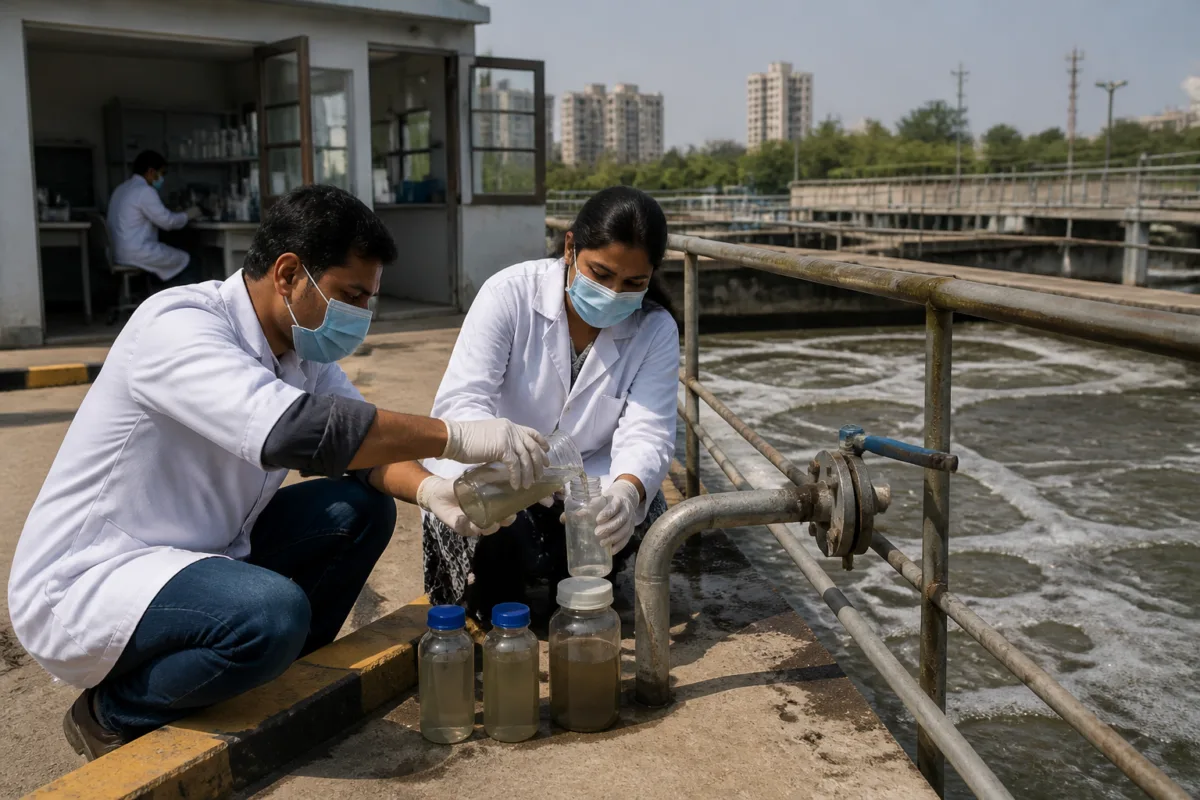
The Union health ministry has released national guidelines for wastewater pathogen surveillance, setting out protocols to detect disease-causing bacteria and viruses in sewage treatment plants and open drains before infections become visible through routine healthcare systems.
Released in New Delhi on November 16, the guidelines were issued by Dr Rakesh Gupta, Additional Secretary (Public Health), Ministry of Health and Family Welfare. They were developed with contributions from the Alliance for Pathogen Surveillance and Innovations (APSI), a consortium formed by the CSIR-Centre for Cellular and Molecular Biology (CCMB), Hyderabad, in 2021, along with research and clinical institutions across India.
Wastewater surveillance involves collecting and testing sewage samples for pathogens circulating in communities. The approach can complement clinical surveillance by helping public-health authorities assess disease burden and identify changes in pathogen circulation before a rise in diagnosed cases is recorded by hospitals and laboratories.
The guidelines cover influenza, monkeypox, hepatitis A and E, rotavirus, adenovirus and respiratory syncytial virus. They also include Vibrio cholerae, Salmonella typhi and Salmonella paratyphi, the bacteria associated with cholera and typhoid. According to the report, the protocols can also support the detection of novel pathogens with potential pandemic risks.
For cities, the framework places wastewater treatment and drainage networks within a wider disease-monitoring system. Sewage treatment plants and open drains become potential surveillance points, allowing samples to provide population-level signals that may not depend on individuals seeking medical care or being tested in clinical settings. The system could therefore add an environmental layer to existing public-health monitoring, particularly for infections that are underdiagnosed or emerge unevenly across neighbourhoods.
The initiative builds on work undertaken by CSIR-CCMB during the Covid-19 pandemic. Its wastewater environmental surveillance programme demonstrated the potential of sewage testing to track the circulation of SARS-CoV-2 and identify changes in virus variants. The new guidelines seek to extend that experience beyond a single pathogen and create protocols that can be integrated into India’s disease-monitoring systems.
APSI brought together institutions including the Tata Institute of Fundamental Research-National Centre for Biological Sciences, Tata Institute for Genetics and Society, CSIR-National Chemical Laboratory, Indian Institute of Science Education and Research, Pune, Ashoka University, CSIR-Institute of Genomics and Integrative Biology and Pasteur Institute, Shillong. The consortium worked with the National Centre for Disease Control under the health ministry to develop the protocols and a roadmap for integration.
The framework’s urban importance will depend on how consistently it is connected to local sewage infrastructure and public-health decision-making. Sampling from treatment plants and drains can produce useful signals only when collection points, laboratory testing, data interpretation and institutional response are coordinated. Cities will also need to account for differences in sewer coverage, wastewater flows and the presence of informal or open drainage systems when interpreting results.
The report does not specify the number of surveillance sites, the implementation schedule, funding arrangements or the agencies responsible for operating the system in individual cities. Those details will be important in determining whether the guidelines become a regular public-health service or remain a set of technical protocols.
Dr Vinay K. Nandicoori, director of CSIR-CCMB, said that expanding surveillance to additional pathogens could support more effective management, as demonstrated during the Covid-19 pandemic. The guidelines now provide a national basis for applying that experience to a broader range of infections and for linking environmental monitoring with India’s disease surveillance infrastructure.

