


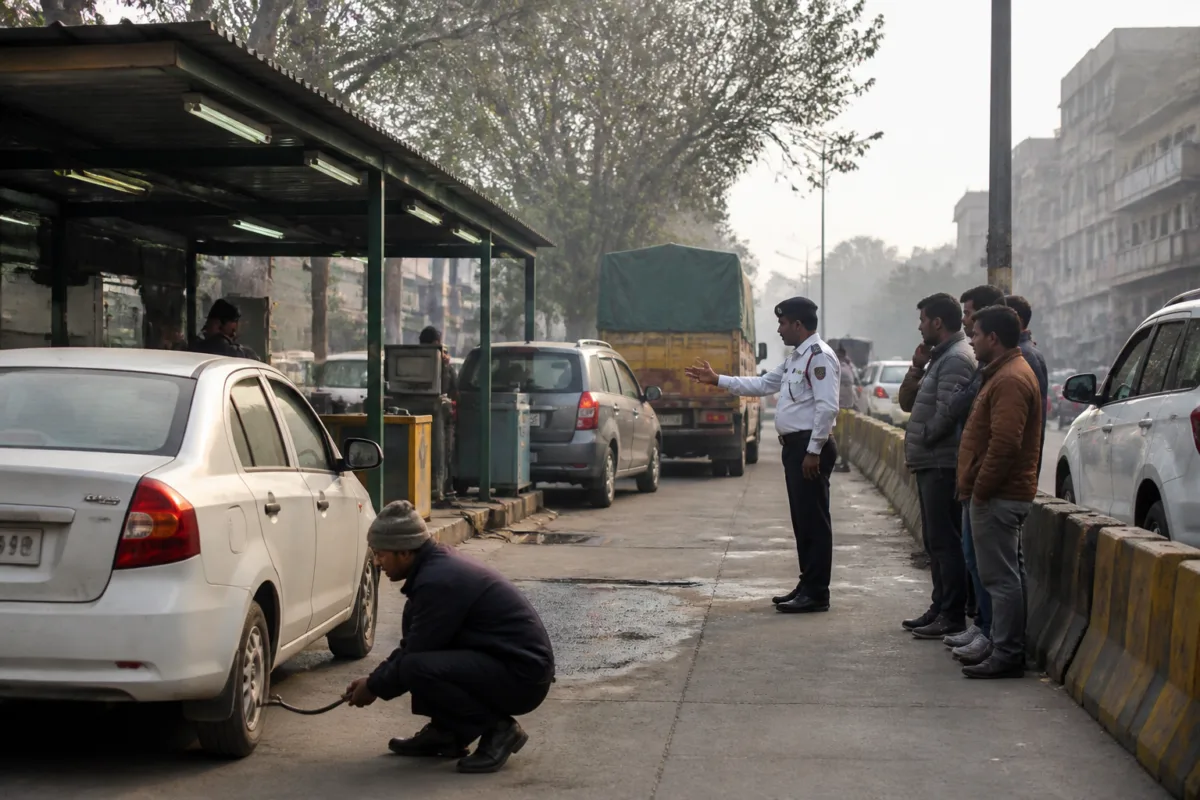
Delhi’s revised Pollution Under Control (PUC) certificate rules create longer renewal intervals for newer BS-VI vehicles but retain frequent testing for older and lower-emission vehicles, as the capital continues to enforce measures aimed at reducing vehicular pollution during the winter season.
The Ministry of Road Transport and Highways notified the changes on November 13 under the Central Motor Vehicles (Sixteenth Amendment) Rules, 2026. The revised schedule came into force after publication in the Official Gazette, according to a Times of India report.
For private BS-VI vehicles up to six years old, a PUC certificate will now be valid for three years. Private BS-VI vehicles between six and 10 years old will require annual renewal, while those older than 10 years will require testing every six months.
The schedule for BS-VI transport vehicles is different. Vehicles up to six years old will receive certificates valid for two years, those between six and 10 years old will require annual renewal, and vehicles older than 10 years will require certificates renewed every six months.
Older emission categories face shorter validity periods. BS-I, BS-II and BS-III vehicles will require renewal every three months, while BS-IV vehicles will have six-month validity.
The rules also clarify how renewal dates are calculated. If a vehicle owner renews a certificate during the 10 days before the existing certificate expires, the new certificate will begin from the earlier expiry date. Renewing after expiry means that the new certificate starts on the date of renewal.
Existing certificates are not immediately altered. Certificates issued before the revised rules took effect will retain their current validity, with the new schedule applying when the vehicle is first renewed after the change.
The revised validity framework comes as Delhi applies additional restrictions to vehicles entering the city. Under the winter pollution framework issued by the Delhi government’s Environment Department on June 23, vehicles below BS-VI standards registered outside Delhi are barred from entering the capital between November 1, 2026 and January 31, 2027. CNG, electric and BS-VI vehicles are allowed to enter, but BS-VI vehicles must also carry a valid PUC certificate.
The entry restrictions apply to more than private cars. Interstate diesel buses that do not meet BS-VI standards cannot enter Delhi, while tractors and jugaad vehicles are also barred. Truck operators whose vehicles do not need to enter the city have been advised to use the Eastern or Western Peripheral Expressways or other alternative routes.
The position for some vehicles changed after air quality improved. On November 17, the Commission for Air Quality Management revoked the restrictions under Stage III of the Graded Response Action Plan. This allowed Delhi-registered BS-III petrol and BS-IV diesel light motor vehicles, including four-wheelers, to ply again. The relaxation also covered the high-vehicle-density districts of Gurugram, Faridabad, Sonipat, Ghaziabad and Gautam Budh Nagar.
However, the relaxation did not remove the separate winter entry restrictions for non-Delhi-registered BS-IV or older vehicles. Those vehicles continue to be kept out of the capital under the Delhi government’s pollution-control framework.
Enforcement against end-of-life vehicles is continuing alongside the PUC changes. Delhi Traffic Police have impounded 9,016 such vehicles so far, including 240 seized during a five-day campaign from November 12 to 16, according to the report. The police are also working with Resident Welfare Associations and Market Welfare Associations to identify abandoned vehicles in colonies, markets and public spaces.
The enforcement has an urban-management dimension beyond emissions. Abandoned and end-of-life vehicles can occupy scarce kerbside space, obstruct movement and create cleanliness and safety concerns in residential and commercial areas. The involvement of local welfare associations indicates that implementation is extending into neighbourhood-level reporting and removal efforts.
For vehicle owners, the immediate requirement is to check the expiry date of the existing PUC certificate and renew it within the 10-day window where possible. People driving into Delhi from another state must check both the vehicle’s emission standard and its PUC status. A BS-VI classification alone does not remove the requirement for a valid certificate, while owners of older vehicles need to confirm whether their vehicles can legally enter or operate under the applicable restrictions.

