


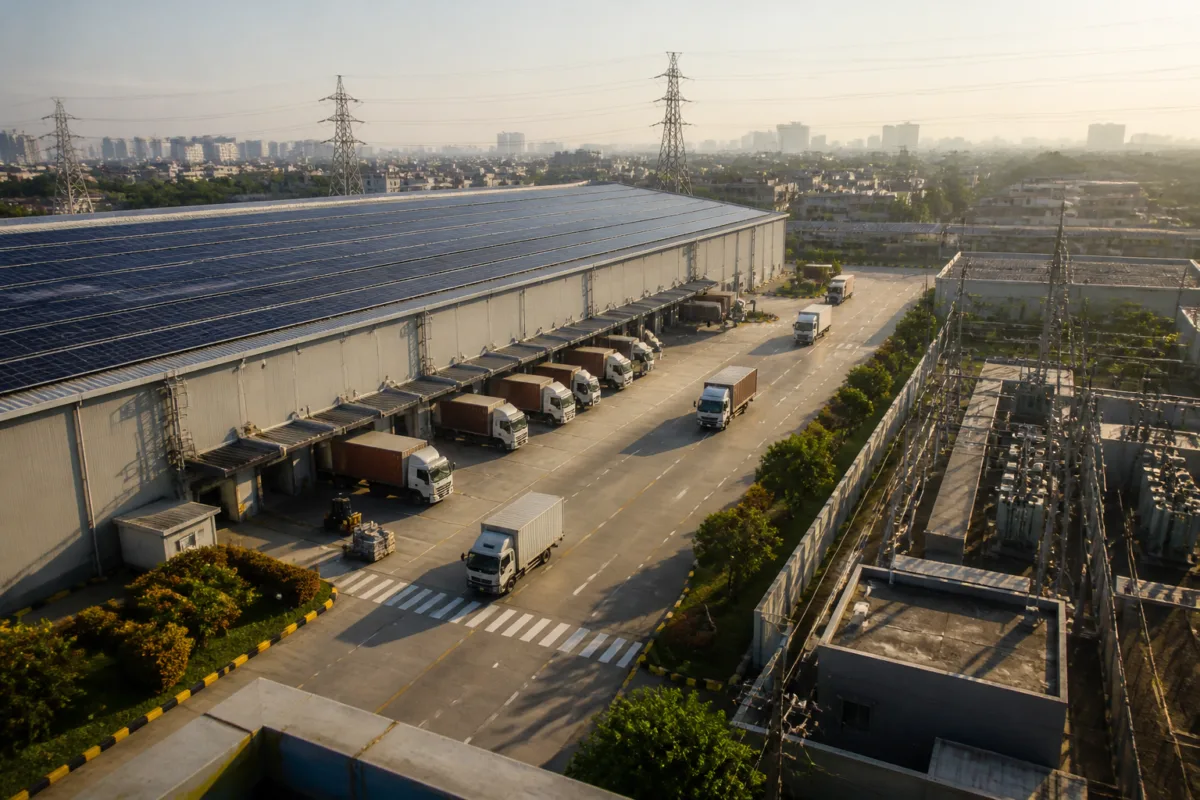
India’s logistics infrastructure is being reshaped by faster delivery expectations, rising energy costs, artificial intelligence adoption and disruption to international trade routes, according to the 2027 Prologis Global Supply Chain Outlook.
The report, prepared by Prologis in partnership with The Harris Poll, surveyed more than 1,800 business leaders in India, the United Kingdom, Germany, China, Mexico and the United States. Its India findings point to growing demand for logistics facilities that can support quicker fulfilment, reliable power and technology-intensive operations.
More than six in 10 Indian respondents said their organisations offer same-day or next-day delivery. At the same time, 96% said these delivery speeds are becoming the baseline consumer expectation in their sectors. Looking ahead, 94% said retailers and logistics providers would need more decentralised fulfilment networks to meet future delivery requirements.
That shift could increase the importance of strategically located warehouses and distribution facilities closer to consumption centres. The report does not quantify the additional floor space or land that would be required, but its findings indicate that fulfilment speed is influencing how businesses think about network design.
Power reliability was the factor selected most often by Indian respondents when considering their next major logistics location decision. Eight in 10 said rising energy costs had significantly affected supply-chain operating costs. The survey also found that 38% reported having on-site generation and energy-independence capabilities, while 63% said they systematically included energy-reliability premiums in property acquisition or leasing decisions.
These findings place energy infrastructure alongside location as a consideration in logistics real estate. Facilities supporting cold chains, automated handling systems and data-intensive operations may face greater consequences from unreliable or expensive power, although the report does not provide a sector-by-sector breakdown of those impacts.
Technology is another major factor. In India, 85% of respondents said their organisations planned significant investment in AI-driven demand forecasting and inventory replenishment over the next two years. The same proportion planned significant investment in agentic AI systems for supply-chain execution. Nearly two-thirds, or 65%, said their AI investments were already providing a competitive edge.
The survey also records the effect of geopolitical and trade-related disruption on network planning. Seventy-one per cent of Indian respondents reported high levels of disruption from shipping-corridor conflicts, while 69% cited rising tariffs. Their reported responses included regionalising operations, cited by 53%; reshoring, cited by 42%; and nearshoring, cited by 29%. In addition, 58% said they had optimised routes and network flows during the previous year in response to rising transportation costs.
Vineet Sekhsaria, Prologis’s head of India, said the findings highlighted the need for well-located logistics facilities with reliable power and the capacity to accommodate modern operations and automation. He said businesses planning for growth needed to consider location, power and technology together when making facility decisions.
The report is a Prologis-backed survey rather than a government assessment or an independently reported measure of India’s logistics property market. Its findings therefore describe the views and stated plans of surveyed business leaders, not confirmed investment or construction outcomes. Even so, the results show how delivery expectations and supply-chain resilience are increasingly connecting warehouse planning with energy reliability, digital systems and the geographic distribution of urban fulfilment capacity.

