


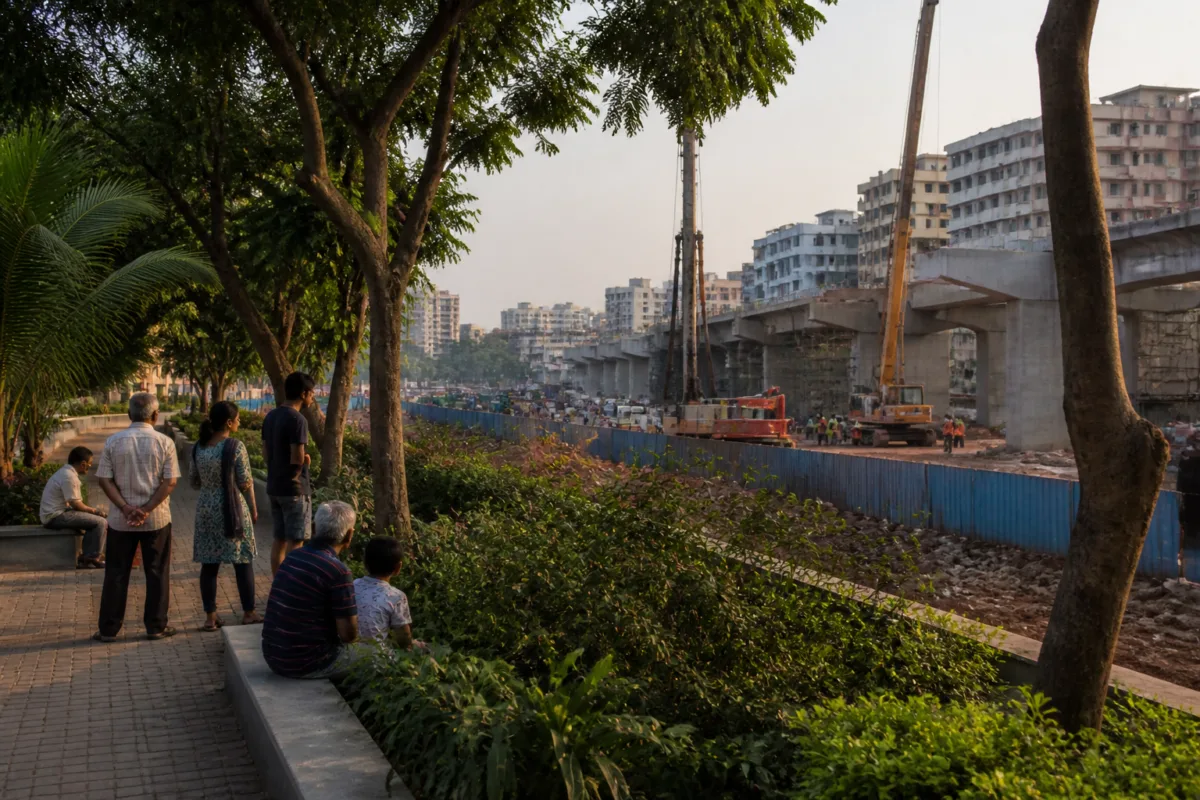
Mumbai’s debate over protecting public open spaces has intensified after tree felling began at Nana Nani Park in Versova for an interchange linked to the Versova-Bhayandar Coastal Road project. The action has brought renewed attention to how transport, utility and redevelopment projects are affecting parks, playgrounds and mature green cover across the city.
The Brihanmumbai Municipal Corporation (BMC) began felling trees at the park on November 18, according to a Free Press Journal report. About 184 trees within Nana Nani Park are slated to be felled, while another 164 are scheduled for transplantation to Seven Bungalows in Versova and BMC-owned land in Powai. The civic body is also required to plant 20,330 compensatory saplings on a 15-hectare plot in Panvel.
Nana Nani Park was developed by local residents in 2001 on a former dumping ground and has since become a recreational space for the Andheri-Versova area. The BMC Tree Authority approved the proposed tree removal in May 2026. However, the commencement of felling prompted protests by residents, environmental activists and public figures, reopening questions about whether compensatory planting elsewhere can replace the everyday recreational and ecological role of an established neighbourhood park.
A similar conflict has emerged at Girgaum Chowpatty, where Maharashtra minister and Malabar Hill MLA Mangal Prabhat Lodha urged the district administration to retain the Mafatlal Gymkhana volleyball ground for public use. The ground is linked to a proposed electrical substation for the Orange Gate-Marine Drive underground road tunnel project.
Lodha met Mumbai City Additional Collector Bappasaheb Thorat and Resident Officer Shivanand Langdapure, and suggested two alternative locations, including a railway-owned plot across the road and a site at Girgaum Chowpatty where work on an underground substation had previously begun. The request, reported by The Times of India and cited in the Free Press Journal article, reflects a recurring planning challenge: infrastructure associated with a wider public project can still displace smaller but heavily used public facilities.
In Bandra Reclamation, the proposed conversion of the Neville D’Souza Football Ground into a commercial exhibition-cum-convention centre produced another public-space dispute. The proposal followed a request from the Maharashtra Housing and Area Development Authority. Footballers, parents, residents and urban planners opposed the change, highlighting the ground’s role in grassroots sport.
The FIFA-standard facility has been operational since 2011 and is used by an estimated 8,000 to 10,000 players annually, according to the report. The Bombay High Court stayed the proposed conversion on August 20, leaving the future of the ground subject to an ongoing legal dispute.
The Hanging Gardens controversy added a further dimension to the debate: whether a major water-infrastructure intervention justified the removal of trees from an iconic public garden. The seven-acre terrace garden is located above the Malabar Hill Reservoir, an approximately 140-year-old structure with a reported capacity of around 150 million litres divided into five compartments.
The BMC initially proposed rebuilding the reservoir in phases but later considered demolishing and rebuilding the entire structure at once. The project cost was reported to have risen from about Rs 700 crore to approximately Rs 1,400 crore, with a larger additional tank planned to maintain water storage during construction. The revised plan would have affected around 390 trees in the garden precinct.
Following public opposition, the BMC agreed to re-examine the reservoir’s condition. A later assessment reportedly found the structure to be sound and in need of minor repairs rather than complete reconstruction. If sustained through formal engineering and administrative records, that reassessment would be significant because it illustrates how the scale and environmental impact of an infrastructure proposal can change when the existing asset is examined more closely.
Other cases cited in the report include proposals involving the removal of 128 trees during the redevelopment of Chhatrapati Shivaji Maharaj Terminus, objections to tree clearing near Godrej Garden in Vikhroli, and an earlier dispute in Powai. In February 2024, the BMC Tree Authority approved the felling of 40 trees and transplantation of 70 others on a wooded plot. When workers began cutting trees in November 2025, residents and environmental groups, including NatConnect, objected and sought intervention. The Union Environment Ministry later ordered a probe.
Taken together, these cases show that Mumbai’s open-space disputes are not limited to one type of project. Coastal-road works, underground transport infrastructure, electrical substations, commercial redevelopment and reservoir planning can all place pressure on land that also serves as parkland, sports space, tree cover or a public amenity.
The immediate public-interest question in each case is therefore not only whether a project is needed, but whether its location, design and construction method adequately account for existing public use and environmental value. The disputes also underline the importance of transparent alternatives, documented condition assessments, credible transplantation and compensatory-planting plans, and clear post-approval monitoring.
For residents, the consequences are practical: the loss or disruption of nearby recreation, reduced access to sports facilities, changes to familiar landscapes and uncertainty over whether replacement planting will mature into equivalent public green space. Mumbai’s continuing infrastructure expansion makes those questions central to how the city balances mobility, utilities and redevelopment with the public spaces that support daily urban life.

