


Andhra Pradesh has amended its Semiconductor and Display Fab Policy 4.0 to align with the second phase of the India Semiconductor Mission, increasing the state’s support for chip manufacturing and setting out plans for a 5,000-acre semiconductor park in Tirupati.
Under the revised policy, the state will match 100 per cent of the Centre’s capital support for silicon fabs, display fabs and semiconductor packaging projects. Silicon fabs approved under Semicon 2.0 will therefore be eligible for combined assistance covering 80 per cent of eligible capital cost: 40 per cent from the Centre and 40 per cent from Andhra Pradesh.
Compound semiconductor, photonics, sensor, discrete and display fabs, along with advanced packaging units, will be eligible for combined support of 70 per cent. Legacy packaging units will receive combined support of 50 per cent. The state said its 80 per cent support for silicon fabs is higher than the incentives offered by Odisha and Tamil Nadu at 65 per cent each, Uttar Pradesh and Madhya Pradesh at 60 per cent each, and Gujarat at 56 per cent.
The amendments cover all 10 categories under Semicon 2.0 across six pillars: design, machines and materials, fabs, packaging, research and development, and talent. For chip design, Andhra Pradesh will provide an additional 50 per cent of the Centre’s support. Commercial design start-ups will be eligible for combined seed funding of up to Rs 225 million, including up to Rs 75 million from the state.
The policy also adds a deployment-linked incentive of 4.5 per cent of net sales from the state, on top of the Centre’s 9 per cent support. This takes the combined incentive to 13.5 per cent, subject to a cap of Rs 450 million per application and Rs 1.8 billion per company.
For semiconductor machinery and materials manufacturing, the state will provide capital support of 18 per cent in addition to the Centre’s 30 per cent, taking combined support to 48 per cent. This will be supplemented by the Centre’s production-linked incentive. Assembly, testing, marking and packaging, or ATMP, and outsourced semiconductor assembly and test, or OSAT, units will receive state capital assistance matching 100 per cent of the Centre’s support.
For research and development and talent-related projects, the state will provide 25 per cent of eligible project cost. Combined central and state assistance for these projects will be capped at 75 per cent. The state’s incentives will be capped at 50 per cent of eligible fixed capital investment, while total support from all sources will be limited to 90 per cent. Andhra Pradesh’s share will be released after each tranche of central assistance, following the same schedule.
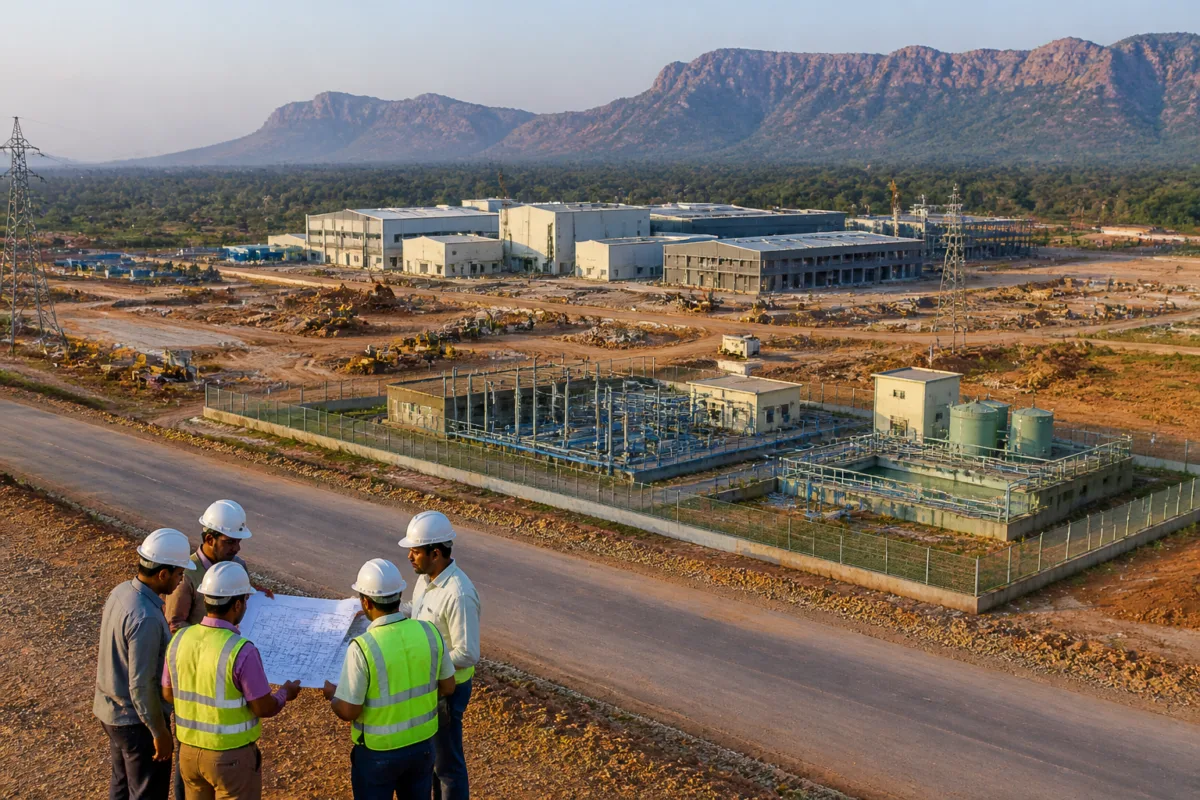
The proposed Andhra Pradesh semiconductor park in Tirupati is intended to provide the physical infrastructure needed to support a manufacturing and supplier cluster across the semiconductor value chain. The park, planned across approximately 5,000 acres, will include developed land, shared industrial cleanrooms, high-voltage power with redundancy, ultrapure water, natural gas and specialty gases.
The planned facilities will also include effluent treatment and water recycling systems, testing laboratories, logistics infrastructure, and research and training centres. These requirements underline the infrastructure intensity of semiconductor manufacturing, where reliable utilities, specialised industrial environments and coordinated supply chains are central to project operations.
The park will be operated by a public-private partnership company with an investor-led board and up to three government nominees, according to the report. The Andhra Pradesh Semiconductor Growth and Innovation Council, or APSGIC, will serve as a single point of contact for investors.
The council will have an oversight body chaired by the chief minister and a chief executive officer-led apex committee comprising experts. The committee will appraise projects, recommend state incentives and coordinate clearances, land allocation, power and water requirements, and engagement with the India Semiconductor Mission and the Union Ministry of Electronics and Information Technology.
The state also plans to establish the Andhra Pradesh Semiconductor Research and Innovation Centre, or AP-SRIC, as a not-for-profit company with independent professional management. It will initially operate from IIT Tirupati before moving to the proposed semiconductor park. Photonics has been identified as its first area of focus.
An Andhra Pradesh Semiconductor Training and Capacity Building Centre, or AP-STCC, will also be established within the park. Its curriculum will be developed with industry and universities in the state. Companies will be eligible for a training subsidy of Rs 10,000 per trainee per month for six months.
The policy provides customised incentive packages for mega projects involving investments between Rs 10 billion and Rs 50 billion, and for ultra-mega projects exceeding Rs 50 billion. These packages will be considered on a case-by-case basis by the state investment promotion board, chaired by the chief minister.
Projects outside Semicon 2.0 will be eligible for a power subsidy of Rs 3 per unit for five years from the start of commercial production, along with incentives available under the state’s industrial or electronics policies.
The amended policy will remain valid for five years or until it is replaced by a new policy. The amendments take effect immediately, while benefits already granted under the existing policy will remain protected. The government will issue separate operational guidelines covering eligibility, project appraisal and incentive disbursement.
Those guidelines will be important for translating the policy’s headline incentives into project-level approvals and infrastructure delivery. They are expected to clarify eligibility, appraisal procedures and the release of state support, while the proposed park and associated institutions will determine how the policy is implemented on the ground.

