


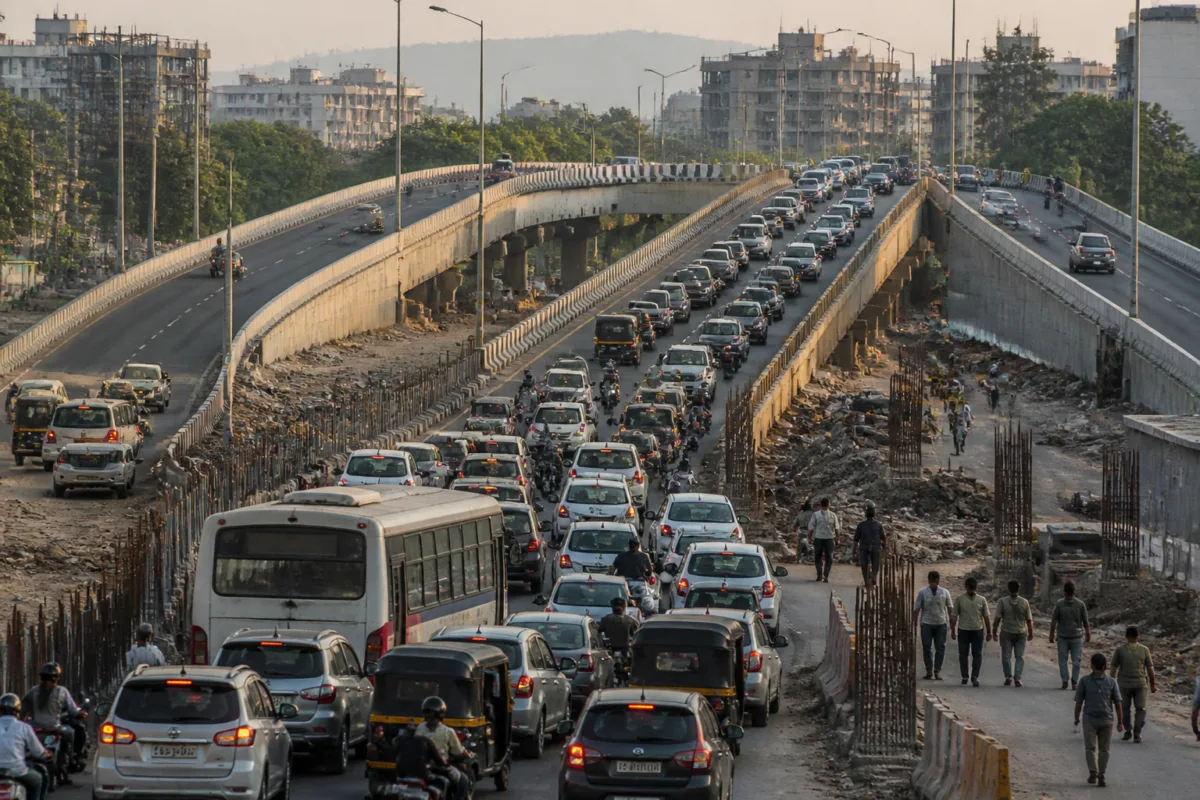
Pune’s new Chandani Chowk bridge has eased some of the junction’s earlier bottlenecks, but congestion continues across the wider western corridor from Navale Bridge to Wakad, according to a report by Pudhari.
The corridor connects traffic heading towards Warje, Bavdhan, Bhugaon, Pashan, Baner, Hinjewadi and Mulshi. The report says that building a bridge at one junction cannot resolve congestion across this network, where highway traffic overlaps with local vehicles, office traffic, weekend tourism, buses, autorickshaws, private passenger vehicles and pedestrians.
The new structure has introduced separate ramps for vehicles travelling in eight directions and has divided through highway movement from local traffic. It also provides connections towards Kothrud, Bavdhan, Pashan, the National Defence Academy and Mulshi. According to the report, the earlier narrow bridge was a principal obstruction, and travel across Chandani Chowk is quicker under normal conditions.
However, the wider system remains vulnerable to disruption. A stalled vehicle or crash can rapidly create queues, while service roads are carrying both local and highway traffic. The Warje–Navale Bridge stretch continues to act as a bottleneck. The report also identifies barricading and unauthorised parking on Paud Road, a shortage of designated bus bays and autorickshaw stands, and incomplete pedestrian connections.
Service-road construction is under way, with concrete roads being built on both sides. But the report says there is no lane connecting the service road continuously from the HEMRL area to Chandani Chowk. As a result, when congestion builds, motorists can remain trapped on the highway instead of moving to an alternative route.
The account also points to pressure from offices in Hinjewadi after working hours, weekend tourist traffic and vehicles travelling towards Mulshi and the Konkan region. This makes the corridor a regional access route as well as a local urban junction, increasing the consequences of weak interchange design and poor roadside management.
The report calls for continuous coordination among the traffic police, the Pune Municipal Corporation, the National Highways Authority of India, Metro agencies and the Pune Metropolitan Region Development Authority. It says the entire Navale Bridge–Wakad highway stretch should undergo a traffic audit rather than being assessed junction by junction.
Among the immediate measures suggested are 24-hour deployment of cranes and towing vans at Chandani Chowk and Warje, a defined time limit for removing disabled vehicles, and additional traffic police during morning and evening peaks. The report also recommends dedicated bus bays for MSRTC, PMPML and private buses, removal of unauthorised stopping by autorickshaws and passenger vehicles, stricter action against parking on service roads, and larger illuminated signs at ramps and alternative routes.
Digital information boards showing congestion and alternative routes could help drivers make decisions before entering a queue. The report further recommends connecting the pedestrian bridge with bus stops and the Metro station. These measures indicate that the corridor’s performance depends not only on bridge capacity, but also on incident management, public transport access, pedestrian continuity and clear route distribution.
The unresolved issue for Pune is therefore how the new bridge will be integrated with the entire western approach network. Without coordinated management and completion of supporting links, capacity added at Chandani Chowk may continue to be constrained by bottlenecks and access gaps elsewhere along the corridor.

