


Delhi schools are returning to regular classroom teaching after days of hybrid lessons introduced under pollution curbs, but teachers say the shift has exposed unequal access to devices, internet connectivity and uninterrupted learning.
The immediate challenge is not visible in attendance registers alone. While some students followed lessons from home, others missed parts of classes when connections failed or were unable to attend because they had no phone or laptop available.
Private schools with established digital infrastructure and teachers experienced in online instruction were able to switch more quickly, according to the report. A parent at Amity International School said her primary-school daughter attended lessons online while her son in Class VII continued attending school in person, and that both arrangements were effective.
The experience was different in government schools. A government school principal said hybrid days resulted in lost learning because teachers could not confirm whether every child had attended online or determine how much each student had understood. When students returned to school, teachers often had to revisit the last lesson taught in person.
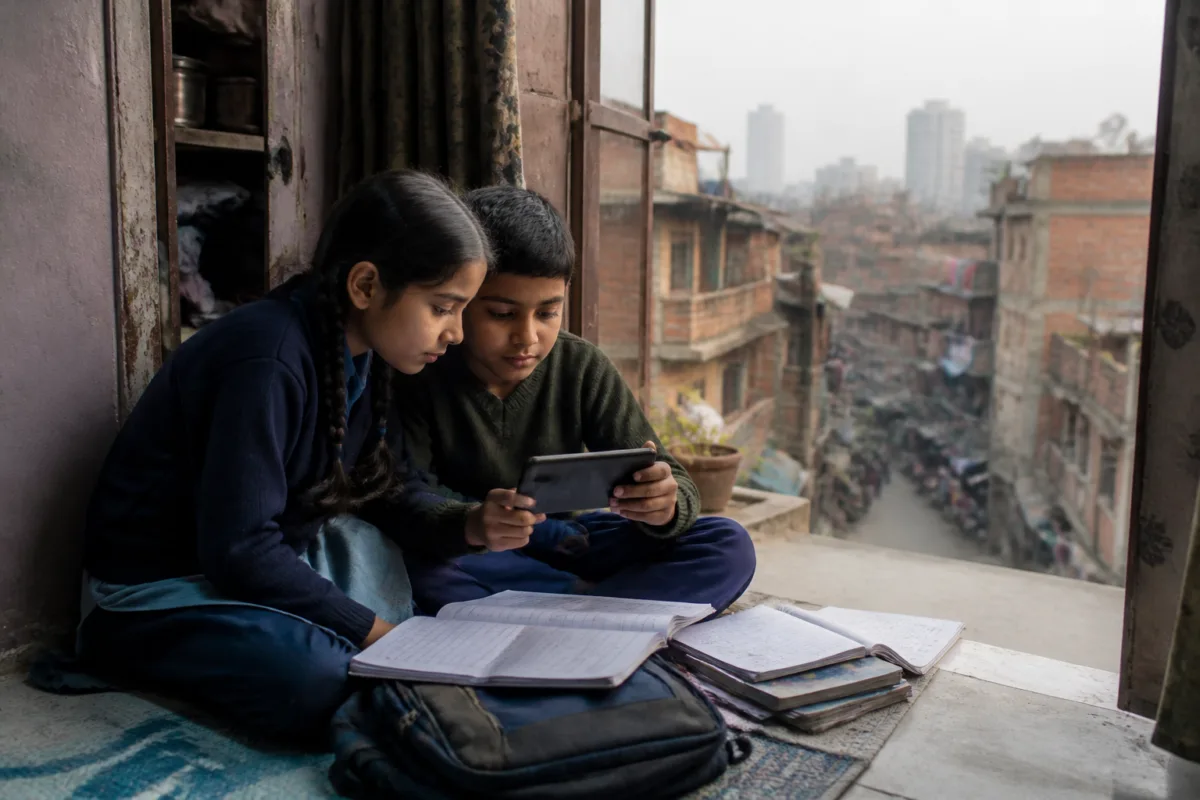
For some children, accessing the online classroom was itself difficult. Meera, a Class V student from a Delhi settlement, said her family did not own a phone. Her father, a rickshaw puller earning Rs 100 to Rs 150 a day, meant she relied on a learning centre run by a non-governmental organisation, where a staff member lent her a phone for classes.
A government school principal said some households had only one phone, which a parent carried to work. In families where siblings shared a device, younger children often missed lessons. Borrowing a phone also did not guarantee continuity, as the device might not be available the following day.
Ten-year-old Aman, a Class IV student from a Delhi settlement, attended online lessons from a neighbour’s home with his siblings. He used a borrowed phone from a corner of the room or the verandah, but a weak internet connection frequently interrupted the class. When the neighbour was away or the phone was unavailable, he missed the lesson altogether.
The accounts show how pollution-related changes to school operations can create different learning conditions across the city. Students in schools with stronger digital systems may be able to continue lessons remotely, while children in households without reliable devices, connectivity or a suitable place to study can lose access altogether.
As schools resume regular classroom teaching and continue to monitor air quality, teachers face classrooms containing students with sharply different levels of continuity. Some followed the topic online, some caught only fragments and others missed it entirely. The report indicates that returning to physical classrooms does not by itself resolve the learning gaps created during hybrid teaching; teachers must first identify which students were able to participate and which were not.

