


Bihar’s cabinet has approved a set of infrastructure and public-service measures spanning transport, power transmission, healthcare, research facilities and decentralised solar generation, according to details released by state officials and reported by the Times of India.
The approvals include a Rs 66.58 crore payment to an agency that will prepare the detailed project report and act as transaction adviser for the proposed six-lane Buxar-Bhagalpur greenfield expressway. The report did not identify the agency or provide a construction schedule. The cabinet’s decision marks an administrative step towards developing the corridor, but the available information does not establish when construction will begin or when the road will be completed.
The cabinet also approved the selection of Adani Energy Solutions Limited to build transmission lines required to draw electricity from the 3×800 MW super thermal power plant planned at Pirpainty in Bhagalpur district. Bihar’s two power distribution companies will pay annual transmission charges of Rs 493.76 crore for 36 years, after which the transmission infrastructure will be handed over to the Bihar State Power Transmission Company Limited, according to the report.
The arrangement links a new generation facility with a long-term transmission obligation and a planned eventual transfer to the state transmission utility. The report, however, does not provide the length, route or capacity of the transmission lines, nor does it state when the power plant or associated network will become operational.
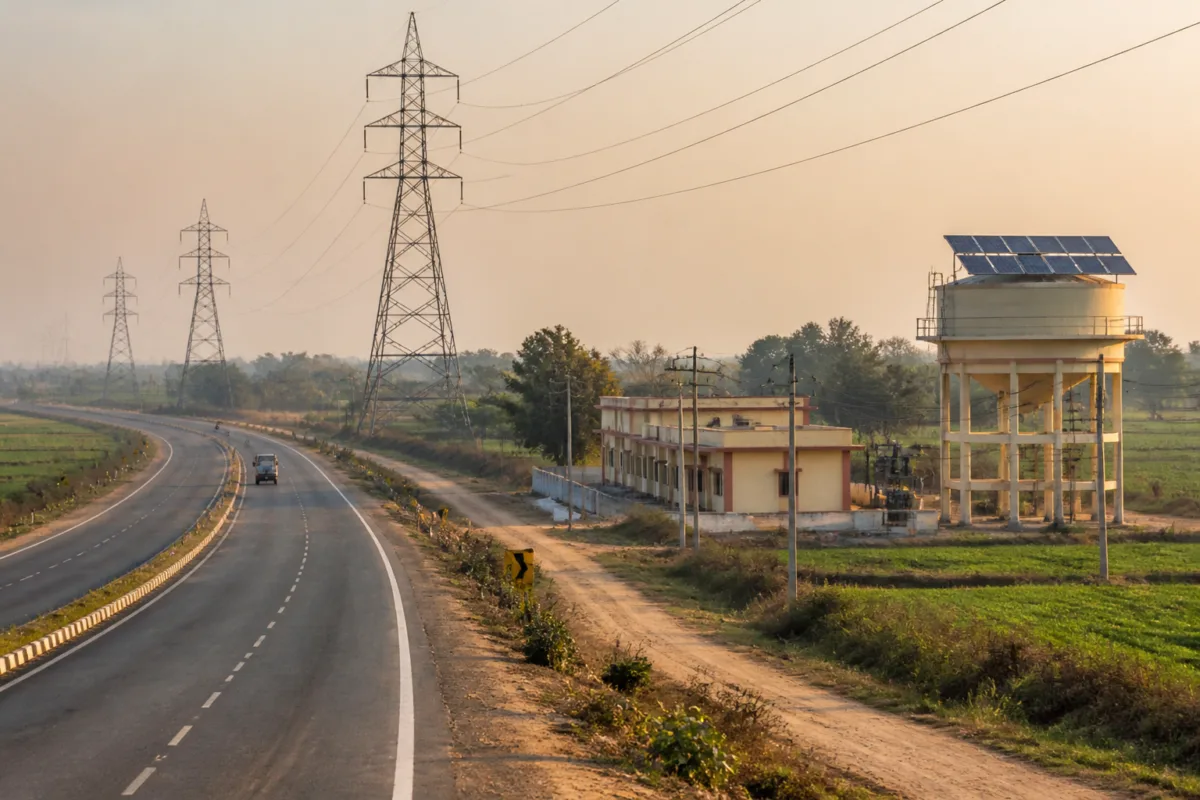
In the rural infrastructure and energy-efficiency segment, the cabinet approved the installation of 5-kilowatt on-grid solar panels at existing water-supply centres and towers in panchayat wards. It also approved 10-kilowatt on-grid solar panels at panchayat sarkar bhavans. The reported expenditure is Rs 4,809.52 crore for the water-supply installations and Rs 482.82 crore for the panchayat buildings.
These measures are intended to support the operation of rural water-supply infrastructure and panchayat buildings through grid-connected solar systems. The report does not specify the number of sites, procurement model, implementation agency, commissioning timeline or expected energy generation. Those details will be important for assessing the programme’s value and delivery requirements.
In Darbhanga, the cabinet approved a plan to make the Gangwara Sadar Hospital operational again after it had remained closed for some time. Muzaffarpur-based Homi Bhabha Cancer Hospital and Research Centre will operate a head, mouth and neck cancer facility in one half of the hospital, while the other half will be used for the Sadar Hospital itself. The decision creates a shared-use model for an existing public building, although the report does not give a reopening date, the planned bed capacity or the investment needed to restore the facility.
The cabinet further approved a memorandum of understanding between Bihar’s building construction department and the Centre for Urbanisation Building and Environment at IIT Madras. CUBE will act as adviser and project management consultant for a research park at IIT Patna. The project cost is Rs 305 crore, and the consultant’s fee will be 5% of that amount, according to the report.
Alongside these infrastructure decisions, the cabinet approved the e-auction of magnetite blocks at Majos and Bhanta in Jamui district and a copper-lead-zinc block at Pindara in Banka district. The state estimates that the auctions could generate Rs 5,053 crore. The mineral decision is not itself an urban project, but it could influence future industrial and transport requirements in the affected districts; the report does not set out any such linked infrastructure plan.
The cabinet also amended provisions of the Bihar Treasury Code concerning utilisation certificates. Officials said the changes would help prevent delays in salaries, pensions, scholarships and incentive payments, including transfers for school uniforms and bicycles. No utilisation certificate will be required for certain grants, while mandatory certificates may be submitted in physical and electronic formats. The report said grants to urban local bodies and panchayati raj institutions would not require utilisation certificates under the revised provisions.
Taken together, the decisions cover project preparation, long-term power transmission, public-building reuse and distributed energy systems. Their public value will depend on the next stage of implementation: the release of project documents, procurement details, site-level plans, financing arrangements and measurable delivery timelines. Those details were not included in the cabinet announcement as reported.

