


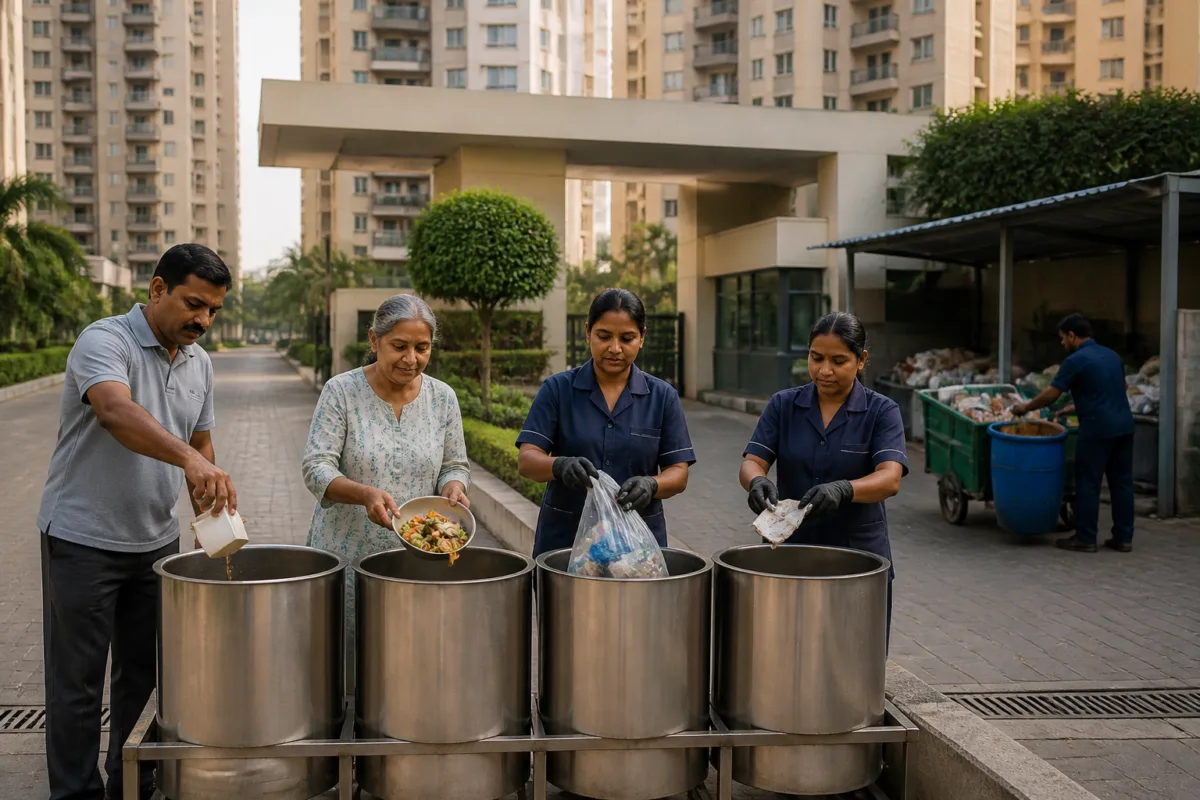
Mumbai housing societies that fail to follow prescribed waste-management requirements could face penalties of up to Rs 10,000 and lose a property-tax rebate of up to 15%, according to measures specified by the Brihanmumbai Municipal Corporation (BMC).
The civic body’s penalty structure sets the fine at Rs 1,000 for a first offence, Rs 5,000 for a second and Rs 10,000 for a third. The process requires the society to receive a notice and an opportunity to respond. A fourth or subsequent violation in the same financial year could lead to withdrawal of the rebate.
The measures follow the Solid Waste Management Rules, 2026, which came into force on April 1, as well as directions from the Supreme Court and Bombay High Court, the report said. In an order dated November 3, the high court directed the BMC to communicate source-segregation requirements directly to housing societies across Mumbai. The civic body has since issued a public notice and circular setting out the compliance requirements.
Under the new guidelines, households and housing societies must keep wet, dry, sanitary and special-care waste separate during storage and collection. Society management committees have been asked to communicate the requirements to residents, housekeeping staff and waste handlers. Residents must also register for the BMC’s designated collection arrangements for sanitary and special-care waste.
The circular identifies a residential establishment as a bulk waste generator (BWG) if it meets any one of three thresholds: a floor area of at least 20,000 square metres, water consumption of at least 40,000 litres a day, or solid-waste generation of at least 100 kg a day. Such establishments must register through the designated BMC and Central Pollution Control Board systems.
Eligible residential BWGs can claim up to a 15% rebate on the general tax component of their property-tax bill. The incentive includes up to 6% for processing wet waste through an approved facility on the premises, 4% for compliant dry-waste management, and 5% for eligible grey-water reuse or rainwater harvesting. The full rebate is subject to verification and continued compliance and is not automatic.
Societies that cannot independently establish wet-waste processing facilities may explore a common facility with neighbouring qualifying societies through a Special Purpose Vehicle, subject to BMC approval. Empanelled agencies may assist with assessment, installation, operation and maintenance of waste-processing facilities.
For existing residential BWGs unable to process wet waste on their premises, the circular provides an alternative route. These societies must obtain an exemption from the BMC, continue four-way segregation, hand over waste through authorised arrangements and procure Extended Bulk Waste Generator Responsibility certificates for the verified quantity of wet waste handled through that system.
Ward-level teams will verify BWG status and inspect waste-management arrangements. The BMC will also prepare a verified register of BWGs, support the revival of non-functional waste-processing plants and identify clusters where common processing facilities can be established.

