


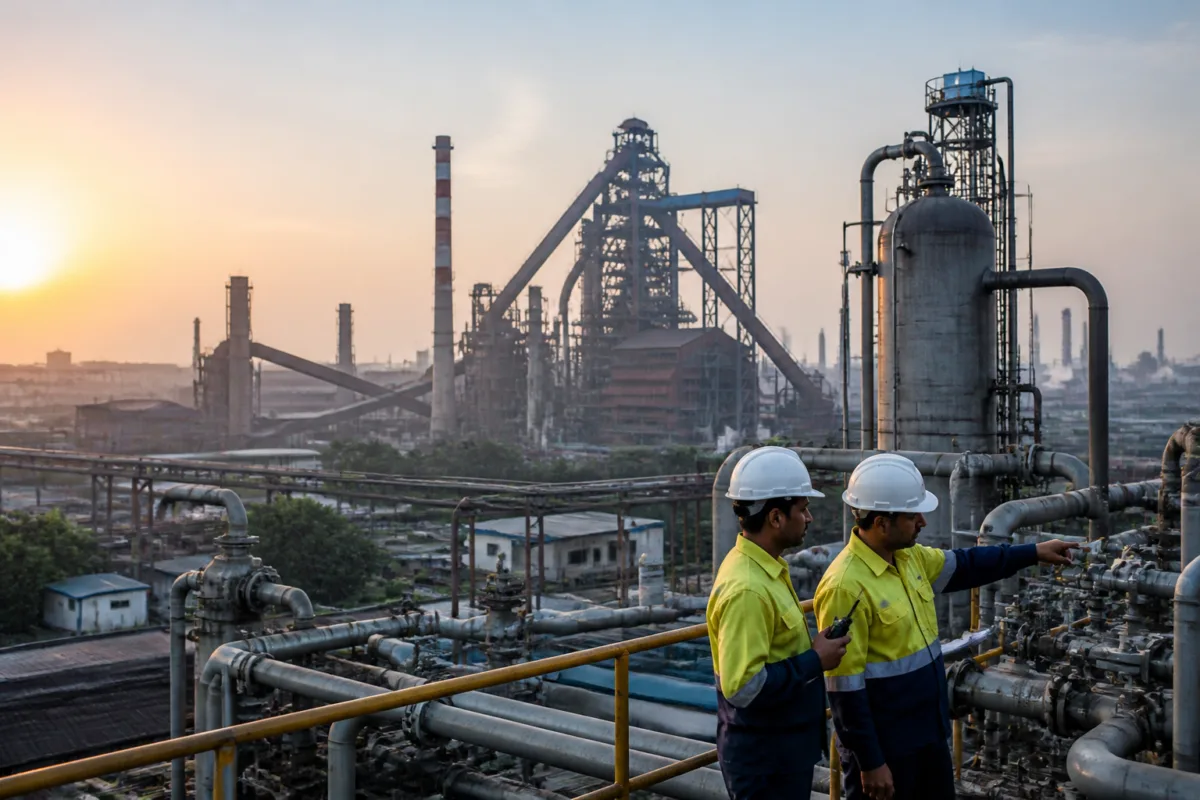
Tata Steel and Houston-based Utility Global are studying a proposed Kalinganagar hydrogen plant that would convert gases generated during steelmaking into high-purity hydrogen, linking industrial waste-gas recovery with the company’s decarbonisation efforts.
The companies will undertake a feasibility study and joint Front-End Engineering and Design work for the proposed facility at Tata Steel’s Kalinganagar plant in Odisha. Tata Steel said the studies will support a Final Investment Decision before the proposal is placed for board approval.
The planned facility would have a capacity of 10 tonnes of hydrogen per day. It would use Utility Global’s H2Gen technology to process off-gases generated during steel production. Utility Global has developed an electrochemical process that uses carbon monoxide-rich steel plant gases to produce high-purity hydrogen.
The project is not yet an operating plant. Installation and operations at Kalinganagar would follow only if the engineering work is completed successfully and a Final Investment Decision is taken, according to the report.
Subodh Pandey, Tata Steel’s Vice-President for Technology, R&D, New Materials Business and Graphene, said technology intended to contribute meaningfully to steel decarbonisation must work at the scale and complexity of an operating steel plant. He described the collaboration with Utility Global as a milestone in Tata Steel’s operational decarbonisation programme.
The proposed approach is significant because it seeks to use an existing industrial by-product rather than relying only on separately produced hydrogen. Steel plants generate several process gases, and the companies are examining whether the carbon monoxide-rich gases can serve as a feedstock for hydrogen production through the H2Gen system.
Utility Global has previously demonstrated the technology using actual blast furnace gas at a steel producer’s blast furnace plant in Canada. The Kalinganagar study would assess its application within Tata Steel’s Indian operating environment, although the source report does not provide details on the expected hydrogen end use, emissions performance, capital cost or commissioning schedule.
The proposal builds on Tata Steel’s earlier work on alternative fuels and carbon-management technologies. The company has previously demonstrated coal-bed methane, hydrogen and biochar injection in blast furnaces. In 2021, it commissioned a plant at Jamshedpur to capture carbon dioxide from blast furnace gas. Tata Steel also commissioned a coke oven gas injection project at its Meramandali plant in September, describing it as a first-of-its-kind initiative in the Indian steel industry.
Together, these projects indicate a technology pathway focused on modifying existing steelmaking systems and using process gases more efficiently. However, the Kalinganagar hydrogen proposal remains at the feasibility and engineering-study stage. Its eventual contribution to emissions reduction will depend on the study findings, the investment decision, plant performance and the operating conditions of the integrated steel facility.
For the Indian steel sector, the project’s central test will be whether hydrogen can be produced reliably from steel plant off-gases at industrial scale. The proposed 10-tonnes-per-day capacity provides a defined target, but the available information does not yet establish the project’s final configuration, implementation timeline or commercial outcome.

