


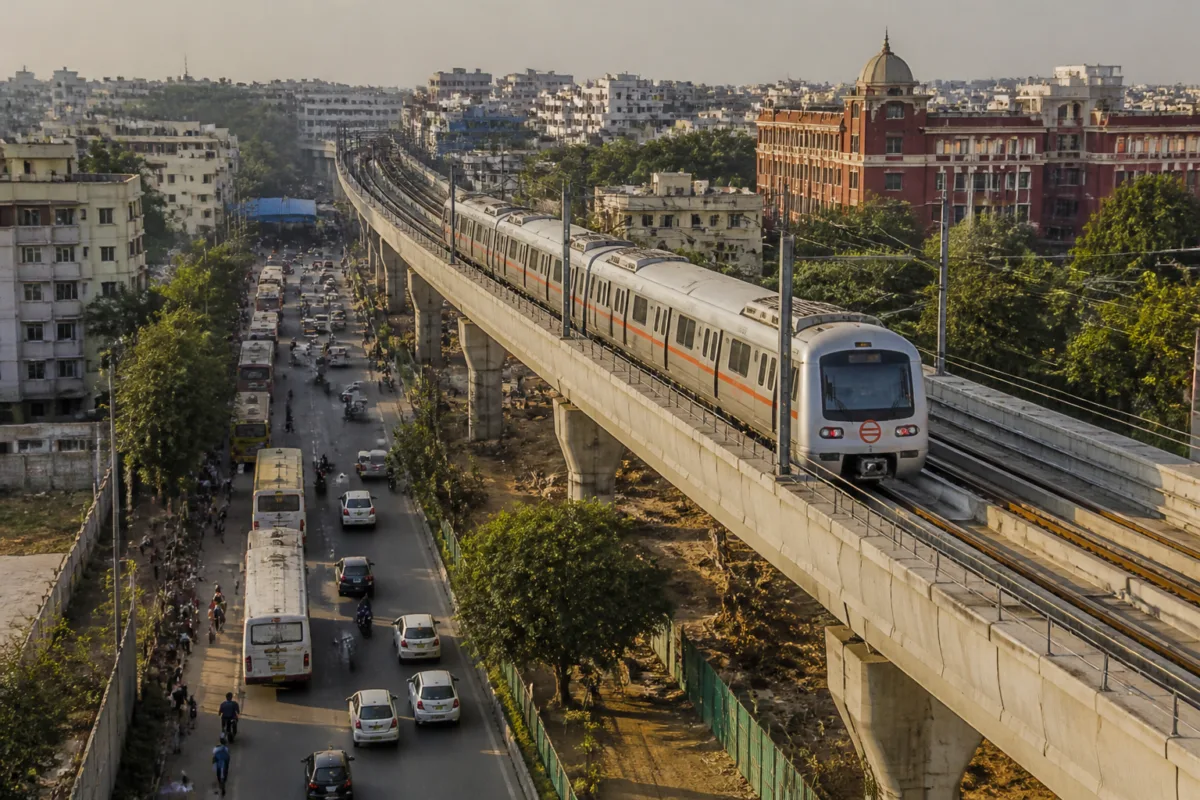
Delhi Metro’s proposed Phase V(B) expansion could add eight corridors connecting outer and densely populated parts of Delhi with areas including Gurugram, Narela, Najafgarh, Rohini and Meethapur, according to information reported as part of an RTI response. The proposals cover a combined network for which the report says 65 stations are planned, although the station count for one of the eight corridors is not specified.
The proposed Yashobhoomi Dwarka Sector 25–Rajiv Chowk corridor is listed as one of the eight routes submitted for government approval. The route would connect the Dwarka area with Gurugram, but the report says it is still awaiting approval from both the Delhi government and the Centre.
The seven other corridors have reportedly received approval from the Delhi government and are awaiting the Centre’s consent. They are Dhansa Bus Stand in Najafgarh–Nangloi, Central Secretariat–Kishangarh, Samaypur Badli–Narela DDA Sports Complex, Kirti Nagar–Palam, Jor Bagh–Mithapur, Mayur Vihar Phase III–Shastri Park and Keshav Puram–Rohini Sector 34.
The proposed Dhansa Bus Stand–Nangloi corridor would be 11.9 kilometres long, with nine elevated stations and interchanges at Nangloi and Dhansa Bus Stand. According to the report, it would extend metro access to Naresh Park Extension, Ranhola, Bakkarwala, Baprola, Dichaon Kalan and Najafgarh Extension.
The Central Secretariat–Kishangarh corridor is proposed to cover 15.9 kilometres with 10 stations, nine of them underground. It would serve New Moti Bagh, R K Puram Sectors 1 and 7, Jawaharlal Nehru University and the Prime Ministers’ Museum, with interchange facilities at Central Secretariat, Moti Bagh, R K Puram and Kishangarh.
The Samaypur Badli–Narela DDA Sports Complex corridor would extend the Yellow Line by 12.9 kilometres and include eight elevated stations. The 9.9-kilometre Kirti Nagar–Palam corridor would extend the Green Line and have six stations, including five underground stations.
The Jor Bagh–Mithapur corridor is proposed to run for about 17 kilometres with 12 stations, seven of them underground. The Mayur Vihar Phase III–Shastri Park corridor would cover 13.2 kilometres, including a nine-kilometre underground section, and have eight stations. The Keshav Puram–Rohini Sector 34 corridor would be 16.3 kilometres long with 12 elevated stations.
The route details indicate a combination of extensions to existing lines and new connections across established residential, institutional and peripheral areas. If taken forward, the proposals could improve access to interchange points and reduce dependence on road-based travel for residents along the identified corridors. Their implementation, however, would depend on approval by the Centre, detailed planning, funding, tendering and construction.
The RTI information also describes the status of other Delhi Metro expansion work. Under Phase V(A), construction is reportedly under way on the R K Ashram Marg–Indraprastha, or Central Vista, corridor. The Aerocity–IGD Airport Terminal 1 and Tughlakabad–Kalindi Kunj corridors are reported to be at the tendering stage, with September 2029 given as their target completion period.
Under Phase IV, the remaining sections of the R K Ashram Marg–Janakpuri West corridor and the Aerocity–Tughlakabad corridor are reported to have a December 2027 completion target. Construction is also under way on the Lajpat Nagar–Saket G Block and Inderlok–Indraprastha corridors, with December 2030 targets. The Rithala–Kundli corridor is reported to be at the tendering stage and also has a December 2030 target.
The reported Phase V(B) figures require confirmation from the underlying RTI reply and the relevant metro planning authorities before the full scope of the proposed network can be established. In particular, the station count and approval status of the Yashobhoomi–Rajiv Chowk corridor remain unclear in the available report.

