


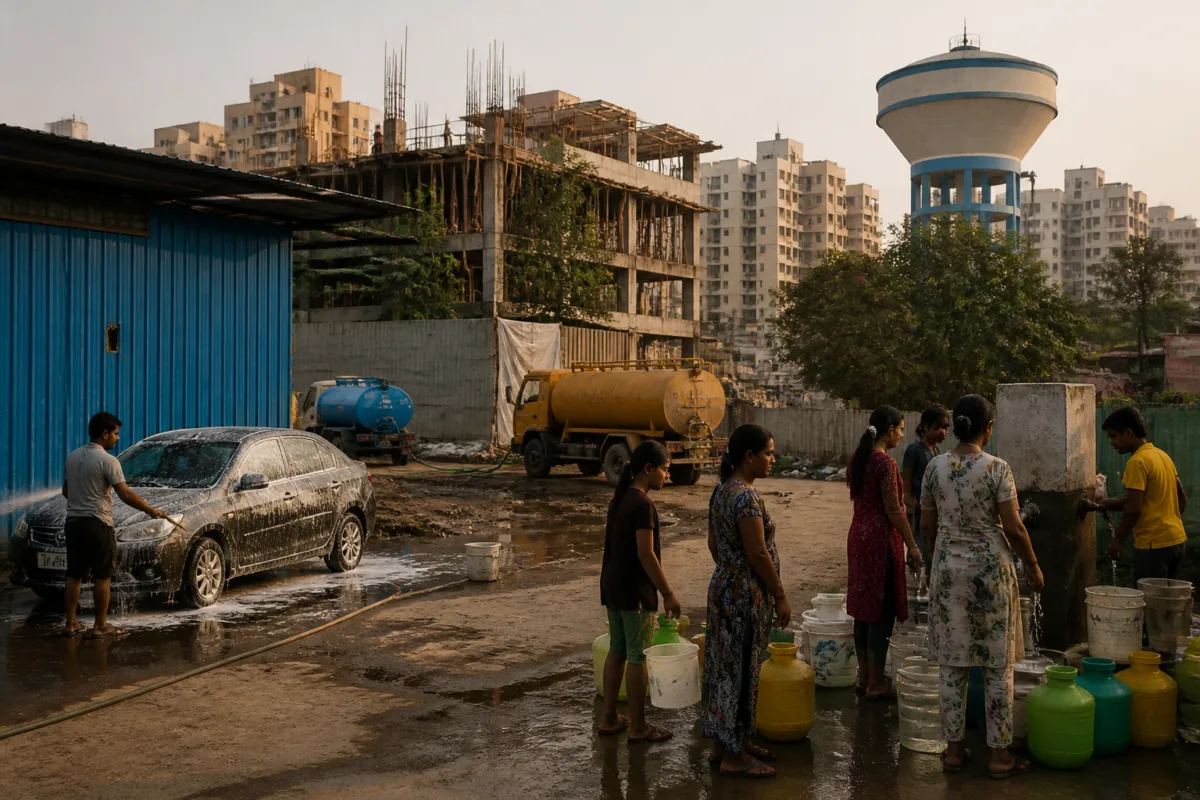
Pune’s water restrictions were intended to conserve drinking water during a period of scarcity. But the city’s own enforcement record, as reported by Lokmat – Pune, points to a familiar urban governance problem: rules can be announced quickly, while the administrative machinery needed to implement them remains absent or inactive.
The report says Pune Municipal Corporation’s water-supply department had issued restrictions covering construction activity, vehicle-washing centres, swimming pools, water wastage, illegal connections and leakage. It also says that, despite a warning that violators would face action, no enforcement action had been taken during the month covered by the report. Washing centres, swimming pools and construction activity were reportedly continuing.
This is not simply a question of whether individual residents or businesses are complying with a water-saving appeal. It is a question of how a municipal restriction becomes operational: who identifies violations, which department records them, what notice or penalty follows, and whether the city can demonstrate that the rules are being applied consistently.
The restrictions were introduced against the backdrop of concerns over water availability. According to the report, the possibility of lower rainfall and the anticipated influence of El Niño had raised fears of water scarcity. The state government had directed local authorities to reduce water use. In response, the municipal corporation began stopping water supply every Thursday from 15 October.
Pune had already experienced a reduction in supply earlier in the year. The report says the city received water on alternate days from 15 June after the monsoon was delayed. That arrangement was withdrawn in July after rainfall increased. The sequence illustrates the difficulty of managing a city’s water system through changing seasonal conditions: restrictions may be tightened, relaxed and reintroduced as supply expectations shift.
The municipal instructions addressed several points where potable water can be diverted from essential domestic use. Construction sites were told not to use drinking water. Vehicle-washing centres were to remain closed, and potable water was not to be used to fill swimming pools. Housing societies were instructed to treat wastewater and reuse it. Residents and institutions were also told to repair leaks in taps and pipelines promptly.
The department further stated that water theft, unauthorised connections and wastage would attract action. These provisions indicate that the policy was not limited to a voluntary conservation request. It included restrictions and enforcement against specific forms of use and unauthorised access to the network.
Yet the gap reported by Lokmat – Pune lies between the written instruction and its execution. If no action is taken against identified or reported violations, the restriction remains largely administrative communication rather than an enforceable water-management measure. The result is that compliant users may face scheduled supply cuts while activities listed as prohibited continue in parts of the city.
That gap also affects the credibility of future restrictions. A water-supply cut is immediately experienced by households, housing societies and businesses connected to the municipal network. Enforcement against non-essential or unauthorised use is less visible unless the corporation publishes inspections, notices, penalties and outcomes. Without such a record, residents have limited means of judging whether the burden of conservation is being distributed across users or falling mainly on those already connected to regulated supply.
The report does not provide a count of washing centres, swimming pools or construction sites inspected, nor does it specify the number of violations identified. It also does not give details of penalties, enforcement staff, ward-level responsibilities or the legal basis for each restriction. Those missing details matter because the effectiveness of the policy cannot be measured only by the existence of a municipal announcement.
The role of the water-supply department’s senior administration is central. Chief Engineer Nandkumar Jagtap had stated in a written communication that action would be taken against those violating the restrictions. The report says he later acknowledged that no action had yet been taken and said new rules would be announced, after which the enforcement process would be implemented.
That response suggests that the corporation’s first set of instructions did not translate into a functioning enforcement cycle. The next set of rules will therefore need more than revised wording to demonstrate a change. The relevant institutional test is whether the corporation can identify regulated users, conduct inspections, document violations and disclose the action taken.
Pune’s water-management challenge is consequently both a supply issue and an administrative one. Municipal water policy often focuses on how much water is available and how frequently it can be supplied. But scarcity management also depends on whether the authority can control avoidable demand, prevent unauthorised use and ensure that restrictions are applied beyond the household level.
The report establishes the announcement of restrictions, the scheduled Thursday shutdown, the earlier alternate-day supply and the absence of action reported during the period examined. It does not establish the total volume of water saved, the scale of violations or whether the proposed new rules have since been issued. Those are the next facts required to assess whether Pune’s conservation policy is functioning as a system rather than remaining on paper.
For now, the city’s most important water question is not only how much supply is available. It is whether the municipal corporation can make its own restrictions visible, enforceable and accountable before scarcity places a heavier burden on residents.

