


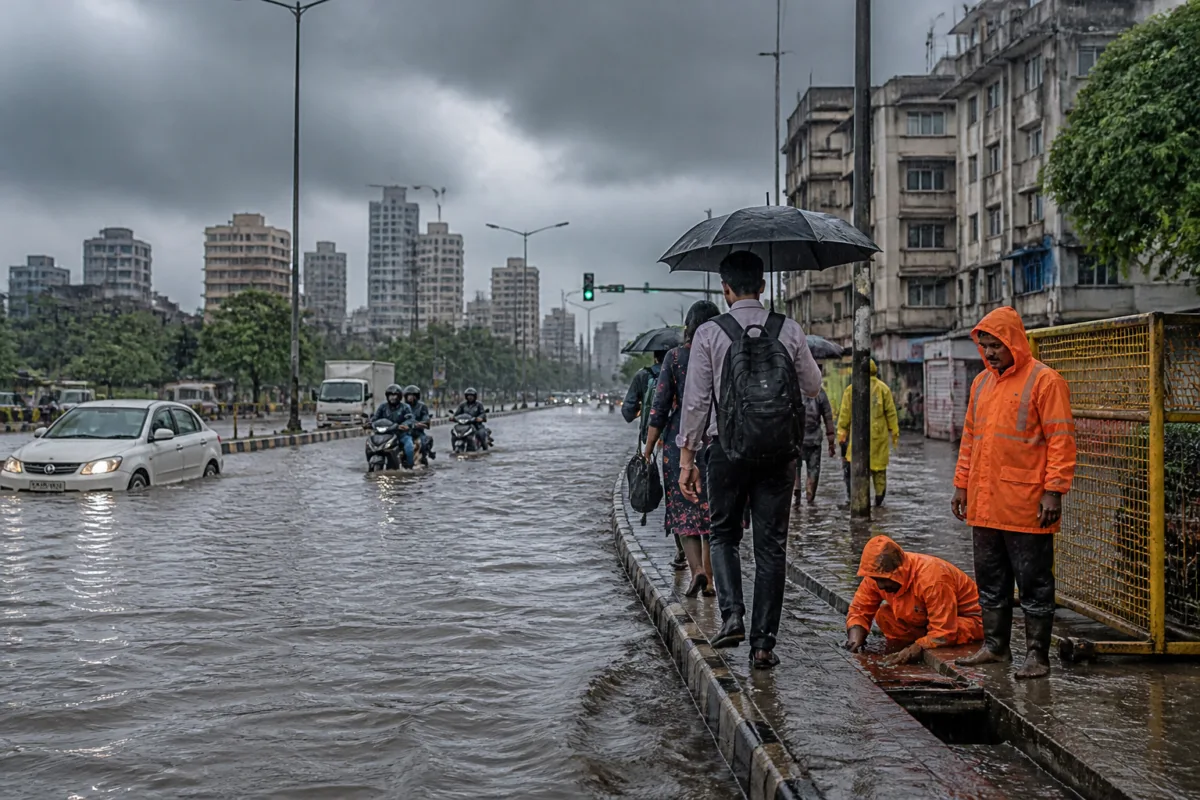
India’s reported position among the countries most affected by extreme weather has renewed attention on a question that extends well beyond climate statistics: whether the country’s cities, infrastructure and public systems are being designed for repeated floods, heatwaves, cyclones and other hazards. A report published by Down To Earth, citing the Climate Risk Index 2027 prepared by Germanwatch, says India has remained among the most climate-vulnerable countries over the past three decades.
The supplied report attributes the index to an assessment of fatalities, affected people and economic losses linked to extreme weather events. It says the analysis uses data from the International Disaster Database, along with socioeconomic information from the International Monetary Fund and the World Bank. According to the report, India recorded 436 extreme weather events between 1996 and 2025, affecting more than 1.2 billion people, causing over 78,000 deaths and producing inflation-adjusted economic losses of more than $170 billion.
These figures describe climate exposure not as a sequence of isolated disasters but as a recurring condition. Floods and landslides associated with heavy monsoons have displaced people and damaged agriculture, while cyclones have caused extensive destruction in coastal areas. Heatwaves have added a different kind of pressure, affecting public health, labour productivity, electricity demand and the safety of people living or working outdoors.
The report lists several events associated with India’s long-term vulnerability, including the 1998 Gujarat cyclone, the 1999 Odisha cyclone, Cyclone Hudhud in 2014, Cyclone Amphan in 2020, the Uttarakhand floods in 2013 and severe flooding across 13 states in 2019. It also refers to intense heatwaves in 1998, 2002, 2003 and 2015, when temperatures approached 50°C and many people died.
For urban India, the significance lies in the interaction between hazards and the built environment. A flood is not only a weather event. Its consequences depend on drainage capacity, the location of homes and infrastructure, the condition of roads, the protection of power and water systems, the availability of evacuation routes and the ability of local authorities to issue and act on warnings. Heat risk similarly depends on housing quality, access to shade and water, workplace conditions, public-health preparedness and the reliability of electricity supplies.
The report quotes Anjal Prakash, an author of United Nations climate reports and a professor of public policy at FLAME University, as saying that climate resilience must become central to the way cities, agriculture, infrastructure and livelihoods are planned. That framing shifts the issue from emergency response to the routine decisions that determine where and how development takes place.
India’s exposure is also shaped by its size and geographic diversity. The supplied report says the country’s estimated population is about 1.476 billion, making it the largest country among those appearing near the top of the vulnerability rankings. The report contrasts India with the Philippines, whose population it puts at about 115 million. A large population means that the number of people exposed to hazards can be substantial even when losses are distributed across different regions and event types.
The report says India faces multiple categories of extreme weather rather than a single dominant hazard. Coastal areas are exposed to cyclones, river basins and low-lying settlements face flood risks, and several regions experience severe heat and drought. This diversity creates an administrative challenge because preparedness cannot be managed through one national template alone. State governments, municipal bodies, disaster-management agencies, infrastructure providers and local communities all have different responsibilities in reducing risk.
The report’s global findings place India within a wider pattern. It says more than 900,000 people died worldwide because of weather extremes over the three decades examined, with heatwaves accounting for more than 364,000 deaths and floods for about 200,000. Nearly 10,000 climate-related extreme weather events reportedly caused direct economic losses exceeding $4.7 trillion and affected 5.5 billion people, including those displaced by disasters.
The same analysis divides the most affected countries into two broad groups: those hit by exceptionally devastating catastrophes and those exposed to repeated extreme weather events. The report places India and the Philippines in the latter group. That distinction is important for urban policy because repeated, moderate-to-severe events can steadily erode household savings, municipal assets and public infrastructure even when no single disaster produces the largest national loss.
The policy implications identified in the supplied material are centred on adaptation, climate-resilient development and international finance. Harjeet Singh, described as a climate activist and founding director of the Satat Sampada Climate Foundation, said the ranking reflected a preparedness deficit and called for stronger domestic adaptation, climate-resilient development and grant-based climate finance from wealthy historical emitters. Sanjay Vashist of Climate Action Network South Asia called for higher adaptation ambition, faster energy transition and adequate finance.
However, the report supplied for this article contains discrepancies that prevent the rankings from being presented as settled facts without checking the original Germanwatch publication. Its headline and several passages describe India as being among the ten hardest-hit countries over the long term. Another passage says India ranked twelfth most vulnerable for 2025, while a later quotation describes India as the tenth most vulnerable country. The text also refers to the index as the Climate Risk Index 2027 and links its release to COP31 in Antalya, but the ranking periods and country positions are not consistently explained.
Those differences do not erase the underlying public-interest issue identified by the report: India is described as facing repeated and varied climate hazards, with significant human and economic consequences. They do, however, matter for accurate publication because rankings depend on the period covered, the indicators used and whether the comparison is annual or long term. The figures for deaths, affected people, economic losses and country position should therefore be checked against the original index methodology and tables.
The urban question is ultimately one of institutional capacity. Climate resilience requires risk information to influence land-use planning, building decisions, infrastructure investment, maintenance budgets and emergency operations. It also requires authorities to account for people who may receive warnings but lack the resources, mobility or safe housing needed to act on them. The supplied report cites a separate warning that one in three people may be unable to act on disaster alerts despite receiving them, underscoring the gap between communication and protection.
What the available material establishes is that extreme weather is being presented as a persistent development and urban-governance challenge rather than a series of isolated emergencies. What remains to be confirmed is the precise Climate Risk Index edition, India’s verified rankings for the relevant periods and the underlying country-level calculations. Those details should be settled against Germanwatch’s original report before the findings are treated as definitive.

