


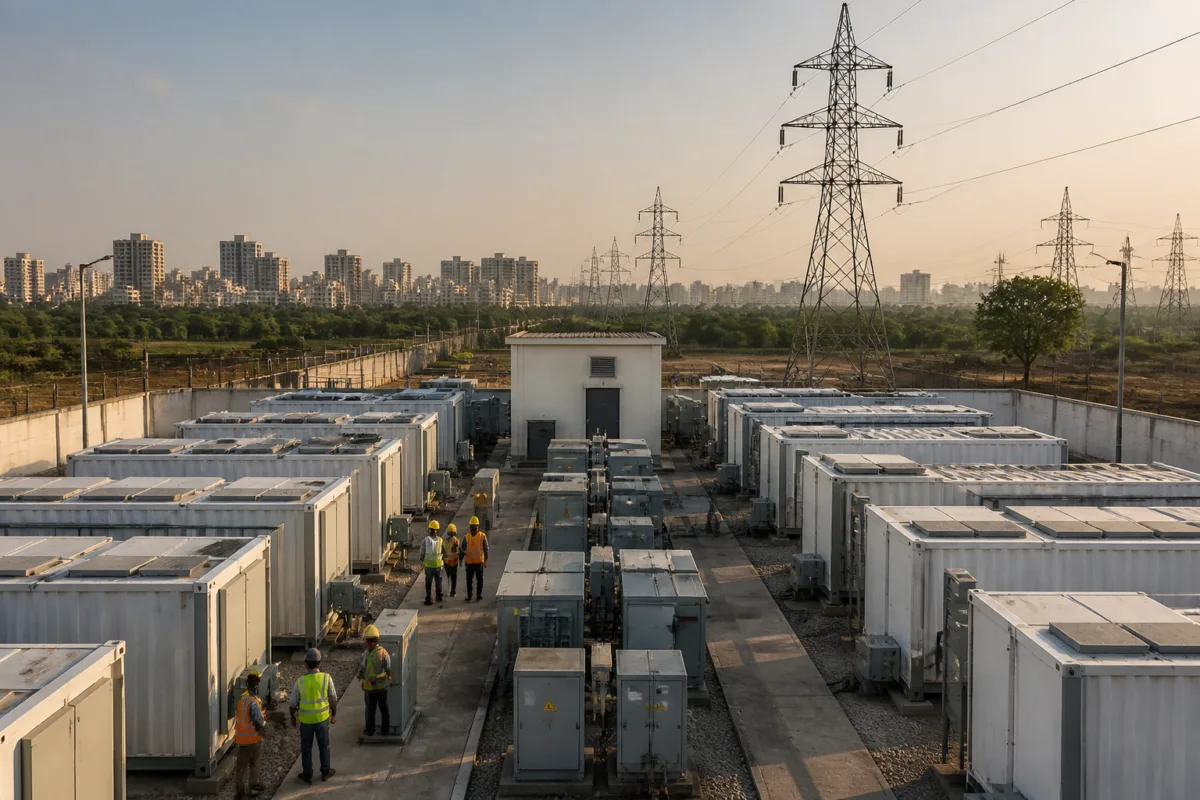
SECI’s new BESS tender does more than invite battery suppliers to bid. It establishes a rolling market-access framework through which suppliers, system integrators and aggregators can qualify for future grid-interactive storage projects, while leaving the price competition and project-specific obligations to later procurements.
The Solar Energy Corporation of India Limited has issued a request for empanelment covering battery energy storage system suppliers, integrators and aggregators across four capacity tiers. The tender allows companies to qualify without submitting price bids at the first stage. Those that are empanelled can then compete for specific projects through requests for quotations and electronic reverse auctions.
The bid submission deadline is November 30, 2026. Empanelment will remain valid for one year, and qualification for a higher capacity tier will automatically qualify a bidder for all lower tiers. The structure indicates that SECI is attempting to create a ready pool of technically and financially qualified companies before individual storage projects are taken to the market.
That distinction matters because battery storage is not a single equipment purchase. A grid-interactive BESS project combines batteries, power electronics, control systems, thermal management, fire protection, software and site-level engineering. The tender separates the process of establishing supplier capability from the later task of selecting a project-specific commercial offer.
The two-stage model changes how participation in the storage market will work. Under Stage I, bidders are assessed against technical and financial qualification criteria without price bids. Under Stage II, empanelled companies compete for identified projects through RfQs and electronic reverse auctions. The arrangement can reduce the need to repeat basic qualification checks for every project, while allowing project-level pricing to be tested separately.
It also creates a distinction between market entry and project delivery. Being empanelled does not, by itself, award a storage project. The supplier must still compete under the relevant Stage-II procurement and meet the conditions set out in that project’s RfQ. The tender therefore functions as a qualification gateway rather than a blanket commitment by SECI to purchase a specified volume of storage from every successful applicant.
The four tiers establish the scale at which companies can participate. Tier I covers projects up to 100 MWh, Tier II covers projects above 100 MWh and up to 300 MWh, Tier III covers projects above 300 MWh and up to 600 MWh, and Tier IV covers projects above 600 MWh and up to 1,000 MWh.
The tier structure is significant for the built environment and energy infrastructure because it recognises that a smaller grid-storage deployment and a project of up to 1,000 MWh carry different levels of financial, technical and execution risk. A company seeking a higher tier must demonstrate stronger financial capacity and larger relevant technical experience. At the same time, automatic qualification for lower tiers means that higher-capacity capability can be used across the full range of smaller project categories.
The financial thresholds rise sharply with project scale. For Tier I, bidders must show a positive net worth in the last financial year, minimum average annual turnover of Rs 279 million and minimum working capital of Rs 232.5 million. The corresponding turnover and working capital thresholds are Rs 837 million and Rs 697.5 million for Tier II; Rs 1,674 million and Rs 1,395 million for Tier III; and Rs 2,790 million and Rs 2,325 million for Tier IV.
These requirements place working capital alongside turnover as a central test of readiness. Storage projects require procurement, manufacturing, installation and commissioning across multiple systems before the full commercial obligations are completed. The tender’s financial criteria therefore assess not only a company’s past scale but also its ability to support delivery at the relevant capacity level.
The technical qualification routes are designed to accommodate different types of participants. Under Route I, a bidder can qualify through battery manufacturing and supply experience supported by an operational manufacturing facility. Under Route II, qualification can be based on experience as an integrator, supplier or aggregator of grid-interactive BESS.
The minimum cumulative technical experience is 10 MWh for Tier I, 30 MWh for Tier II, 60 MWh for Tier III and 100 MWh for Tier IV. This allows the tender to include both manufacturers and companies that assemble or manage storage systems, rather than limiting participation to battery producers alone. It also makes the distinction between a battery component and a complete grid-interactive system explicit.
That distinction is important because the contractual scope extends well beyond the battery cells or modules. Stage-II suppliers will be responsible for the design, engineering, manufacturing, supply, installation, testing and commissioning of BESS DC blocks, battery management systems, power conditioning systems, thermal management systems, fire suppression systems and energy management systems. Mandatory spares and comprehensive warranty obligations are also included.
The listed systems show that SECI is procuring an integrated operational asset. Battery management controls the condition and performance of the battery system. Power conditioning connects the storage system to the electrical network. Thermal management and fire suppression address operational safety, while the energy management system governs how the asset responds to grid requirements. Treating these elements as part of one delivery responsibility assigns system-level performance to the selected supplier.
At the same time, the tender does not place every part of the project within the Stage-II supplier’s scope. Balance-of-plant and civil works for the BESS yard will be procured separately by SECI or the project entity. This creates a divided implementation structure: the storage technology package is procured from the empanelled supplier, while site works and related infrastructure are arranged separately.
That division can give project entities greater control over site development, but it also makes coordination important. The technology supplier’s installation and commissioning responsibilities will have to align with the readiness of the BESS yard and associated civil works. The supplied material does not establish how future RfQs will allocate interface risks, so those conditions will need to be examined project by project.
The same project-specific approach applies to timelines and post-delivery obligations. Full commissioning schedules, service requirements and maintenance obligations will be specified in the respective Stage-II RfQs. The tender establishes a 12-month defect liability period from the date of material delivery at site, but the detailed operating and maintenance framework will depend on each project procurement.
The financial commitments begin even before a Stage-II award. Bidders must pay a bid processing fee of Rs 5,000 plus GST, while no earnest money deposit is required at the empanelment stage. Within 15 days of receiving notification of empanelment, successful bidders must submit a non-refundable one-year empanelment fee and an empanelment bank guarantee valid for 15 months. That bank guarantee will also serve as the earnest money deposit for Stage-II procurement.
The bank guarantee increases by tier, from Rs 18.6 million for Tier I to Rs 55.8 million for Tier II, Rs 111.6 million for Tier III and Rs 186 million for Tier IV. The associated one-year empanelment fees are Rs 25,000, Rs 50,000, Rs 75,000 and Rs 100,000 respectively. The structure links the cost of maintaining market access and the financial security required for later bidding to the scale of projects a company seeks to pursue.
For urban India, the significance of the framework lies in the role storage can play within a wider electricity and infrastructure system. The tender itself does not specify a project location, technology chemistry, contracted duration or a guaranteed deployment volume. It does, however, establish a procurement mechanism for assets that can be integrated into the grid and connected to future energy infrastructure serving cities, industrial areas and other demand centres.
The framework also places institutional responsibility in view. SECI is not merely announcing a technology preference; it is defining who can participate, what evidence of capability is acceptable, which systems must be delivered together, and which works will remain outside the supplier package. Those choices shape the eventual supplier pool and the way project entities will manage construction, commissioning, warranties and site interfaces.
The immediate evidence therefore points to a market-formation exercise rather than a single project award. SECI is creating a qualified panel across four scales, with competition deferred until project-specific RfQs and reverse auctions. The approach may give future procurements a common qualification base, but the final cost, delivery timetable, operating performance and geographic distribution of storage will only become clear through subsequent Stage-II tenders.
The next fixed milestone is the November 30, 2026 bid submission deadline. Beyond that date, the key developments to monitor will be the list of empanelled companies, the Stage-II RfQs, the treatment of civil and balance-of-plant interfaces, and the service and maintenance requirements attached to individual projects. These steps will determine how the qualification framework translates into operating grid-storage capacity.

