


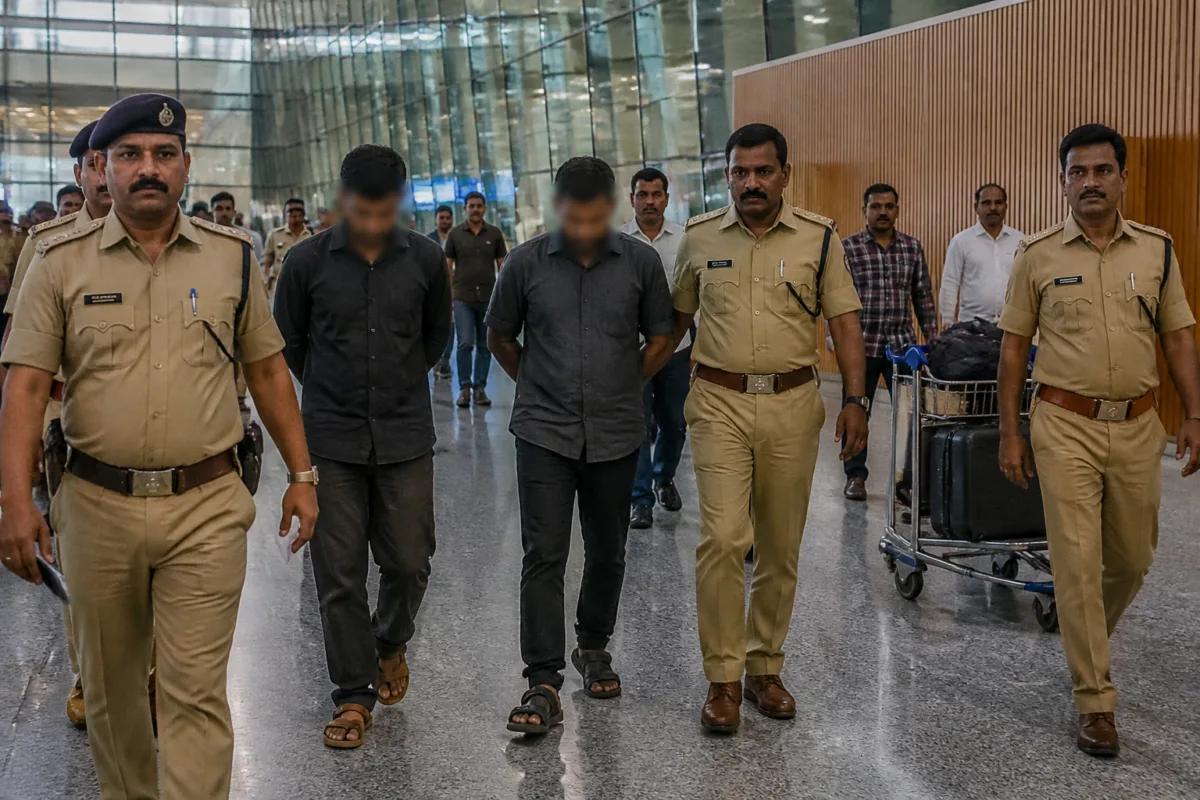
The Pune police flight escort of two accused persons from Kolkata has brought an operational decision inside the criminal justice system into public view: when can urgency justify air travel funded through investigation resources, and what documentation must support that choice? The two men were arrested in separate cases involving alleged theft or misappropriation of precious metals and brought to Pune by a team comprising an assistant police inspector and three personnel. The police have said the team turned to air travel after missing a train and facing limited time to produce the accused before a court. However, the exact cost, approval trail and financial record of the journey have not been established in the available report.
That distinction is important. The arrests themselves represent routine but necessary investigative work across state borders. The controversy is about what happened after the arrests: how the transport decision was made, whether the urgency was documented, and whether public funds were used according to procedure. These are administrative questions, but they are also central to how policing functions in a large and interconnected urban system.
The report identifies two separate cases being investigated by Faraskhana police. In the first, Lalan Mandal, who had worked as an artisan at a jewellery shop in Ganesh Peth, was wanted in connection with the alleged theft of silver ornaments and silver bars valued at about Rs 40.80 lakh. The reported value included approximately 17 kilograms of silver articles. The shop owner allegedly saw Mandal leaving the premises with a large bag in CCTV footage before a case was registered.
The second case relates to Prabhanjan Shanti Dolai, who allegedly received 1,850 grams of pure gold from a jeweller in Sunday Peth to manufacture ornaments. According to the report, the gold or finished jewellery was not returned, resulting in suspected misappropriation valued at about Rs 2.59 crore. A case was registered against Dolai and his manager. During the investigation, police received information that both accused had travelled to Kolkata, following which a four-member team went there to locate them.
The reported arrests therefore involved two separate investigations and a cross-state operation. Once the accused were detained, the team brought them to Pune by air rather than by train. The decision has prompted questions within the police department and among members of the public because train travel is generally considered the standard option for long-distance movement of accused persons. The report, however, does not establish that air travel is prohibited or that the journey was definitively unauthorised. It establishes that the basis for selecting it remains unclear.
A senior police officer, speaking to Civic Mirror on condition of anonymity, said official documents had been sought to understand the circumstances. According to the officer, the investigation team reported that train tickets had been booked but that the train was missed. The officer also said that the accused had to be produced before a court within a limited period, making air travel the faster option. These statements explain the justification offered by the team, but they do not independently establish whether the train tickets were booked, how much time remained under the relevant court process, or whether the decision was approved in advance.
The legal timetable is a key part of the issue. When police arrest an accused person in another state, the process can involve obtaining a transit warrant and completing the required court procedure before bringing the person to the investigating state. The available report says the accused had to be produced before the competent court within a specified period and that the remaining time was presented as the reason for choosing the faster mode of transport. Yet the exact transit-warrant timeline in these cases has not been disclosed in the supplied material. Without that information, it is not possible to determine whether the flight was unavoidable, merely convenient, or chosen after a preventable delay.
This is where operational urgency meets financial accountability. Police investigations require spending on travel, accommodation, communications and other field activities. A senior officer cited in the report said that investigation funds can be used for urgent expenditure arising during an inquiry. The officer also said that if a later review finds the spending unnecessary or the reasons inadequate, the concerned officers may be required to reimburse the amount from their salaries.
That explanation describes a possible financial safeguard, but it does not answer the case-specific questions raised by the journey. The report does not state the total Kolkata-Pune airfare, whether the expenditure was paid from an investigation fund, whether senior officers granted prior approval, or whether the expense was recorded in the prescribed manner. It also does not establish whether the police department has completed its review of the documents requested from the team.
The absence of these details matters because public accountability is not limited to proving that an accused was eventually brought before a court. It also covers the chain of decisions that uses public resources: who authorised the expenditure, what alternative options were assessed, what emergency condition was recorded, and how the expense was audited afterwards. In a city police system handling investigations across state borders, these records are the mechanism through which urgency can be distinguished from avoidable cost.
The episode also reveals the administrative complexity behind what may appear to be a simple transport choice. A cross-state arrest requires coordination with local authorities, court-related compliance and the movement of both police personnel and accused persons. The team must balance the time available under the transit process against security, logistics and cost. Each of those factors can affect the decision, but they need to be recorded if the decision is later questioned.
The report does not provide a general police rule requiring accused persons to travel by train, nor does it provide a published benchmark against which the air travel can be judged. It therefore would be premature to conclude that the flight was wasteful or that the officers acted improperly. At the same time, the lack of a disclosed cost and approval trail prevents the decision from being treated as administratively settled. The police explanation remains a reported account awaiting documentary verification.
For urban residents, the larger issue is not the relative comfort or speed of one mode of travel. It is whether public agencies can make time-sensitive decisions while maintaining a traceable record of necessity and expenditure. Police departments routinely operate under pressure, but pressure cannot by itself replace documentation. The stronger the claim of urgency, the more important the supporting record becomes: train booking details, court deadlines, authorisation notes, travel bills and the entry made in the investigation accounts.
The Pune case also shows why internal financial controls are part of everyday urban governance. Public confidence in policing is shaped not only by arrests and crime detection, but also by whether citizens can understand how state power and public money are used. In this instance, the police have reportedly sought official documents and offered an explanation based on a missed train and limited time for court production. What remains unresolved is whether those circumstances are supported by records and whether the expenditure complied with the department’s approval and accounting requirements.
The next important development is therefore documentary rather than rhetorical. The police department’s review will need to establish the actual travel cost, the source of funds, the status of prior or subsequent approval, the train reservation claim and the time available under the transit-warrant process. Until those details are made clear, the flight escort remains a reported operational decision surrounded by unanswered questions about necessity, authorisation and public spending.

