


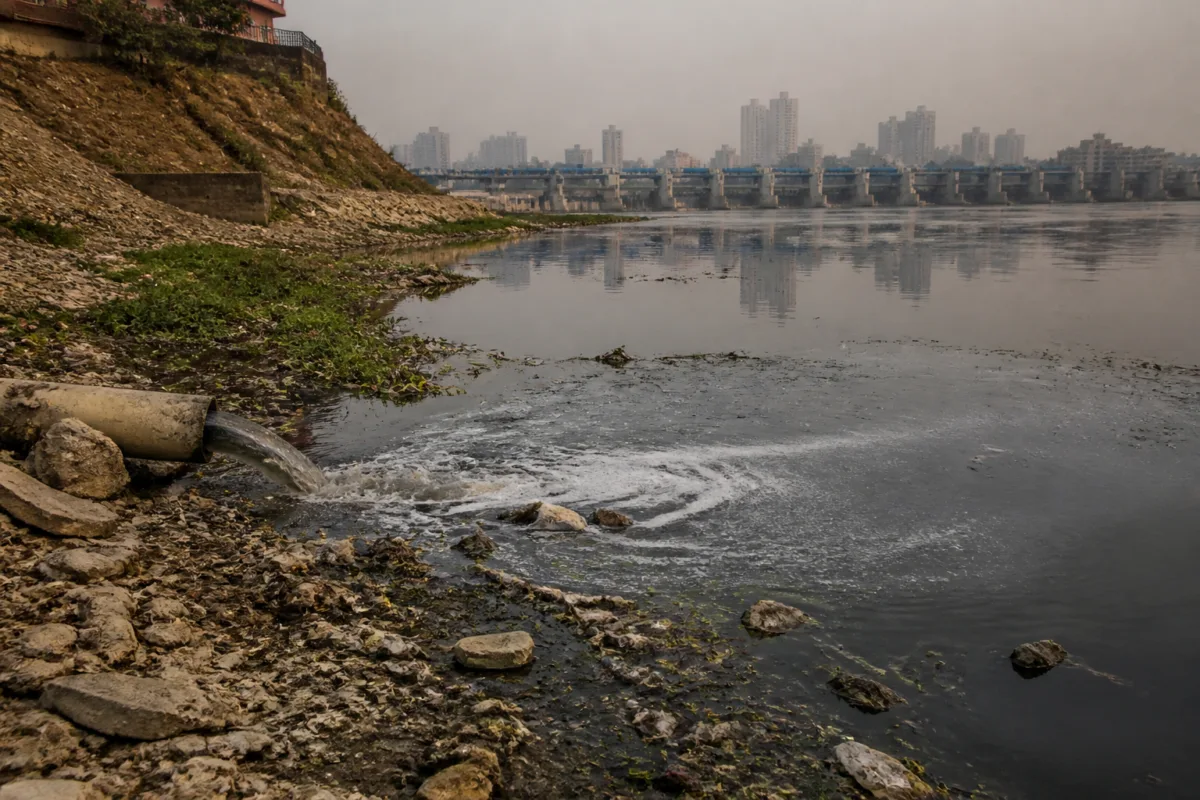
A new study of Delhi’s Yamuna shows that the river’s pollution problem is not confined to the microplastic particles that can be counted in water samples. The particles are carrying or associated with a wider chemical mixture that includes pharmaceutical residues, pesticides and industrial effluents, creating a more complicated monitoring and governance challenge across the city’s 48.8-km stretch of the river.
Researchers from the University of Delhi examined samples from eight locations between Palla, where the Yamuna enters Delhi, and Asgarpur Jagir, where it exits the city. The sites covered agricultural, residential, industrial, recreational and forested settings. The study, published in the Journal of Hazardous Materials Advances in September 2026, recovered 2,289 microplastic particles and recorded an average abundance of 3.18 particles per litre.
Those figures are significant because they establish the scale and distribution of one visible part of the problem. But the study’s more important contribution is its examination of the chemical compounds associated with the recovered microplastic fractions. Across the samples, researchers identified 321 distinct chemical compounds. Fifty of these appeared in extracts from recovered microplastic fractions at four or more locations.
Of those 50 compounds, 36 corresponded to structures with hazard classifications under the Global Harmonized System. The classifications covered carcinogenicity, reproductive toxicity, acute toxicity and aquatic hazards. Seven compounds, including 2-naphthylamine, lidocaine and monobutyl phthalate, were detected across all eight sampling locations.
The presence of a hazard classification does not establish that people or aquatic organisms have been exposed at a harmful level. The researchers specifically cautioned that the chemical results were based on screening-level identification and require further confirmation through quantitative analysis. The study therefore does not provide a direct measurement of human-health risk. It does, however, show why a particle count alone cannot describe the river’s chemical condition.
The finding changes the way the Yamuna’s pollution should be understood. Microplastics are often treated as discrete solid contaminants that can be measured by number, size or polymer type. In this study, they are part of a broader mixture involving compounds from different urban systems. Pharmaceutical residues point towards domestic and healthcare-related waste streams; pesticide-related substances indicate agricultural runoff; and industrial compounds suggest the influence of manufacturing and other commercial activity. The supplied study does not assign each compound to a specific source, but the range of substances reflects the multiple activities connected to the river.
That connection is also visible in the geography of the sampling. The highest microplastic concentration was recorded at a recreational-hydraulic site near a barrage. The next highest level occurred in a floodplain area where multiple drains converge. By contrast, the lowest abundance was recorded at the agricultural entry point at Palla and along a forested stretch.
The differences matter because they show that pollution is not evenly distributed along the river. Hydraulic infrastructure, drain confluences, land use and the degree of urbanisation influence what enters the river and where contaminants accumulate or are detected. A single citywide figure would conceal these local variations. Monitoring that separates entry points, drain outfalls, floodplains, barrages and relatively natural stretches can reveal how the river behaves as it moves through the urban region.
The study identified polyethylene and polypropylene as the predominant polymers among the spectrally identified particles, accounting for 44.1 per cent and 27.3 per cent respectively. These materials are widely used in packaging, consumer products and other everyday applications. Their predominance does not by itself identify the precise source of the particles, but it reinforces the link between ordinary urban consumption and the waste reaching waterways.
The chemical profile also included pharmaceutical compounds such as atomoxetine, domperidone and telmisartan, along with agrochemical-related substances including diuron and thiamethoxam. The study’s emphasis is not that every detected substance presents an established exposure risk at the sampling locations. Rather, the findings indicate that the river receives and carries a mixture that cannot be evaluated adequately through conventional indicators alone.
This is where the Yamuna’s pollution becomes an institutional problem, not only a sanitation problem. The Delhi stretch receives inputs from 22 tributary drains carrying partially treated or untreated sewage, agricultural runoff and industrial effluents, according to the study. Each stream may fall within a different administrative or regulatory responsibility, while the river integrates them into one connected system.
Sewage treatment, industrial discharge control, agricultural runoff management, solid-waste collection and riverbank protection are often handled through separate programmes and agencies. The study’s results suggest that this fragmented approach can miss interactions between pollutants. Measuring whether a drain is carrying sewage, for example, does not answer whether pharmaceutical residues or microplastics are moving through the same system. Similarly, counting plastic particles without identifying associated chemicals leaves part of the pollution profile unexamined.
Radhey Shyam Sharma, head of the Department of Environmental Studies at the University of Delhi and a co-author of the study, said the findings need to be viewed through the lens of mixture toxicity. He also highlighted the importance of land-use patterns in understanding the river’s contamination. His comments point to a monitoring framework that follows the river’s catchment and surrounding activities rather than treating the waterway as an isolated channel.
Sharma also called for nature-based solutions, including stronger vegetation along riverbanks and protection of natural river ecosystems. The study does not present vegetation as a substitute for sewage treatment or industrial regulation. Its argument is that healthy river-edge ecosystems can help prevent pollution from entering the water and can form part of a wider risk-reduction strategy.
The land-use findings give this approach a practical basis. The agricultural entry point and forested stretch recorded lower microplastic abundance than the recreational-hydraulic and drain-confluence sites. These observations cannot, on their own, prove that vegetation caused the lower levels, because the study also identified differences in local conditions and inputs. They do show, however, why the protection of natural stretches and floodplain areas is relevant to river management.
The evidence also exposes a gap between detecting pollution and managing its consequences. The researchers identified compounds with GHS hazard classifications, but screening-level identification is not the same as measuring concentration, persistence, bioavailability or exposure. Further quantitative testing would be needed to establish how much of each substance is present and whether the detected levels create a demonstrated ecological or public-health risk.
That distinction is essential for public reporting and policymaking. A hazard classification can flag the need for investigation, but it cannot be converted automatically into a claim that the river is causing a specific illness or that every detected compound is present at a dangerous level. The study itself maintains that caution. Its strongest conclusion is about the complexity of the pollution mixture and the need for more spatially detailed monitoring.
For Delhi, the larger question is whether river restoration can be assessed through a narrow set of indicators. Visible floating waste, biochemical measures, sewage-treatment capacity and microplastic abundance each describe part of the system. None captures the full range of compounds entering the river through 22 drains and different land-use zones. A more complete assessment would need to connect particle monitoring with chemical analysis, drain-level information and location-specific sampling.
The study does not establish that the Yamuna’s pollution has a single source or a single technical solution. It shows instead that the river is receiving a layered mixture from urban, agricultural and industrial landscapes, with concentrations varying across the city. It also demonstrates that the most polluted sampling points may be associated with hydraulic structures and drain convergence rather than with the river’s entry into Delhi alone.
The immediate next step identified by the researchers is further confirmation through quantitative analysis and more detailed monitoring of both microplastics and associated chemical substances. Until that work is completed, the findings should be read as a warning about an under-measured pollution system: the Yamuna’s condition cannot be represented fully by counting plastic particles, and the city’s river-management institutions will need evidence that follows contaminants from their sources to the waterway.

