


Police have arrested Amit Kumar Dubey, one of two prime suspects in the murder of Whitefield advocate Manjunath, after he allegedly travelled about 2,000 km across four states on a commuter motorcycle and took up farm work in a Bihar village to evade arrest.
A Bengaluru police team apprehended Dubey last Friday in Nanauri village, in Patna district’s Dhanarua block, according to a report by the Times of India. Investigators said the suspect had travelled north from Bengaluru through Telangana, Maharashtra and Uttar Pradesh before reaching Bihar. Police are still searching for Pavan, the other prime suspect who allegedly shot the advocate dead.
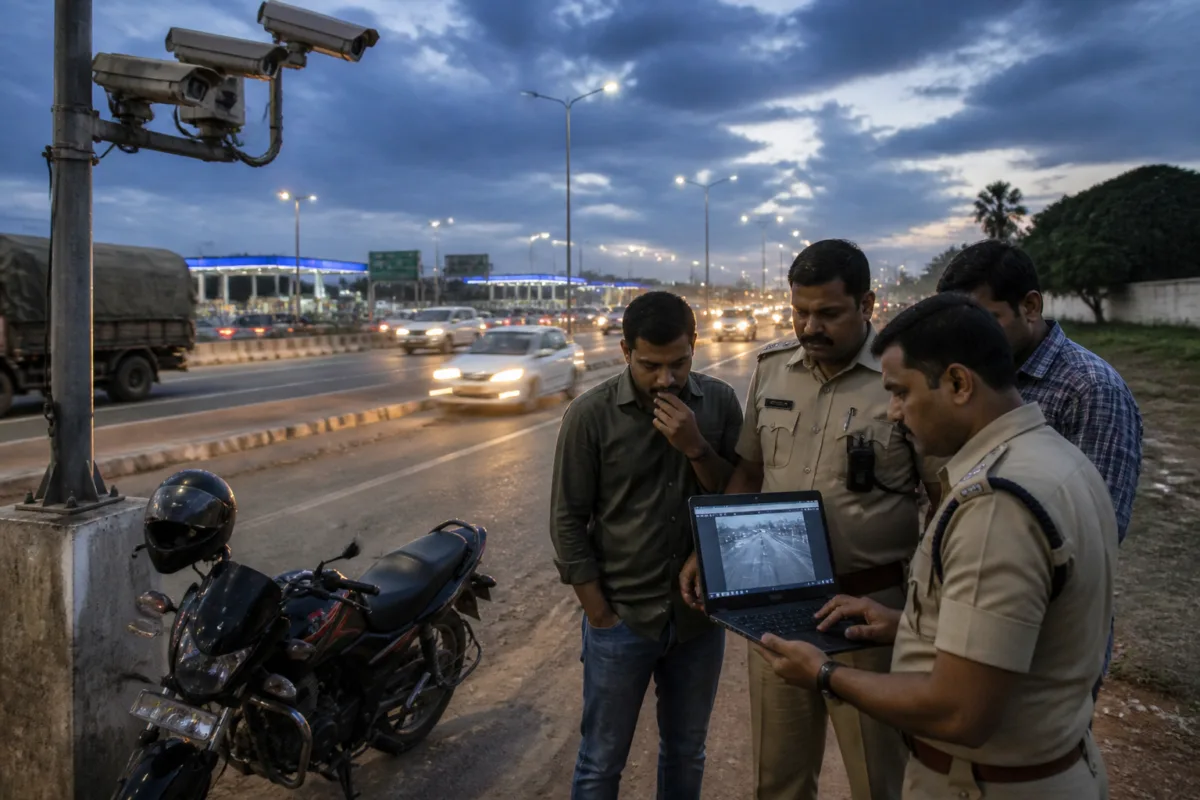
The investigation showed how surveillance systems along highways and transport-linked locations helped reconstruct Dubey’s movements. Police tracked him through CCTV footage recorded on parts of the Bengaluru–Hyderabad–Nagpur corridor. The trail weakened beyond Nagpur, where highway surveillance was described as sparse, but investigators later obtained footage from a fuel station outside Varanasi showing that he was travelling towards Bihar.
Dubey allegedly chose a motorcycle instead of public transport because he feared being identified at bus stands and railway stations, where CCTV cameras could expose him to police. After the murder, he reportedly packed clothes, a charger and electronic devices in a backpack, wore a jacket and full-face helmet, and rode from morning until night.
According to the report, he first reached Hyderabad, about 575 km from Bengaluru, where he sold one mobile handset to raise money and spent the night at a railway station. He then travelled to Nagpur, roughly 500 km farther, and rested at a bus stand. From Nagpur, he rode towards Varanasi, a journey of about 730 km, before continuing approximately 230 km into Bihar.
During the journey, Dubey allegedly avoided hotels and paid between Rs 200 and Rs 300 a night for a charpai at roadside eateries. After reaching Nanauri, he stayed with a distant maternal relative and worked as an agricultural labourer for Rs 400 a day, police said.
Call-detail records from Dubey’s past communications provided another lead. Investigators found that he had been in frequent contact with his grandmother, who lives in Nanauri. Police had raided the area soon after the murder but did not find him. They subsequently kept the village under discreet surveillance and sent officers in plain clothes to monitor possible movements.
The team eventually located Dubey working in agricultural fields and arrested him before he could flee. The case illustrates the combined role of fixed surveillance cameras, private fuel-station footage, mobile-phone records and field-level policing in tracking an accused across multiple jurisdictions. It also exposed gaps in surveillance coverage along parts of the inter-state highway route, according to the report.
Police investigations into the Whitefield murder are continuing, with officers searching for Pavan, who is alleged to have fired the fatal shot. Further legal proceedings against Dubey will follow his arrest.

