


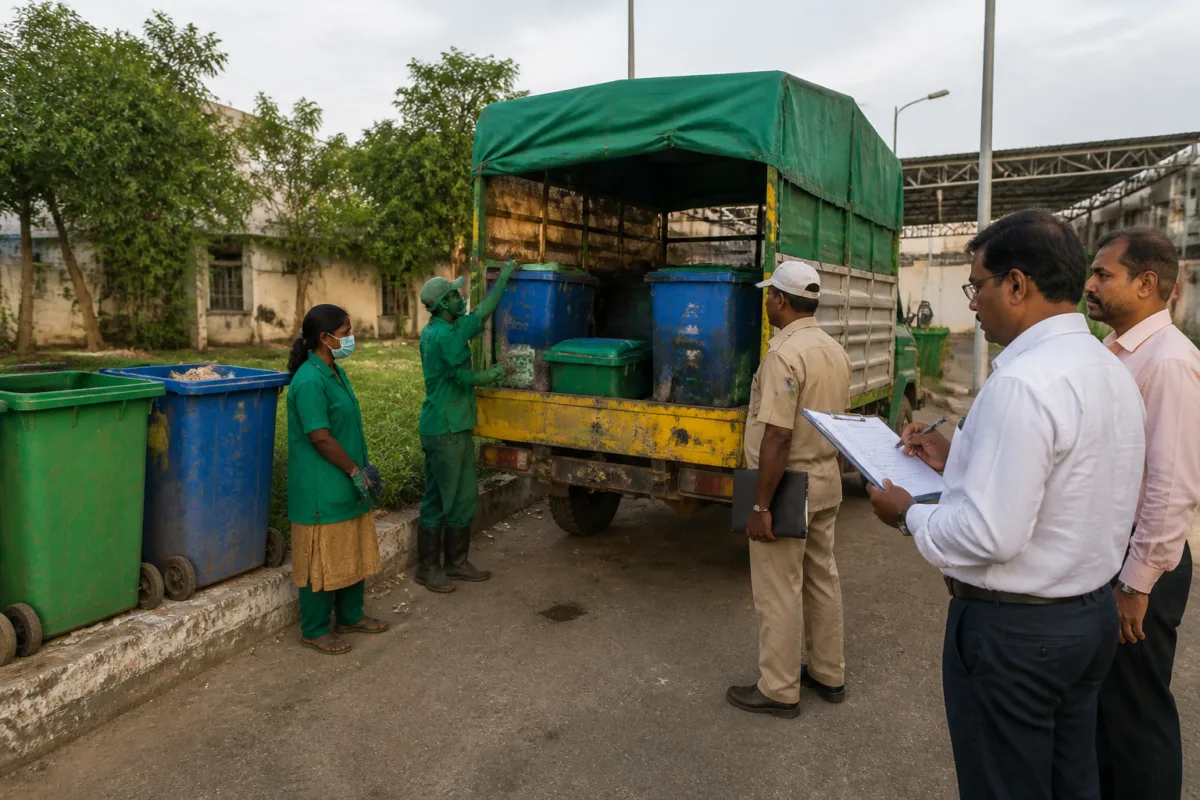
NTR district in Andhra Pradesh has formed a 20-member special cell to enforce solid waste management rules across urban and rural local bodies, with penalties, vehicle seizures and possible utility disconnections planned for violators.
District collector Dr G. Lakshmisha issued orders constituting the cell, which will monitor compliance with the Solid Waste Management Rules, 2026. The action is based on Supreme Court directions, powers available to district collectors under Section 5 of the Environment (Protection) Act, 1986, and guidelines issued by the state municipal administration and urban development department.
The collector will head the cell, while the joint collector will serve as vice-chairperson and the Vijayawada municipal commissioner will be the member-convener. The committee also includes the district superintendent of police, district forest officer and officials from the pollution control board, electricity, public health engineering, panchayat raj, medical and health, industries, transport, GST and education departments.
Project directors of the District Rural Development Agency and the Mission for Elimination of Poverty in Municipal Areas, along with other municipal commissioners in the district, will also be members. The cross-department structure gives the cell responsibilities extending beyond municipal collection to enforcement, transport, public health, electricity and rural administration.
The cell will monitor door-to-door collection of segregated wet and dry waste in all urban and rural local bodies. It will also oversee the scientific processing and disposal of collected waste. Special inspections will be carried out at hotels, function halls, malls, industries and other large commercial establishments to verify compliance by bulk waste generators.
The district administration said the cell would act against illegal dumping and the burning of garbage in forests, hill areas, water bodies and open spaces. It will identify garbage accumulation points and ensure their permanent clearance. Bio-mining of old dumping yards will also be expedited, although the order does not specify the number of sites covered or a completion deadline.
Waste transportation will be allowed only through authorised, fully covered vehicles. Unauthorised vehicles will be prohibited. Enforcement measures listed by the administration include penalties, seizure of vehicles, recommendations for closure of establishments that do not comply, and disconnection of water and electricity supplies.
Repeat offenders may face criminal cases under environmental laws. The cell will meet at least once every month to review implementation and submit fortnightly and monthly progress reports to the government. The reporting schedule will place responsibility on the committee to track collection, processing, disposal and enforcement activity across the district.
The order does not provide details of the penalty amounts, the inspection schedule for individual establishments or the existing waste-processing capacity available to local bodies. Those details will determine how the new monitoring mechanism is implemented on the ground.

