


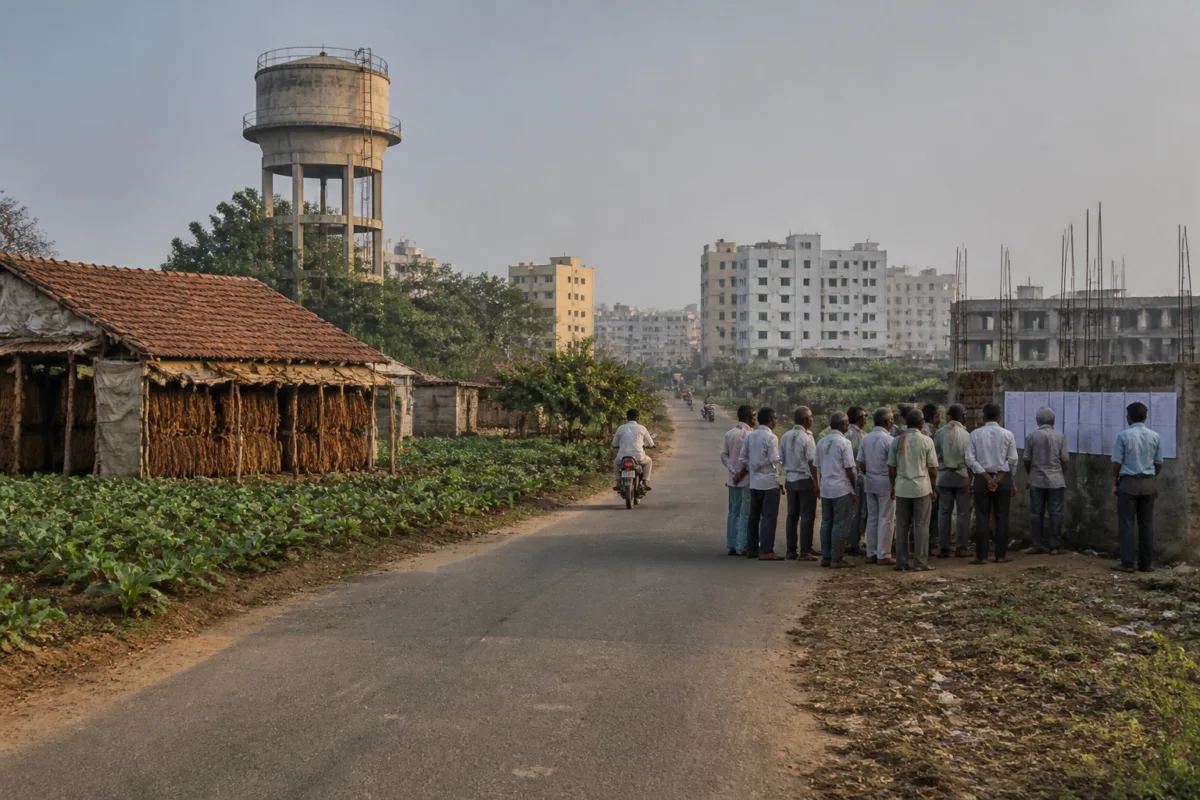
Chowdaripalem’s threat to boycott political parties and vote for NOTA unless its gram panchayat status is restored is more than an election-season protest. It exposes the administrative gap that can emerge when a village is absorbed into a municipality without a clear, visible and trusted transition in civic services, taxation and welfare access. The village’s dispute with Kavali municipality has continued for nearly seven years, while similar merger-related controversies are affecting municipalities across SPSR Nellore, Prakasam and Markapuram districts.
The immediate issue is the proposed continuation of Chowdaripalem’s status within Kavali municipality. Residents say the village, located 10 kilometres from Kavali, was merged during the YSR Congress government’s term despite opposition. The village has a population of 719 and 638 voters. Residents subsequently approached the high court, a move that delayed the constitution of an elected council in Kavali after the 2021 municipal elections. After the Telugu Desam-led alliance came to power in 2024, villagers expected the merger to be reversed and withdrew their court case, citing assurances made by Chief Minister Chandrababu Naidu and minister Nara Lokesh during electioneering. With municipal elections now being held, they fear that the promised reversal has not taken place.
That sequence shows why boundary reorganisation is not simply a question of drawing a new line on an administrative map. A merger changes the institution through which residents seek roads, water, schools, sanitation and local development funds. It can also change the taxation framework and determine whether residents remain eligible for schemes designed for rural areas. When the change is contested in court or politically promised but not formally implemented, residents can be left between two systems, each pointing to the other for responsibility.
The accounts in the report suggest that this is precisely what residents believe has happened in Chowdaripalem. They allege that local development has stalled, that neither the municipality nor the mandal parishad is providing basic amenities, and that several roads were built using public contributions. Villagers also pooled money to demolish an old overhead water tank last year. Water supply problems continue, while the local school has closed. These claims are presented as residents’ allegations, but the institutional responses quoted in the report confirm the underlying jurisdictional uncertainty: Kavali municipal officials say the civic body was willing to extend services but residents showed disinterest, while mandal parishad development officials say Chowdaripalem does not fall under their jurisdiction and that their office provides no services there.
This is the central accountability problem. A municipality may formally include a village, but formal inclusion does not automatically guarantee that services will be delivered at the same standard or through an understood chain of responsibility. Conversely, once a village leaves the rural administrative structure, mandal-level agencies may no longer treat it as their service area. If the transition is not accompanied by a documented service plan, funding allocation, staff responsibility and public communication, the merger can create an administrative vacuum even when every institution is following its stated jurisdiction.
The economic consequences are particularly significant for a village whose residents depend heavily on agriculture. Chowdaripalem’s tobacco farmers cultivate more than 700 acres, according to the report. Residents allege that 65 tobacco curing barns have been placed in the commercial property tax category, creating an additional financial burden. The classification is important because it illustrates how a merger can alter the cost structure faced by local economic activity. A rural production space may be treated differently from a commercial property after incorporation into an urban local body. The report does not provide the earlier or current tax amounts, so the precise financial impact cannot be established from the available material. But the dispute shows that taxation is not a peripheral concern: it is one of the most tangible ways in which residents experience a change in administrative status.
Residents are also apprehensive about losing access to rural welfare and employment schemes, including the newly introduced VB-G RAM G programme. The supplied report does not establish whether individual households have been formally denied benefits or whether an alternative urban entitlement has been provided. That distinction matters. A merger may be justified administratively only if the new municipal framework replaces, or clearly supplements, the benefits and services that residents previously accessed. Without transparent information on eligibility, residents can reasonably perceive urbanisation as a loss rather than an upgrade.
The disagreement also reveals how elections can become a pressure point in unresolved boundary disputes. Residents say they may boycott parties and vote for NOTA if their demand is not addressed. In North Mopur, residents have similarly declared that they would boycott local body elections until their panchayat status is restored, according to the report. The electoral response is not only a protest against a particular merger. It signals a loss of confidence in the ability of elected institutions to resolve questions that have been pending through legal and administrative channels.
The wider pattern is important. The Chowdaripalem dispute is described as one among several merger-related controversies affecting five municipalities—Kavali, Gudur, Alluru, Kandukur and Podili—across SPSR Nellore, Prakasam and Markapuram districts. In Gudur, the merger of four neighbouring villages has led to litigation up to the Supreme Court. Residents of North Mopur and Singapeta have challenged their merger with Alluru Nagar Panchayat. Kandukur has not held municipal elections since 2012 because of a merger-related legal dispute, while Podili has also faced litigation over the inclusion of neighbouring areas.
These cases indicate that the problem is not limited to one village’s dissatisfaction with municipal performance. The repeated litigation and election disruption suggest that the process of creating or expanding urban local bodies has not consistently produced consent, clarity or institutional continuity. The evidence supplied does not establish whether the mergers were supported by common criteria, whether impact assessments were conducted, or whether transition plans were published. It does, however, establish that multiple settlements are contesting the consequences of boundary change at the same time.
The administrative distinction between a gram panchayat, a mandal-level system and a municipality carries practical consequences. Each structure has different responsibilities and operates through different channels of public finance and service delivery. Once a village is merged, residents need to know which body will maintain roads, supply water, run or support schools, assess local properties, process welfare claims and respond to complaints. The Chowdaripalem account suggests that residents do not believe those responsibilities have been made operational on the ground. The municipal officials’ claim that residents showed disinterest, and the mandal officials’ clarification that the village is outside their jurisdiction, reinforce the perception of a gap between formal authority and actual delivery.
The dispute also raises a sequencing question. Should boundary change precede service integration, or should service capacity be demonstrated before residents are moved into a new administrative system? The report does not provide the government’s merger rationale or the details of any transition plan, so no conclusion can be drawn about the original decision-making process. But the present conflict shows the cost of leaving that sequence unclear. Years after the merger, residents are still seeking clarity on the status of their village, while an election is proceeding without resolving the underlying institutional dispute.
For the state government, the immediate challenge is therefore not only whether to accept or reject Chowdaripalem’s demand. It is to clarify the legal status, service responsibility, taxation treatment and welfare eligibility of residents affected by mergers. The report says the municipality will act according to government directions. That places the next decisive step with the government, which must determine whether the merger will continue, be reversed or be revised through a formal process. Until that happens, local officials remain constrained by jurisdictional boundaries and residents remain caught between competing administrative expectations.
Chowdaripalem’s case confirms that urban expansion is not measured only by the number of villages brought within municipal limits. It is also measured by whether residents receive reliable services, understandable taxation and a functioning route to accountability after the boundary changes. The available evidence establishes a prolonged dispute and a wider regional pattern, but not the government’s final position or the exact service and tax records behind every allegation. Those formal decisions, along with the outcome of the municipal election process and related court cases, will determine whether these mergers become genuine administrative integration or remain unresolved sources of civic disenfranchisement.

