


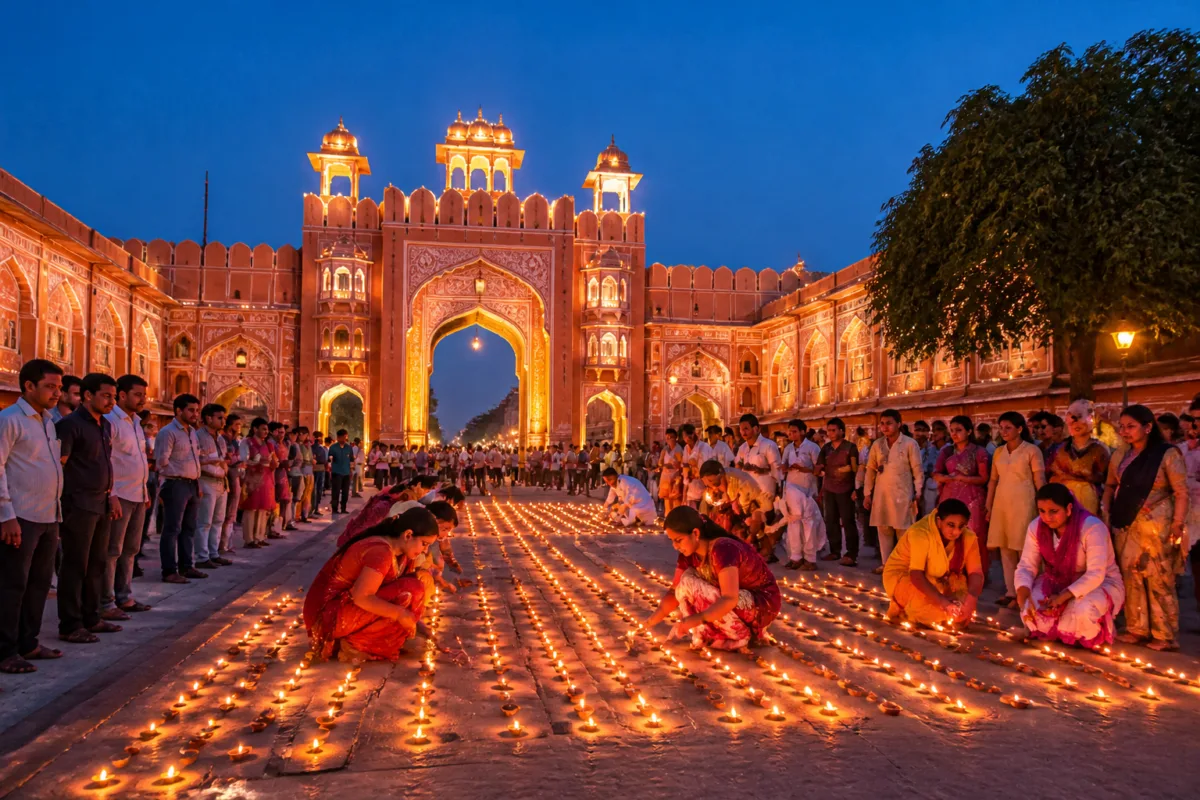
Jaipur Foundation Day celebrations began on November 17 with programmes at temples, historic gates, cultural venues and heritage sites as the city prepares to enter its 300th year on November 18. Organised by the Jaipur Municipal Corporation and other institutions, the two-day programme combines religious ceremonies, traditional performances, literary events, public lighting and a contemporary art exhibition.
The celebrations began at 9 am at the Moti Dungri Ganesh Temple, where Jaipur Mayor Sunil Kothari, elected representatives and officials offered prayers for the city’s prosperity, happiness and continued development. The ceremony also sought blessings for the smooth conduct of the foundation-day events.
Traditional shehnai performances are being held at several gates of the walled city, including New Gate, Sanganeri Gate, Ajmeri Gate, Zorawar Singh Gate, Gangapole Gate, Surajpole Gate, Chandpole Gate and Ghat Gate. The performances are intended to highlight Jaipur’s traditional musical heritage while bringing the celebrations into the historic urban core rather than keeping them confined to a single venue.
A national-level poetry conference is scheduled at Birla Auditorium at 5 pm on November 17. The event will feature poets from Rajasthan and other parts of the country, with performances centred on humour, satire and poetry. On November 18, a special Ganesh puja will be held at Gangapole Gate between 9.30 am and 10 am, followed by prayers at the Govind Devji Temple from 10.30 am to 11 am.
The main heritage programme is scheduled for 3 pm at the cenotaphs of Gaitore, a site associated with Jaipur’s founding rulers. It will begin with a floral tribute at the memorial of Maharaja Sawai Jai Singh II, who founded Jaipur in 1727. Traditional social and cultural performances will follow. Students will display paintings and models of Jaipur’s historic sites, while schoolgirls will perform the traditional ghoomar dance.
The Gaitore programme will also include a collective pledge to keep Jaipur clean, attractive and green. This links the foundation-day programme to the maintenance of the city’s public environment, although the report does not specify a separate implementation plan or monitoring mechanism for the pledge.
A public lamp-lighting ceremony is planned at Statue Circle at 5 pm on November 18, with thousands of lamps expected to illuminate the area. The event is intended to mark Jaipur’s entry into its 300th year and to represent hopes for the city’s prosperity and future.
At the City Palace Museum, the Jaipur Centre for Art, in collaboration with the museum, will host an exhibition titled ‘Traces of Us’ from 7 pm on November 18. Conceived by Udit Bhambri, the exhibition will include works by artists such as Arpita Singh, Bharti Kher, Kulpreet Singh, M.F. Husain, N.S. Harsha and Shilpa Gupta. Organisers describe the exhibition as an exploration of Jaipur’s 300-year journey through art and creative expression.
Jaipur was founded on November 18, 1727, when Maharaja Sawai Jai Singh II moved his capital from Amer to the plains. The decision was linked to the need for expansion, the city’s growing population and water constraints at Amer. Architect Vidyadhar Bhattacharya prepared the plan, which was organised around nine chowkris, or urban sectors. Two were intended for royal buildings and palaces, while seven were planned for residents. Wide roads, markets, public squares and a consistent architectural language became defining features of the city.
The main construction of Jaipur was completed in about four years, according to the report. The city’s pink identity dates to 1876, when buildings were painted pink to welcome the Prince of Wales during his visit. The foundation-day programme now brings that planned urban history into public spaces, monuments and cultural institutions across Jaipur.

