


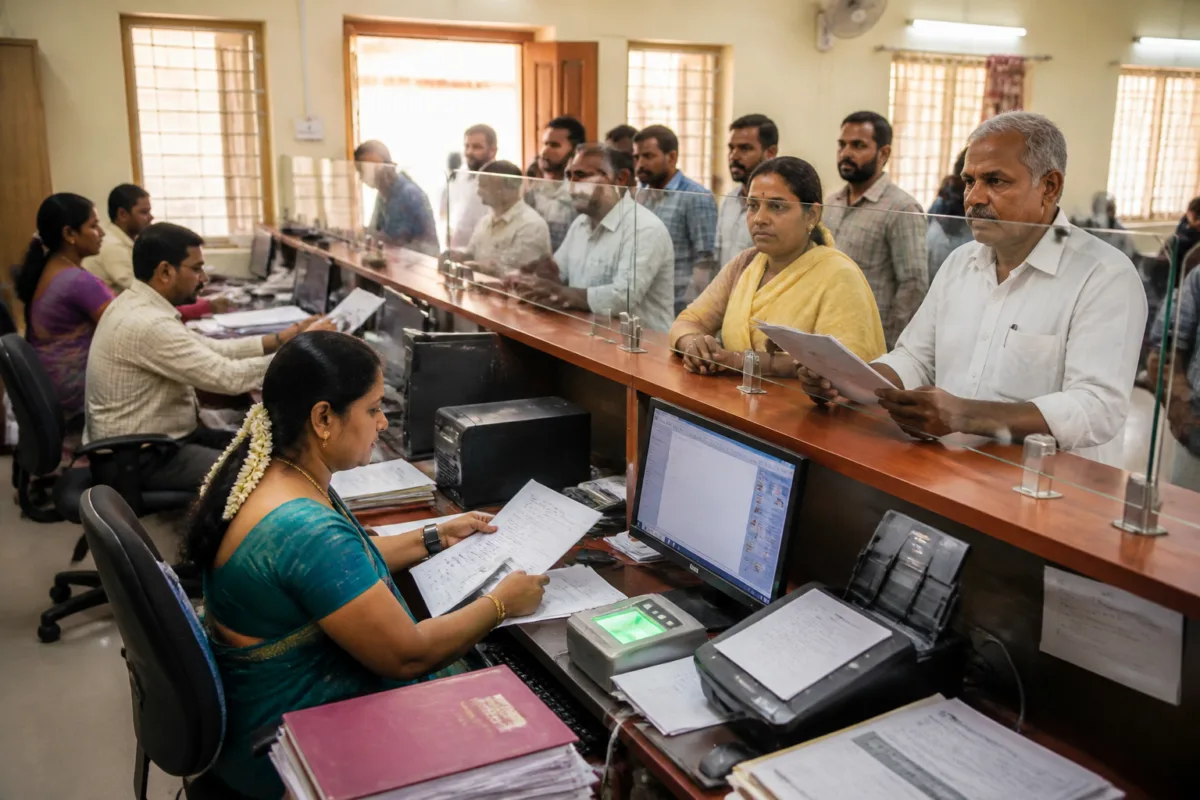
Tamil Nadu’s property registration department will modify its STAR 3.0 online system to retain the role of document writers while expanding self-service registration, Commercial Taxes and Registration Minister D Lokesh Tamilselvan said in Salem on Tuesday. The changes are intended to address concerns that the presence-less registration process could affect the livelihoods of document writers.
Under the planned modification, details of document writers will be added as a watermark to documents uploaded through the presence-less registration system, the minister said. The move would preserve their association with property documentation even as applicants gain access to more self-service functions through STAR 3.0.
Tamilselvan also said the government was taking steps to issue fresh licences to document writers. According to the minister, new licences had not been issued since 1997. The licensing gap is significant because document writers continue to play a role in preparing and submitting property-related documents, even as registration processes become increasingly digital.
The minister said registration officials would assist members of the public and advised applicants not to approach middlemen for faster processing. Documents would normally be returned within one or two days after the prescribed government fees were paid. Officials had been instructed to return documents on the same day wherever possible, he said.
The comments came after Tamilselvan conducted a surprise inspection at the regional commercial taxes office in Hasthampatti, Salem. He also reviewed tax collection in Salem and Namakkal districts during the visit.
The minister said a committee had been formed to examine complaints about high guideline values, which are used in determining the value of property for registration purposes. A decision on rationalisation would follow the committee’s report and the identification of locations where substantial disparities existed, he said. The statement did not specify the locations under review or a timeline for the committee’s recommendations.
Tamilselvan also addressed complaints relating to corruption and administrative conduct. He said the Directorate of Vigilance and Anti-Corruption was taking immediate action against officials caught accepting bribes, while departmental inquiries would proceed against officials accused of wrongdoing. No action would be taken unless the wrongdoing was proved, he said.
Officials had been told not to harass taxpayers, and the department’s intelligence wing would identify tax evaders for action, the minister said. He rejected allegations that large companies received preferential treatment and stated that all taxpayers were treated equally.
Separate tax collection targets had been set for each zone for the current financial year, according to the minister. He added that decisions on concessions for new industries rested with the state government and the chief minister. Businesses with annual turnover below Rs 20 lakh remained outside the GST threshold, he said.
The department was also addressing taxpayer grievances through timelines of 30, 60 and 90 days, depending on the nature of tax filings and payments. The proposed STAR 3.0 changes, the licensing steps for document writers and the committee’s review of guideline values are now the key administrative measures identified in the minister’s statement.

