


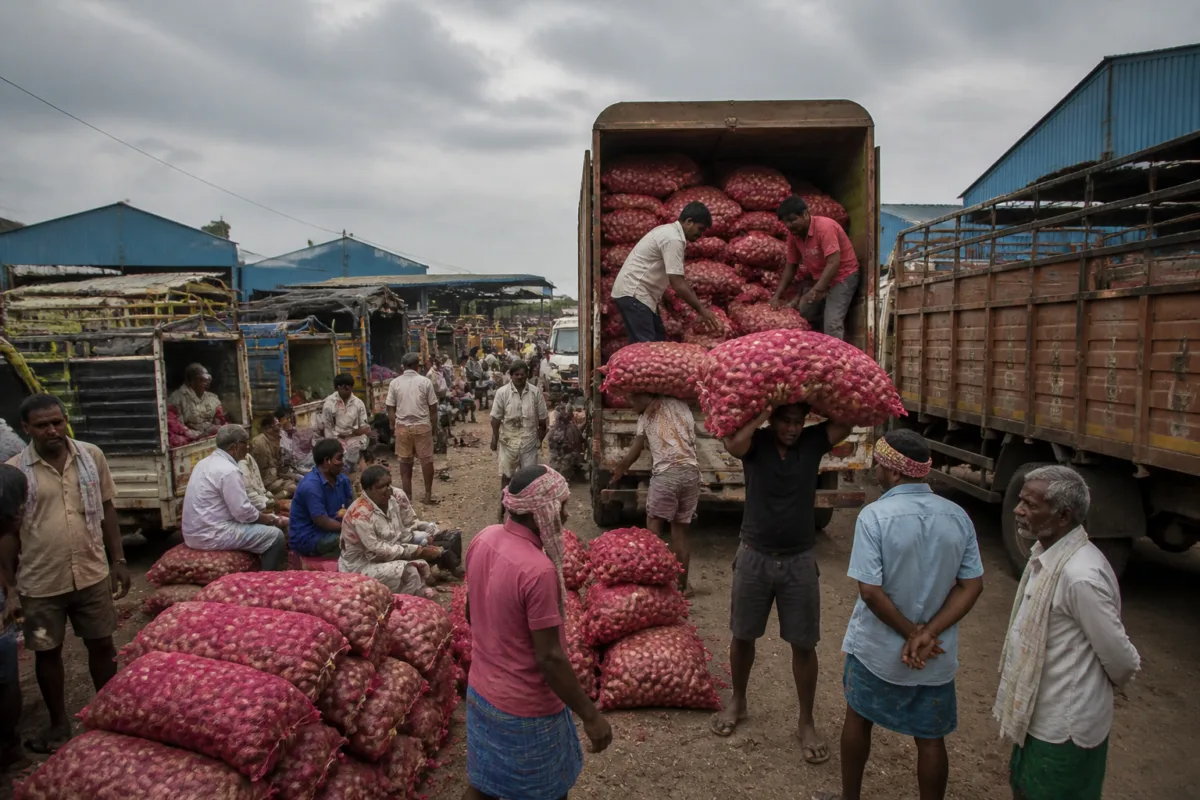
The relocation of onion trading from Bengaluru’s Yeshwanthpur Agricultural Produce Market Committee (APMC) to the Dasanapura sub-market has exposed a wider urban governance problem: moving a high-volume market to reduce traffic without providing the infrastructure needed by farmers, traders, workers and buyers. According to a report by Prajavani, the temporary shift has reduced buyer turnout, increased transport costs and contributed to an alleged fall of ₹200 to ₹300 per quintal in onion prices.
The decision was taken to ease congestion on Tumakuru Road near Yeshwanthpur. However, onion trading has been moved roughly 18 kilometres away to Dasanapura, while trading in potatoes, garlic, ginger and other agricultural commodities continues at the older market. That split has changed how buyers operate. Traders who earlier purchased several commodities in one visit now have to travel between two markets to complete their procurement.
This arrangement matters because an agricultural market is not only a collection of shops. It is a coordinated system involving auction space, unloading areas, storage, transport, labour, sanitation, buyer access and links to surrounding production districts. When one commodity is separated from the rest of the trading ecosystem, the additional time and cost can affect every participant in the chain, from the farmer arriving with a truckload to the buyer sending produce onward to retail markets.
Prajavani quoted Gopi K., an onion buyer from Anekal taluk, as saying that buyers earlier purchased onions along with potatoes and other commodities at Yeshwanthpur. They now have to pay for vehicles to visit both locations, increasing fuel and rental expenses and wasting time. The report said the number of buyers coming specifically for onions has fallen as a result.
For farmers, the most immediate concern is price discovery. Harish, an onion grower from Koppal district, told Prajavani that auctions at Yeshwanthpur previously attracted enough buyers to generate better prices. After the shift, he said, the reduced buyer presence had already lowered prices by around ₹200 to ₹300 per quintal, while transport costs had also increased. These claims are based on the accounts reported by the publication; the supplied report does not provide official auction data comparing prices before and after the relocation.
The scale of the disruption is linked to the market’s regional role. Farmers from Koppal, Raichur, Bagalkot and other districts reportedly travel between 400 and 500 kilometres to sell onions in Bengaluru. Some leave their villages early in the morning and reach the city around 4 a.m. Under the new arrangement, farmers who arrive at Yeshwanthpur and learn that onion trading is no longer taking place there must travel onwards to Dasanapura.
That additional movement is not a minor logistical inconvenience. Perishable agricultural commodities depend on timely unloading, auctioning and dispatch. A delay can increase the period during which produce remains on a vehicle or in an unsuitable holding area. The report says farmers are also facing difficulty finding hamalis to unload and move their onion bags after reaching Dasanapura. The result is a chain of waiting: the farmer waits for market access, the buyer faces an extra trip and labour availability becomes another constraint.
The physical difference between the two locations is central to the dispute. Yeshwanthpur reportedly has shops measuring between 900 and 3,000 square feet, while shops at Dasanapura measure only about 300 to 400 square feet. Traders have questioned how the new market can accommodate large-volume onion trading in such limited spaces. The report says there is insufficient room to unload, store and auction thousands of bags brought by farmers.
The shortage of basic amenities further weakens the market’s ability to serve a regional agricultural economy. Prajavani reported gaps in drinking water, toilets, rest areas and facilities for farmers who need to stay at the market. These are not peripheral services. For producers travelling hundreds of kilometres, sanitation, rest and safe handling areas form part of the basic operating infrastructure that determines whether a market is accessible in practice.
The labour dimension is equally important. Thousands of hamalis and other casual workers depend on market activity for their livelihoods. The report says workers are reluctant to travel to the new location because housing, transport and employment-support facilities are inadequate. If labour is unavailable at the point of unloading, the cost of the market shift is transferred to farmers and buyers through delays and additional handling arrangements.
Dasanapura’s connectivity problems also appear to predate the onion relocation. The market was reportedly established 17 years ago, but roads around it have not been widened. The report refers to the absence of a police outpost, dependence on a service road near the toll area, a damaged bridge inside the market and two-way traffic on a narrow road. Transport between Yeshwanthpur and Dasanapura can take up to three hours at times, according to the report.
This creates a mismatch between the stated objective and the implementation framework. Reducing congestion near Yeshwanthpur may address one urban problem, but shifting activity to a location with narrow roads, limited market space and inadequate services can move the pressure rather than resolve it. The available report does not establish whether a traffic assessment, capacity study or phased relocation plan was conducted before the decision. It does, however, record the concerns of the affected market participants that the alternative arrangements were not ready.
The case also highlights the importance of treating APMC markets as city infrastructure. Although their primary function is agricultural trade, they shape road traffic, wholesale distribution, employment and food supply across the metropolitan region. Their location determines how trucks enter the city, where workers gather, how commodities are consolidated and how quickly produce reaches buyers. Planning decisions made in the name of traffic management therefore have consequences for both urban mobility and rural incomes.
The split between onion trading at Dasanapura and other commodities at Yeshwanthpur has created a two-market procurement route. Buyers who previously combined purchases now face higher vehicle costs and longer journeys. Farmers, meanwhile, depend on the presence of multiple buyers to obtain competitive auction prices. If buyer participation declines, the market may become less competitive even when the volume of produce remains high.
The supplied report does not include the total volume of onions traded, the number of daily arrivals, official price records, the relocation order or a government response to the complaints. It also does not establish how long the temporary arrangement will continue. Those gaps matter because the effect of the shift cannot be fully assessed without baseline data on arrivals, auction prices, transport time, labour availability and market capacity.
What is already clear from the reported experiences is that the relocation has connected several urban systems that are often handled separately: traffic management, wholesale markets, freight movement, labour access and farmer incomes. The decision may have been intended as a temporary response to congestion, but its consequences depend on whether the receiving market can support the volume and complexity of the activity being transferred.
The next question is therefore not only whether onion trading should remain at Dasanapura. It is whether any relocation of a major wholesale market can be considered workable without matching road capacity, auction space, unloading areas, basic amenities, labour access and reliable connections for buyers and farmers. Until those conditions are addressed and the government provides evidence on the arrangement’s capacity and duration, the Yeshwanthpur-Dasanapura shift remains an example of urban congestion management creating new costs elsewhere in the city’s food supply network.

