


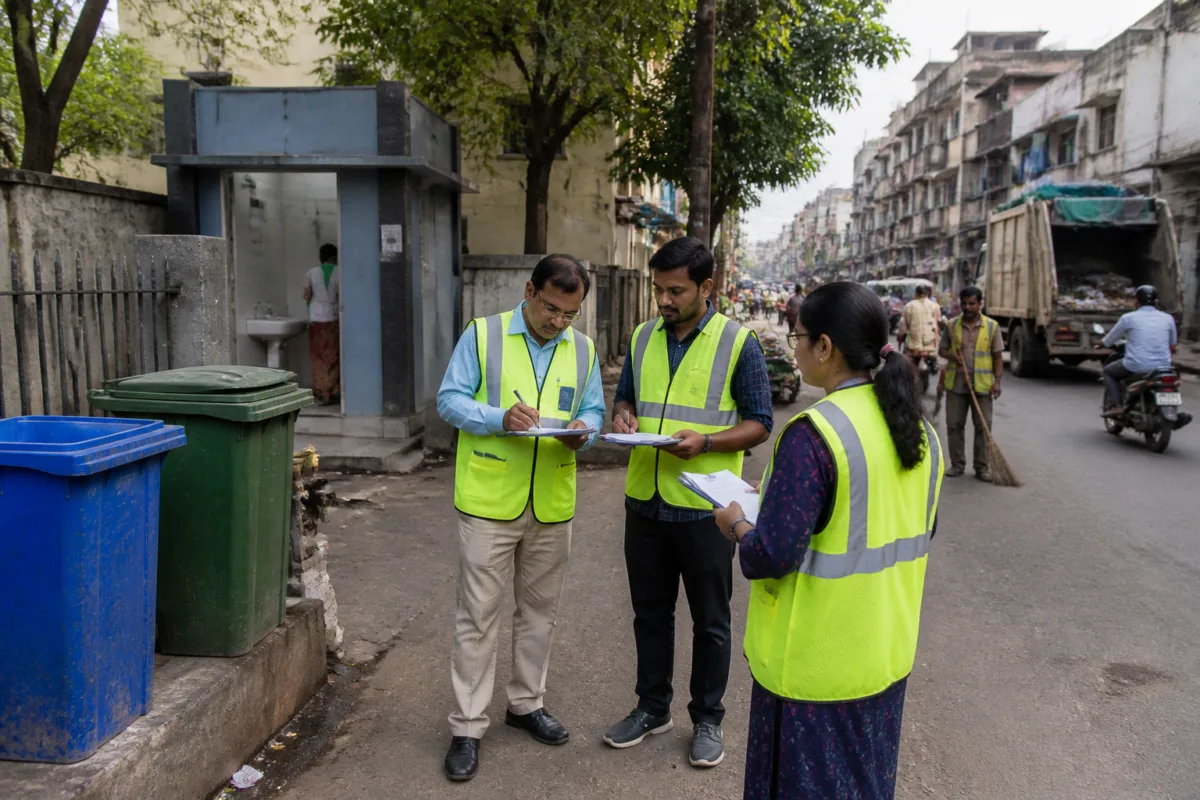
A political challenge to cleanliness awards received by Ahmedabad, Surat and Vadodara has shifted attention from rankings to the evidence behind them. The Gujarat Congress has questioned the reliability of the surveys used to assess the three cities and demanded that the state government publish the underlying scorecards, citizen-response data, inspection details and waste-management figures.
The dispute, reported by Nav Gujarat Samay, is not only about whether the three cities deserved national-level recognition. It raises a more fundamental urban governance question: can a cleanliness ranking be trusted if residents cannot examine how it was produced, which places were inspected and how the results compare with conditions across different kinds of neighbourhoods?
The Congress has alleged that official claims about cleanliness do not fully reflect conditions on the ground. It has questioned the surveys conducted for the cities, the process through which residents were invited to provide feedback and the broader credibility of the assessment exercise. The party has also launched a QR-code-based public initiative described as a ‘real cleanliness survey’, seeking citizen participation to present an alternative account.
The supplied report does not establish that the government’s survey results were manipulated or that the awards were incorrectly granted. It records the Congress’s objections and its demand for disclosure. That distinction matters because the central issue is currently one of transparency and verification rather than a proven failure of the official assessment.
The first demand is for the complete cleanliness scorecards of Ahmedabad, Surat and Vadodara. Congress chief spokesperson Dr Manish Doshi has asked the government to publish the marks received by each city under every assessment criterion. Without that information, a headline ranking can show an outcome but not the reasons behind it. Readers may know that a city received recognition, but not whether the result was driven by waste collection, public sanitation, citizen feedback, inspection performance or another component of the evaluation.
The party has also sought the total number of citizen responses received from each city and that figure as a proportion of the respective population. It wants the government to identify how responses were collected through online channels, QR codes and applications. This request focuses on the representativeness of public feedback. A survey can record a large number of responses, but the meaning of that number depends on who participated, how participation was distributed across the city and whether the result reflects residents beyond digitally connected groups.
The demand for channel-wise disclosure also points to an institutional problem in urban measurement. When feedback is gathered through multiple digital routes, the public needs to know whether each route follows the same process and whether the responses are combined using a common method. The report does not provide the government’s methodology or explain how the official survey treated responses from different platforms. Those details remain central to evaluating the reliability of the results.
Congress has further asked the government to disclose the safeguards used to prevent duplicate or unauthorised responses. It wants details of the verification system, the report of any independent evaluation agency and information on GPS-based inspections. These requests go beyond a demand for raw scores. They concern the controls that determine whether an assessment measures actual urban conditions or simply records participation and selected observations.
The inspection question is particularly important because the locations chosen for assessment can shape the picture of a city. The party has asked for the criteria used to select inspection sites and for details of the places covered by GPS-based monitoring. The source report does not say how many sites were inspected, which sites were included or whether the inspection record has been released. Consequently, it is not possible from the available material to determine how comprehensively the surveys represented the three cities.
The Congress has specifically called for separate cleanliness scores for every ward. It has also asked that the government disclose conditions in inner areas, slums, industrial zones and neighbourhoods around dumping sites. This is the most direct ground-level dimension of the dispute. City-wide scores can conceal uneven service delivery when cleaner or more visible areas receive greater attention than peripheral, informal or industrial locations.
A ward-wise record would not by itself resolve every question about sanitation. But it would allow residents and administrators to see whether performance is consistent across the municipal area or concentrated in selected locations. Publishing separate information for inner neighbourhoods, slum areas, industrial zones and dumping-site surroundings would also recognise that sanitation conditions are shaped by land use, density, access to municipal services and proximity to waste facilities. The report does not provide such ward-level data, so the extent of variation between neighbourhoods remains unestablished.
Waste processing is another major part of the information sought. The Congress has demanded city-wise details of the quantity of waste generated each day, the amount scientifically processed, the amount recycled and the amount sent to dumping sites. These categories would help distinguish between cleanliness at the visible street level and the management of waste after collection.
The demand is significant because a clean road or public space does not necessarily indicate that the wider waste chain is functioning effectively. Collection, segregation, processing, recycling and final disposal are separate stages. The supplied report does not state the daily waste volumes or the proportions handled through these routes in Ahmedabad, Surat or Vadodara. It therefore cannot establish whether the three cities are meeting any particular processing or recycling benchmark. It does show, however, that the opposition wants cleanliness recognition to be assessed against the complete waste-management chain rather than surface appearance alone.
Public toilets form a further part of the requested disclosure. Congress has asked for the number of public toilets in each city, their present condition, cleaning schedules, maintenance contracts and expenditure on those contracts. These demands bring the debate closer to the everyday experience of residents who depend on shared sanitation facilities.
A count of public toilets is only one measure of access. Their condition, frequency of cleaning, maintenance responsibility and operating expenditure determine whether the facilities remain usable. By asking for contracts and spending records alongside the number of toilets, the party is seeking to connect service outcomes with municipal administration and public money. The source does not provide the current condition or maintenance data for the three cities, and no independent assessment of those facilities is included.
The dispute therefore centres on two different ways of describing urban cleanliness. One is the award or ranking, which presents a consolidated assessment. The other is the service record experienced by residents across wards and neighbourhood types. The political challenge argues that the second cannot be assumed from the first. It asks the government to publish enough detail for citizens to compare official recognition with local conditions.
The institutional responsibilities are also clear in outline, even though the available report does not specify the agencies involved in each stage. The state government is being asked to disclose the survey scorecards and methodology. Municipal administrations would be expected to hold information on wards, waste generation, processing, recycling, dumping-site disposal, public toilets, contracts and expenditure. Survey or evaluation agencies would be relevant to the verification of responses and inspections. A credible public record would need to connect these different layers rather than present only a final city ranking.
At this stage, the evidence establishes that the Gujarat Congress has raised these questions and launched a QR-code-based citizen initiative. It does not establish the official response, whether the government has agreed to release the requested records, whether an independent evaluation was conducted or whether the QR survey will follow a statistically comparable methodology. It also does not provide the official cleanliness scores, ward-level results or waste-processing figures.
That absence of information is the central reason the episode matters beyond a political exchange. Cleanliness awards are public claims about the performance of urban systems. If the supporting records are not easily available, residents cannot assess the difference between a city-wide average and their own service conditions. If the records are released, the debate can move from competing assertions to a review of methodology, coverage and outcomes.
For Ahmedabad, Surat and Vadodara, the next significant development is whether the government publishes the requested scorecards, response counts, verification procedures, inspection records, ward-level results, waste-flow data and public-toilet accounts. Until then, the political allegation remains a demand for scrutiny rather than proof that the official cleanliness assessments are invalid. The unresolved question is whether the three cities’ recognition will be supported by a transparent public record that residents can examine.

