


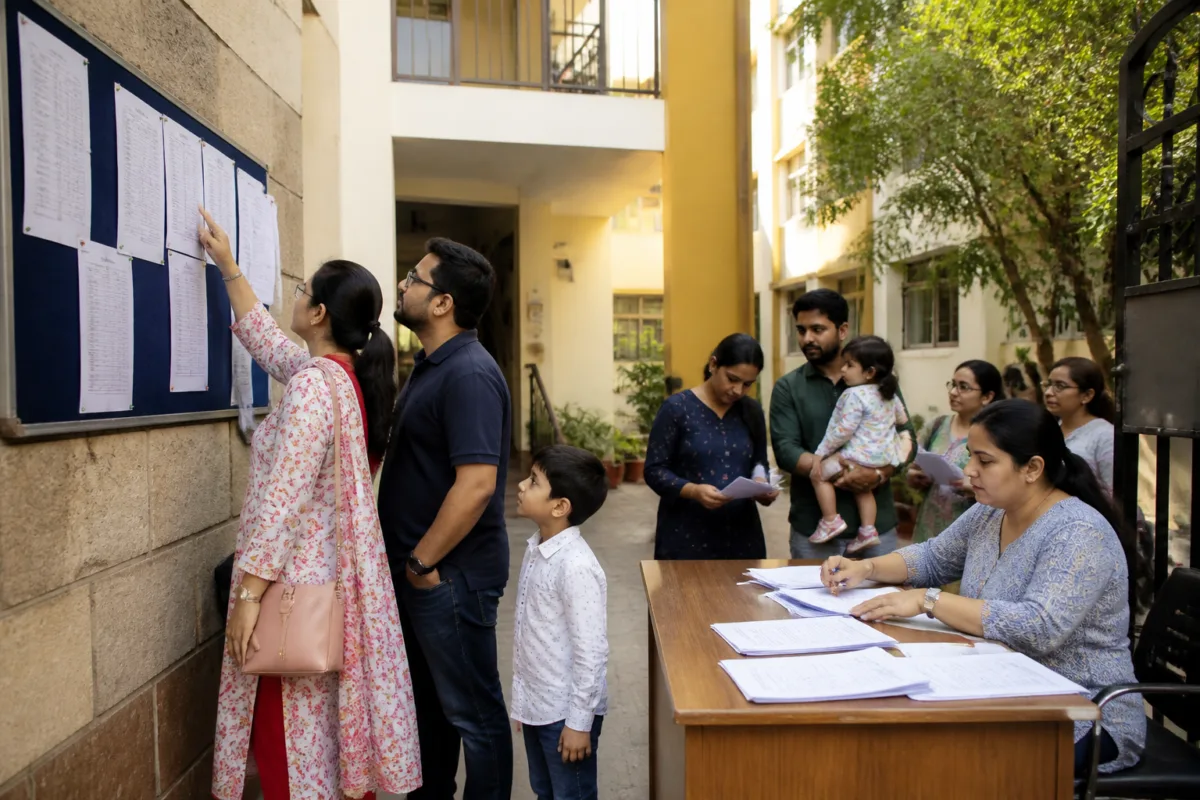
Maharashtra’s new private school admission rules attempt to address a problem that has long been experienced at the point where families first enter the formal education system: admissions are often treated as a private transaction rather than a regulated public-facing process. The standard operating procedure issued by the Primary Education Directorate places controls on admissions, fees, documentation, selection methods and school-linked purchases in recognised private unaided pre-primary schools across the state.
The significance of the SOP lies not only in the restrictions themselves, but in the attempt to turn an opaque process into a documented one. Schools will have to publish admission schedules on their websites and notice boards, provide parents with at least 10 working days to apply, preserve records of applications and selections, and follow a transparent lottery when applications exceed available seats. These requirements shift part of the admission process from informal school-level discretion to procedures that can be inspected and challenged.
According to the report by Sakal, Primary Education Directorate director Sharad Gosavi issued the directions on Monday. The stated purpose is to regulate admissions and fee collection in recognised private unaided pre-primary schools and to support effective implementation of the Right of Children to Free and Compulsory Education Act. The SOP also seeks to stop collection of donations and additional charges that are not authorised under the applicable rules.
The first institutional change is the removal of screening at entry level. Schools will not be permitted to conduct written or oral tests, interviews or any other form of scrutiny for admission. They also cannot demand documents beyond those prescribed by the state government. The report specifically identifies income-tax returns, income certificates and family photographs as examples of additional documents that schools cannot require from parents.
This matters because documentation can become an indirect selection tool even when a school does not formally announce a test or interview. A request for extra financial or family information may discourage applications, delay a child’s admission or create unequal treatment between households. By limiting the documents that may be demanded, the SOP defines a clearer boundary between information needed for admission and information that can become an unnecessary barrier.
The rules also prohibit discrimination based on caste, religion, language, gender, social or economic circumstances and the educational background of parents. In practical terms, the provision treats access to pre-primary education as a process that cannot be filtered through the social profile of a family. The report does not provide details of a separate monitoring database or a dedicated complaints portal, but it does specify that complaints from parents must be investigated directly by education officials.
Where demand is higher than the number of available seats, schools must conduct admissions through a transparent lottery in accordance with government directions. The requirement is important because oversubscribed schools can otherwise rely on selection practices that are difficult for parents to verify. Publishing the schedule, giving a minimum application window and preserving records creates a basic chain of evidence: parents can know when applications opened, what process was followed and how the final list was produced.
The SOP’s approach to fees extends the same logic of disclosure to the financial side of schooling. Schools must publish their fee structure on notice boards and websites, issue official receipts for every fee and avoid charges that fall outside the rules. The directions also prohibit schools from forcing parents to buy books, notebooks, uniforms or privately published textbooks from a particular shop. Schools are required to use textbooks approved by the relevant boards.
These provisions address costs that can sit outside the headline fee. A family may be told that admission has one official price, while the actual cost of starting school also includes a prescribed shop, a particular uniform supplier, additional books or charges that are not clearly explained. The SOP does not eliminate every expense associated with schooling, but it requires schools to make the fee structure visible and to provide a formal record of payments. That makes the total transaction more traceable for parents and authorities.
The rules also introduce a staged age framework for school entry. From the 2027-28 academic year, the minimum age for nursery admission will be three years. The minimum age for junior kindergarten will become four years from 2028-29, for senior kindergarten five years from 2029-30, and for Class 1 six years from 2030-31. The reference date for calculating age will be June 30 each year.
The staggered schedule is an attempt to standardise age eligibility across stages rather than leave each school to interpret the entry point independently. For parents, the June 30 reference date provides a fixed basis for determining eligibility. For schools, it creates a sequence of future compliance milestones. The fact that the changes begin in different academic years also means that implementation will depend on schools communicating the timeline clearly during each admission cycle.
The Directorate’s enforcement design relies substantially on education officers. Officials have been directed to carry out surprise inspections of schools and examine admission records, fee records and lottery documentation. They must also investigate parents’ complaints directly. Where violations are found, schools may receive notices and face punitive action. A monthly report on implementation is to be submitted to deputy directors of education.
This reporting chain is significant because a rulebook alone cannot resolve the gap between formal rights and actual access. The SOP identifies three levels of administrative work: inspection at the school, investigation of complaints and monthly reporting to higher education authorities. The supplied report does not specify the amount of penalties, the number of officials assigned, the format of the monthly reports or the time limit for resolving a complaint. Those details will determine how consistently the framework operates across districts.
The policy also illustrates the limits of regulating private education through procedural controls. Admission transparency can be improved by publishing schedules and using lotteries, but parents still need timely information to participate in the process. Fee disclosure is meaningful only when families can compare the published structure with receipts and identify charges that do not appear in the official schedule. Similarly, a ban on forced purchases requires inspections or complaint action capable of detecting arrangements that may not be recorded formally.
The SOP therefore places considerable importance on records. Applications, selections, admissions, fees and lottery processes must leave an administrative trail. That trail can support inspections and complaints, but only if schools preserve complete records and officials regularly examine them. The monthly reporting requirement may help the Directorate identify recurring violations, although the supplied material does not say whether these reports will be made public or whether district-level data will be published.
For families, the immediate change is not a new school or additional capacity; it is a new set of rules governing access to existing places. The framework addresses several points at which uncertainty can impose costs: knowing when to apply, understanding which documents are legitimate, avoiding interviews or tests for entry, seeing how a lottery is conducted, identifying the official fee and choosing where to buy books and uniforms. Each of these controls reduces the space for informal demands, provided the rules are enforced.
The larger urban question is how cities and growing settlements manage access to essential services when demand is concentrated in a limited number of institutions. Private unaided pre-primary schools are part of the education infrastructure used by urban households, but the report provides no state-wide figures on applications, available seats, fee levels or complaints. Without those numbers, it is not possible to measure how widespread the reported practices are or how much the SOP will reduce household costs.
What the available information establishes is a move towards standardised procedure, financial disclosure, non-discrimination safeguards and administrative inspection. What remains uncertain is the enforcement capacity behind the framework: how often surprise inspections will occur, how complaints will be resolved, what penalties will be applied and whether monthly reports will reveal patterns across districts. The next important milestones are the publication and implementation of the admission schedules, the first inspection cycle and the phased introduction of the age criteria beginning with nursery admissions in the 2027-28 academic year.

