


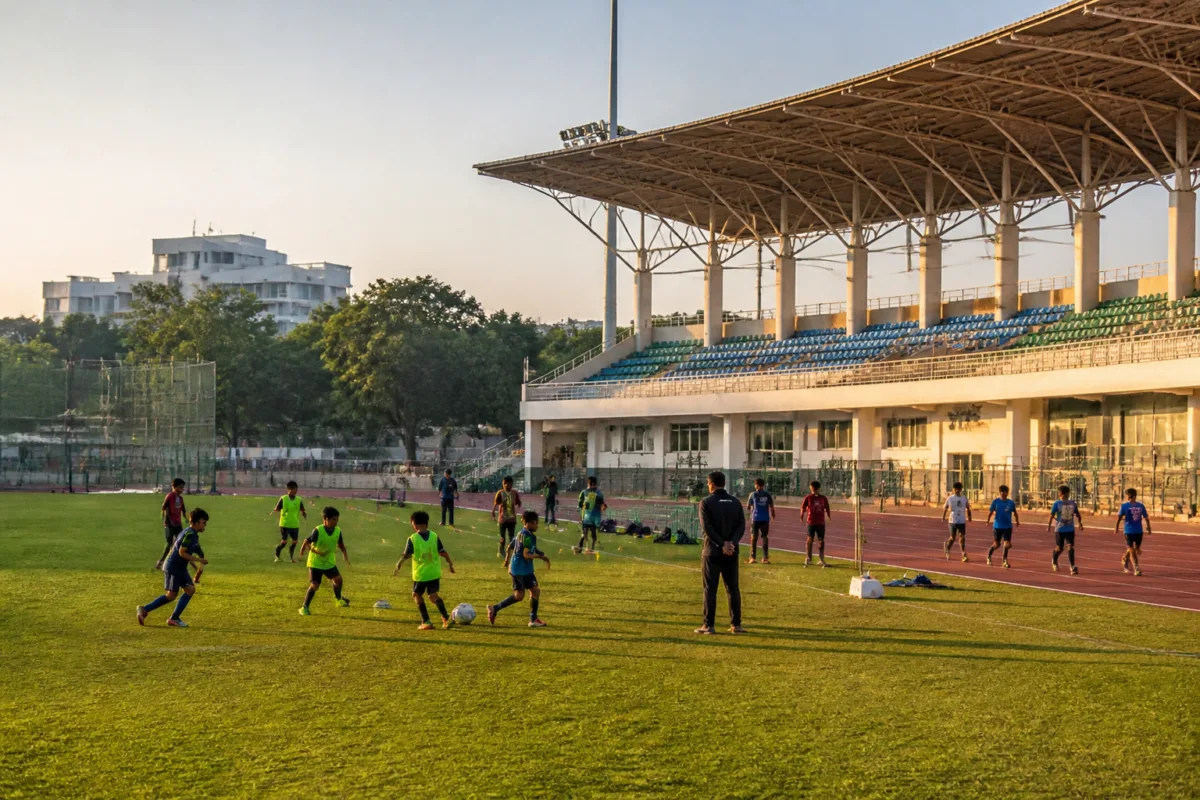
The Municipal Corporation of Delhi’s proposed public-private partnership model for 13 stadiums is presented as an upgrade to neglected civic sports infrastructure. But the policy’s real test will be whether private investment improves facilities without narrowing access to the public institutions and schoolchildren these stadiums are meant to serve.
According to a report by Jagran – New Delhi, the MCD has prepared a policy under which private operators would receive responsibility for the development, operation and maintenance of stadiums under the education department for five years. The operators would be expected to invest their own money in improving sports infrastructure. In return, they would be allowed to conduct commercial activities subject to prescribed conditions.
The arrangement covers 13 MCD-run stadiums where facilities are available for football, cricket, volleyball, badminton and athletics. The report says these facilities have not been used to their full potential because of limited resources, maintenance constraints and a lack of professional management. The proposed PPP model therefore attempts to address an operational problem through a change in management and financing rather than by relying entirely on municipal expenditure.
That shift matters because public sports infrastructure is not simply a collection of buildings and playing surfaces. Its value depends on regular maintenance, trained coaches, safe access, functioning equipment and predictable operating hours. A stadium that exists on paper but lacks upkeep or professional programming does not provide the same public service as a facility that can be used consistently by students, athletes and neighbourhood residents.
The MCD’s proposed structure separates access into two broad groups. Students enrolled in MCD schools would receive free sports training under qualified coaches, while other Delhi residents could use the facilities on payment of fees. The policy also provides for multi-sport coaching and wider community sports activities.
This design makes the schoolchildren’s entitlement central to the model. It also establishes the main institutional question surrounding the proposal: how will the corporation ensure that commercially viable activities do not displace the free training promised to MCD students? The supplied report does not provide the proposed number of free training hours, the number of beneficiaries, eligibility procedures, coach-to-student ratios or the mechanism through which the corporation will verify delivery.
Those details are important because the PPP model depends on a relationship between public obligations and private operating rights. The operator is expected to bear the cost of development, operation and maintenance. Commercial activity is the stated counter-benefit. In practice, the contract will have to define which spaces can be monetised, at what times, and under what limits. It will also have to protect school use and community access from being treated as residual activities after paid programming has been scheduled.
The report says that operators will be selected separately for each stadium through a transparent process based on eligibility standards and contractual conditions. The agreement will run for five years, with a possible extension of up to six months following review and mutual consent. This duration is long enough for an operator to plan maintenance and programming, but short enough to make monitoring and transition arrangements significant parts of the contract.
A five-year operating period can also create different incentives for different kinds of investment. Routine maintenance, coaching and day-to-day operations may produce visible improvements quickly. Larger capital works may require longer planning, approvals and time to recover costs. The report does not specify the scale of investment expected from each operator, whether minimum capital expenditure will be prescribed, or what happens to assets created by a private operator when the contract ends.
The policy reportedly includes digital monitoring and other technology tools to improve transparency. It also provides for regular reviews of operator performance, the quality of sports facilities, training provided to students and maintenance standards. These provisions indicate that the MCD is not treating the arrangement as a one-time handover. Instead, the corporation is retaining a supervisory role over service delivery.
That supervisory role will determine whether the policy functions as public asset management or merely as outsourcing. Digital monitoring can record attendance, facility use, maintenance complaints and training schedules, but the report does not state what information will be published, who will audit it, or how students and residents will be able to challenge inaccurate records. Without clear public reporting, monitoring may remain an internal administrative exercise rather than a tool of accountability.
The inclusion of safety, child protection, insurance, emergency arrangements and grievance redressal is significant because sports facilities serve minors as well as adult users. The report says operators will have to follow prescribed standards and may face action for rule violations or poor performance. These safeguards recognise that the operating contract has consequences beyond the condition of the stadium itself.
For MCD school students, the quality of implementation will be measured in practical terms: whether training is genuinely free, whether qualified coaches are available, whether equipment is usable and whether sessions take place regularly. For other residents, the key issue will be the level and structure of fees, the availability of neighbourhood access and whether paid activities are concentrated at the most convenient times. The report confirms the broad access categories but does not disclose the fee framework or reservation policy.
The proposal also places the MCD’s education department at the centre of a wider urban infrastructure challenge. Municipal bodies often control land and facilities that have public value but face limitations in funding, technical capacity and day-to-day management. A PPP model can bring external investment and specialised operations, but it does not remove the public authority’s responsibility to define service standards, protect access and enforce the contract.
The available evidence does not establish whether the 13 stadiums are evenly distributed across Delhi, whether they differ substantially in size or condition, or whether each location will receive the same service obligations. It also does not identify the likely private operators, the expected revenue model, the procurement timetable or the investment amount for individual sites. Those gaps prevent a complete assessment of the policy’s financial and spatial impact.
The MCD’s approach nevertheless reveals a broader shift in how municipal sports assets are being considered. Instead of treating stadiums only as facilities requiring annual maintenance, the policy treats them as assets that can combine public programming with regulated commercial use. The model’s success will depend on whether those two functions reinforce each other or compete for the same space and time.
The evidence currently confirms that the MCD has prepared a five-year PPP framework for 13 education-department stadiums, with private operators expected to fund improvements, manage facilities and provide free coaching to MCD school students. It does not yet establish how the contracts will allocate revenue, measure outcomes or protect access in practice. The next material developments will be the publication of eligibility conditions, tender documents, operator-selection rules, stadium-wise obligations and the monitoring framework.

