


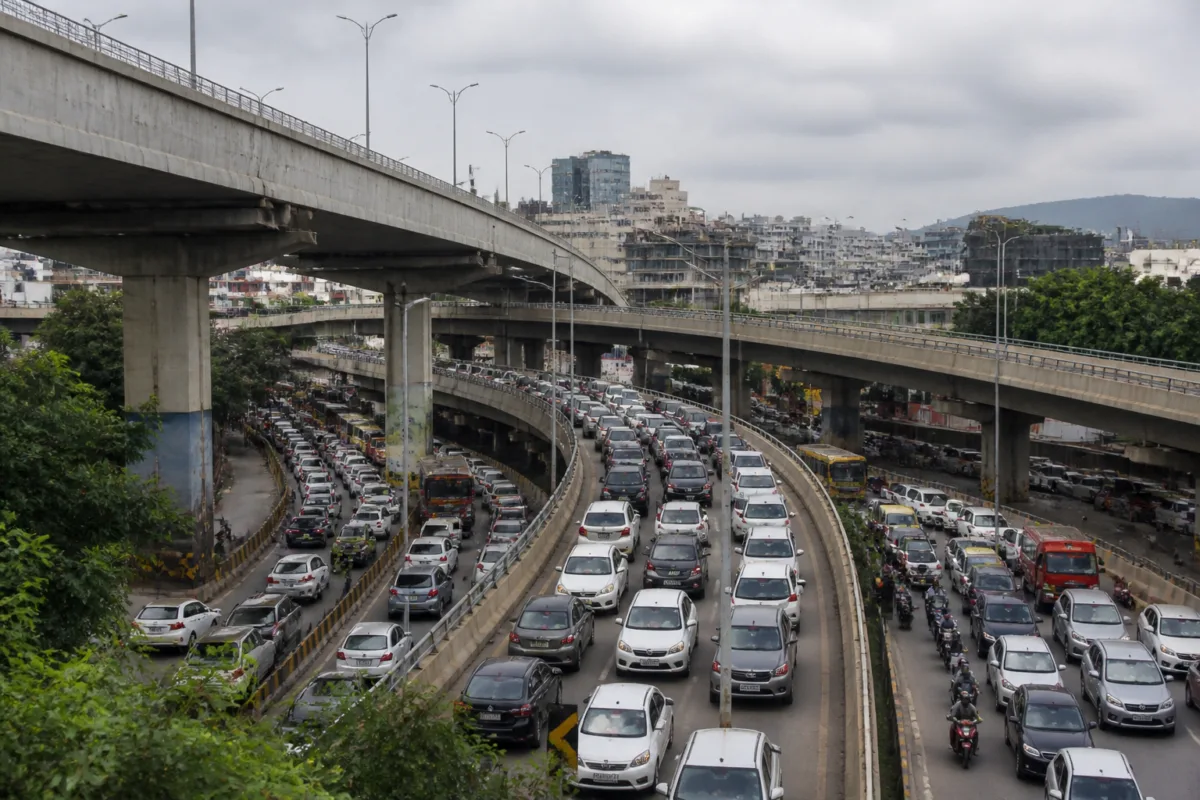
Pune’s Chandani Chowk continues to experience serious traffic congestion despite the completion of an integrated infrastructure project costing about Rs 865 crore, according to an on-ground report by Pudhari. The upgraded interchange has improved traffic movement under normal conditions, but peak-hour demand, breakdowns, accidents and sudden holiday surges can still slow traffic across a much wider network, extending from Navale Bridge and Warje towards Chandani Chowk and Pashan.
The persistence of congestion at the junction raises a central question about large urban road projects: can a redesigned interchange resolve traffic pressure if the surrounding network remains vulnerable to small disruptions? The Pudhari report’s findings suggest that Chandani Chowk has gained additional road capacity, but the wider corridor has not become sufficiently resilient to incidents or sharp increases in vehicle volumes.
The project was developed after congestion at Chandani Chowk became a prominent government concern. The report states that former Maharashtra chief minister Eknath Shinde was caught in traffic on the Pune-Bengaluru highway, bringing renewed political and administrative attention to the junction. A master plan was subsequently prepared, while Pune MP Murlidhar Mohol and Bharatiya Janata Party leaders pursued measures to address the bottleneck. Union minister Nitin Gadkari and government officials also inspected the location as preparations for a long-term solution began.
The Centre inaugurated the integrated infrastructure project on 12 August 2023. Its principal components included a 2.2-kilometre interchange, eight ramps connecting traffic in eight directions, and internal and external service roads on both sides of the highway. Taken together, the roads built as part of the project have an approximate combined length of 16.98 kilometres.
These elements changed the physical form of Chandani Chowk. The junction was no longer dependent on a single surface-level movement pattern, and traffic could be distributed through multiple ramps and service roads. Pudhari reports that traffic flow improved after the bridge and interchange were built. That improvement, however, has not translated into consistently free-flowing movement during office hours, which remain the most difficult period on the route.
The distinction between improved flow and resolved congestion is important. A major interchange can remove one conflict point while leaving demand across the larger corridor unchanged. In Chandani Chowk’s case, the project added ramps, grade-separated movement and service roads, but vehicles still converge on the broader road system linking the western approach to Pune with areas including Warje, Navale Bridge and Pashan. The report does not establish that the project failed in its stated engineering objectives. It shows instead that the project has not eliminated congestion across all operating conditions.
The most revealing part of the report concerns incidents. A vehicle breakdown or road accident can cause traffic to slow substantially along the route. On a normal day, the interchange’s additional capacity may absorb traffic and keep vehicles moving. When one lane or movement path is obstructed, however, the available alternatives can quickly become insufficient. This suggests that the performance of the junction depends not only on its designed capacity but also on how quickly disruptions are detected, cleared and managed.
The same vulnerability appears during holidays, when vehicle numbers suddenly increase. According to Pudhari’s observation, congestion can then affect Navale Bridge, Warje, Chandani Chowk and the road towards Pashan. The geographical spread of the impact indicates that Chandani Chowk functions as part of a connected urban and highway corridor rather than as an isolated junction. Traffic conditions at the interchange can influence adjoining roads, while pressure on those roads can feed back into the junction.
This is the institutional challenge behind the headline. The project involved a large public investment and a complex set of physical works, but congestion is experienced by citizens as a continuous journey through several authorities and road sections. An interchange may be designed and built as a single project, while the daily traffic problem extends across connecting highways, bridges, service roads and local access routes. The report does not identify the precise administrative division of responsibility for each section, but its description of corridor-wide disruption shows why a single-project approach cannot by itself guarantee corridor-wide performance.
The project’s figures also illustrate the scale of the intervention. The reported Rs 865-crore cost funded a 2.2-kilometre interchange, eight ramps and nearly 17 kilometres of combined roads. Those numbers demonstrate that the response was not a minor junction modification. It was a substantial attempt to redesign movement at one of Pune’s major western gateways. Yet the continuing peak-hour congestion shows that physical scale and operational reliability are not identical measures.
The evidence supplied in the report is observational rather than a formal before-and-after traffic evaluation. It does not provide traffic counts, average travel speeds, queue lengths, clearance times, accident data or a comparison of congestion levels before and after the project. It therefore cannot establish how much congestion has reduced, how often incidents occur or whether travel times have improved over a longer period. What it does establish is narrower and significant: traffic has become smoother in some conditions, but congestion continues during office hours and can intensify sharply when vehicles break down, accidents occur or holiday traffic rises.
That limitation matters when infrastructure outcomes are assessed. A project may succeed at separating traffic streams and still fall short of public expectations if commuters continue to face long delays at predictable times. Conversely, recurring congestion does not automatically prove that the engineering intervention was ineffective. Without published performance data, the supplied evidence cannot distinguish between insufficient capacity, poor incident management, excessive demand, bottlenecks beyond the interchange or a combination of these factors.
For Pune’s western approach, the larger urban question is whether road capacity is being managed as a network. The Chandani Chowk project created multiple routes through a difficult junction, but the report shows that the system remains sensitive to disruptions. The practical test for commuters is not only whether vehicles can pass through the interchange under normal conditions. It is whether the corridor can continue functioning when a vehicle stops, an accident occurs or traffic rises unexpectedly.
That test also changes the meaning of a permanent solution. The government response was triggered by a visible congestion crisis and produced a major construction project. The continuing delays indicate that permanence cannot be measured only by the completion of bridges and ramps. It must also be assessed through the corridor’s day-to-day operating performance, including peak-hour movement and the handling of incidents. The source material does not state whether a dedicated incident-response mechanism, traffic monitoring system or further corridor works are currently planned, so those aspects remain unestablished.
What the available evidence confirms is that Chandani Chowk has been physically transformed and that the project has improved traffic flow in ordinary conditions. It also confirms that the western gateway remains vulnerable to congestion during office hours, holidays and unexpected disruptions. The next step in judging the project’s full impact would be transparent performance data covering traffic volumes, travel times, bottleneck locations and incident-related delays across the connected corridor.

