


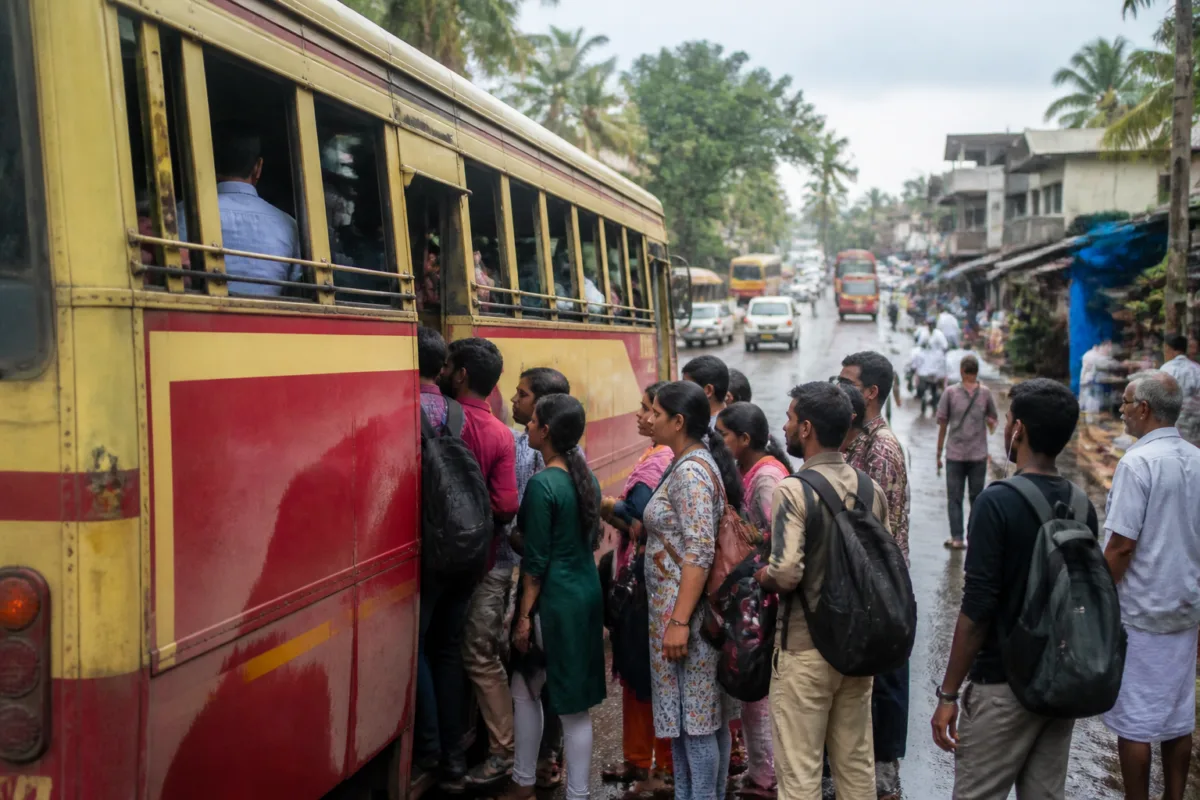
The Mangaluru-Kasaragod bus service is carrying a growing cross-border commuter burden that its existing timetable and vehicle capacity are struggling to absorb. The pressure has become more visible since Kerala introduced the Priyadarshini scheme, under which women can travel free on state-run buses, but the underlying problem is broader: thousands of students, workers and daily passengers depend on a corridor where services are divided into rigid operating windows between Kerala and Karnataka.
The result is a public transport system that offers frequent buses on paper but unreliable journeys in practice. The report from Prajavani describes passengers waiting well before school or work, travelling in severely crowded vehicles and arriving late in Mangaluru. For people commuting from Kasaragod district to the coastal city, the issue is not simply whether a bus exists. It is whether a bus has enough space, stops at the required location and arrives during the narrow period in which a student or employee must reach class or work.
That distinction is important for understanding the corridor. A service can appear well supplied when measured by the number of scheduled buses, while still failing passengers at peak times if demand is concentrated into a few departures. In this case, the problem is intensified by the way Kerala and Karnataka services are scheduled. The report says buses from the two states operate in alternating two-hour periods between Kasaragod and Mangaluru. If Karnataka buses begin operating from Kasaragod at 6 a.m., they serve the route for two hours before Kerala buses take over for the next two hours. A similar arrangement applies from Mangaluru.
This creates a timetable that may be administratively convenient but difficult for passengers who cannot wait for the next operating block. The report says 38 Kerala buses operate on the route, including seven deluxe buses, while Karnataka operates 34 buses, including four Rajahamsa services. The combined fleet is substantial, yet the alternating schedule means passengers may still have to plan around a two-hour gap between state-operated services. Free travel does not remove that constraint. It can make the timing problem more consequential by concentrating demand on the services that provide the benefit.
The Priyadarshini scheme has changed the pattern of travel on the corridor, according to the accounts cited in the report. Women who previously may have limited their trips or used other modes are now travelling to Mangaluru for employment, education and smaller personal errands. A schoolteacher from Manjeshwar, who boards from Kumbla every day, said she now arrives at the bus stop half an hour earlier to improve her chances of reaching school on time. Her account illustrates how a fare policy can alter the daily geography of a border region: cheaper travel expands access to the larger city, but without corresponding capacity, the benefit is accompanied by longer waits and more crowded journeys.
The reported demand is not restricted to women. The Mangaluru division controller of the Karnataka State Road Transport Corporation, Rajesh, said the number of women travelling on Karnataka buses had not declined even after the Kerala scheme was introduced. The report also quotes a Kasaragod bus driver, Lingappa, making a similar observation. This suggests that passengers are not choosing services solely on the basis of whether travel is free. They are also responding to departure times, route availability and the difficulty of waiting for a particular state’s buses.
The statement attributed to Kerala’s station master at the Mangaluru KSRTC bus stand, Vishwambaran, captures the institutional position. He acknowledged that the number of women on Kerala buses had increased significantly but said the transport system’s responsibility was to accommodate beneficiaries of the government scheme. That places the operational burden on the bus network rather than on individual passengers. The public policy objective is to improve access, but its success depends on whether the operating system can absorb the additional demand without compromising safety, punctuality and basic travel comfort.
The numbers cited by conductors indicate a substantial capacity problem. Buses that normally have between 65 and 67 seats are reportedly carrying more than 100 passengers after the scheme’s introduction. Conductors cited in the report said some services had carried between 130 and 140 passengers. These figures are presented as complaints and operational observations in the source report, not as an independently audited passenger count. Even with that limitation, they point to a clear mismatch between vehicle capacity and peak-hour demand.
Overcrowding also changes how buses are operated. The report says limited-stop services are sometimes required to stop more frequently, while restrictions on standing passengers have reportedly been relaxed because travel is free. Such changes may help more people board, but they can also lengthen journey times and alter the service’s intended function. A limited-stop bus becomes less limited when it must pick up passengers at more locations. The result is a trade-off between carrying more people and maintaining predictable travel times.
For daily commuters, this trade-off is felt as uncertainty. A passenger may reach the stop early and still be unable to board, or may board a crowded bus but have no assurance of arriving on time. The report’s account of students and employees from Kasaragod travelling to Mangaluru shows how transport reliability affects access to education and employment. The journey is not an isolated trip; it is part of a daily chain involving school timings, office attendance and return travel. A delay at the beginning of that chain can have consequences throughout the day.
The corridor also demonstrates how border-region mobility does not fit neatly within state transport boundaries. Kasaragod and Mangaluru are in different states, but the report describes a shared daily travel market. People live on one side of the border and depend on the other side for jobs, education, shopping and services. The buses are operated by different state systems, with private operators also serving parts of the route. Passengers, however, experience the corridor as one connected urban and regional transport system.
That institutional fragmentation helps explain why a change in Kerala’s fare policy can produce pressure in Mangaluru. The scheme is implemented by Kerala’s state transport network, but many journeys end in Mangaluru, where commercial establishments, educational institutions and employers receive the additional footfall. The report quotes a private bus operator saying that Mangaluru’s commercial establishments are benefiting from the scheme while private services on both sides of the border are losing women passengers. The remark is an operator’s assessment, but it highlights the distributional effects of a transport subsidy: the fiscal decision is taken by one state, while its travel and commercial effects extend across the border.
Private buses have been particularly exposed to this change. Mangaluru’s private buses operate up to Talapady, while private Kerala buses bring passengers from different parts of Kasaragod district to the same border area. Since women can travel free on Kerala government buses, the report says private services see fewer women passengers during the two-hour periods when Kerala state buses dominate the corridor. The private operators therefore face competition not only from another company but from a publicly supported fare policy.
This does not mean that the scheme itself has reduced mobility. The evidence in the report points in the opposite direction: more women are travelling, and more people are using buses to reach Mangaluru. The unresolved question is whether the network has expanded capacity in line with that new demand. The available information refers to the existing fleet, operating windows and reported overcrowding, but does not establish whether additional buses, revised schedules or formal passenger-load monitoring have been introduced.
The corridor’s experience also raises a wider planning issue. Transport benefits are often evaluated by fare affordability or the number of routes covered. Those measures are necessary but incomplete. A service may be free and geographically available while remaining difficult to use because passengers cannot board, must wait for long periods or travel in unsafe conditions. For a commuter, the value of free travel is reduced if the journey requires arriving much earlier, missing work or school, or standing in an overcrowded vehicle.
A better assessment of the scheme’s effect would therefore need to consider capacity and timing alongside cost. The report provides several indicators that deserve systematic attention: the two-hour alternation between state operators, the fleet size on the route, the reported rise in women passengers, the difference between nominal seating capacity and reported passenger loads, and the effect on limited-stop services. These are operational questions that transport authorities can measure without treating increased ridership as a problem in itself.
The immediate evidence confirms a positive change in access alongside a negative change in service pressure. Kerala’s free travel policy has encouraged more women to use public transport, including for journeys to Mangaluru. At the same time, commuters report overcrowding, early waiting and delays, while private operators report a fall in women passengers. What remains unclear from the supplied report is whether the authorities have formally revised the cross-border timetable or added capacity to match the changed demand. Until that question is answered, the Mangaluru-Kasaragod corridor will continue to show the limits of a fare policy that expands access faster than the transport system can absorb it.

