


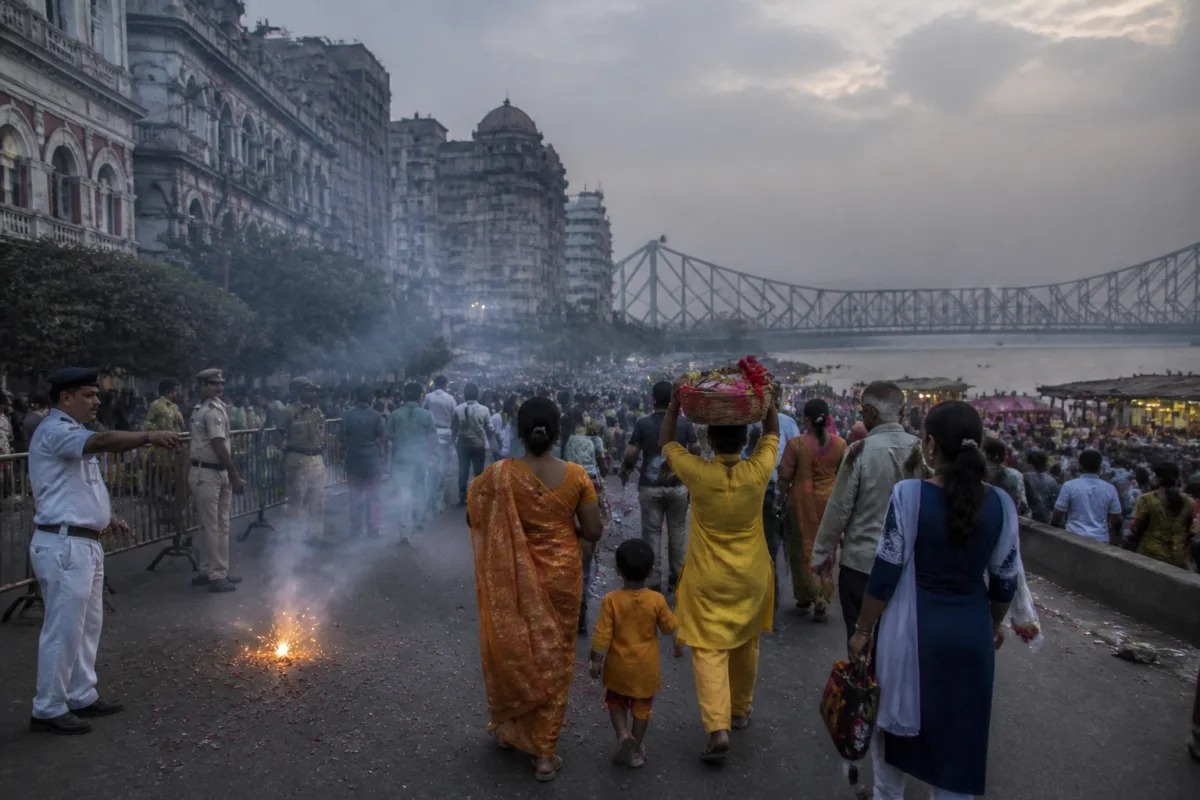
Kolkata’s air quality deteriorated to the “poor” category during early-morning Chhath celebrations on Monday after firecracker restrictions were widely violated across the city, with monitoring stations recording AQI readings above 200 by 9am.
The air quality monitoring station at Rabindra Bharati recorded an AQI of 219 at 9am, while the Victoria Memorial station recorded 212 at 9.30am, according to the West Bengal Pollution Control Board. Under the National Air Quality Index prepared by the Central Pollution Control Board, an AQI between 201 and 300 is classified as “poor”. Prolonged exposure at this level can cause breathing discomfort in most people.
The restrictions permitted green crackers only between 6am and 8am. However, loud firecrackers were reported from around 3.30am in several parts of Kolkata, including Jadavpur, Kasba, Burrabazar, Taltala, Sealdah and Bhowanipore. Firecrackers were also reported along parts of Mahatma Gandhi Road, College Street and Surya Sen Street between 4am and 6am.
Residents described disruption during the early-morning celebrations. Prabir Ghosh, a Kasba resident, said crackers began bursting around 3.30am along with loud music and drumbeats, keeping residents awake for nearly two hours. A Sovabazar resident told the newspaper that a cracker fell near his feet on Beadon Street at around 5am.
The violations were reported as thousands of devotees travelled before dawn to designated ghats and water bodies for Usha Arghya, the final ritual of the Chhath festivities, around 5.50am. Crackers were reportedly burst along routes leading to Babughat, including from the Maidan side opposite Eden Gardens, as well as on Beadon Street and Central Avenue. Similar scenes were reported on Panditiya Road.
The Kolkata Municipal Corporation and Kolkata Metropolitan Development Authority had prepared 163 sites for morning offerings along the Hooghly, stretches of the Tolly’s Nullah, existing water bodies and artificial ponds. Rabindra Sarobar and Subhas Sarobar were kept closed for Chhath celebrations. A senior KMDA official said all 12 gates of Rabindra Sarobar were sealed and that the gates were opened after 3pm.
Around 4,000 police personnel were deployed to manage traffic and crowds at ghats, water bodies and ponds. Senior Kolkata Police officers said several people had been arrested for disorderly conduct and that banned firecrackers had been seized, although exact figures were not available by Monday evening.
Green activists attributed the deterioration in air quality to the indiscriminate bursting of firecrackers during the early hours. The city’s air quality improved later in the afternoon, according to the report.

