


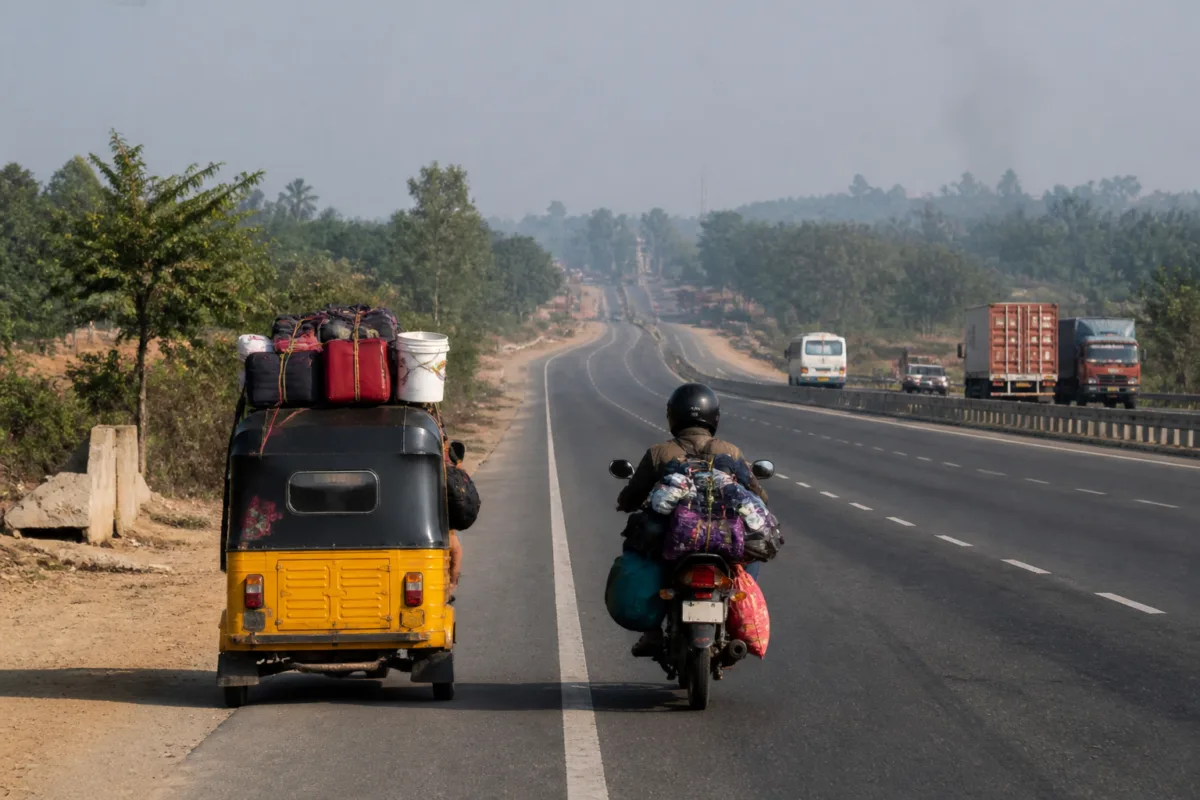
Two journeys to Bihar for Chhath Puja—one by motorcycle from Pune and another by autorickshaw from Bengaluru—show how seasonal travel demand can push migrant workers and professionals towards exhausting, risky and unconventional forms of mobility when formal transport becomes inaccessible.
Ram Ranjan Ojha, a 32-year-old IT professional from Pune, rode nearly 1,900km from Dhanori to Daltonganj in Jharkhand. Awadhesh Kumar, a 26-year-old autorickshaw driver from Bengaluru, drove approximately 2,000km to Bhanja Chhapra village near Motihari in Bihar’s East Champaran district. Their choices were not presented as leisure road trips. Both were responses to the same constraint: trains were overbooked and airfares were beyond what they considered affordable.
Ojha told the Times of India that a one-way flight was listed at Rs 20,000. After trying several trains, he calculated that riding home would cost less. He left Pune on November 6 and reached Daltonganj by noon on November 8, travelling through Chhatrapati Sambhajinagar, Akola, Amravati, Nagpur, Bhandara and Gondia, among other places. The trip cost him Rs 15,000. He said he maintained a moderate speed, avoided risky overtaking and took breaks during the journey.
Kumar’s journey involved four people sharing a three-wheeler. He, his brother-in-law Nawal and two friends left Bengaluru on November 3 and reached their destination on the morning of November 5. The route passed through Karnataka, Andhra Pradesh, parts of Telangana and Madhya Pradesh. Kumar said the group spent Rs 8,000, with all four contributing to the expenses.
The contrast between the two journeys is important. Ojha’s decision was shaped by the price of a flight and the inability to secure a suitable train. Kumar’s was shaped by three years of failing to find train tickets for the festival. Their incomes and occupations were different, but both encountered the same urban mobility problem: the transport system did not provide a practical, affordable and available connection home during a predictable period of exceptional demand.
## Seasonal demand is not an unexpected transport shock
Chhath Puja creates a large, concentrated movement of people towards Bihar and eastern India. The report does not provide a passenger count, additional train capacity or comparative fare data, so it cannot establish the scale of the travel shortfall. It does, however, document how the pressure was experienced by individual travellers: through unavailable train tickets, high airfares and journeys lasting between two and three days by road.
That distinction matters. The journeys were not caused by a sudden disaster or an isolated service disruption described in the report. They occurred around a major annual festival whose travel demand is foreseeable. When predictable peaks cannot be absorbed by rail or air services, the burden shifts to private vehicles, shared vehicles and informal decisions made by travellers themselves.
The resulting mobility is highly unequal. A passenger who cannot obtain a train ticket may have the option of paying for an expensive flight, but that option is limited by price. A person who cannot afford the flight may use a motorcycle, a commercial three-wheeler or a car if one is available. The report shows the length to which people may go when the formal network does not match their need to travel at a particular time.
## The affordability problem sits alongside the capacity problem
The reported journeys also show that transport access cannot be measured only by the existence of a route. Pune and Bengaluru are connected to Bihar by established road, rail and air networks. Yet a route is not necessarily useful if seats are unavailable, fares rise beyond household budgets or the travel timetable does not serve the relevant period.
Ojha’s calculation captures this gap clearly. His motorcycle trip cost Rs 15,000, compared with a listed one-way flight fare of Rs 20,000. The saving was not large enough to make the road journey easy: he travelled nearly 1,900km over three days. His account suggests that affordability was considered together with the emotional importance of reaching home, rather than as a simple choice between two equally convenient modes.
Kumar’s case adds another dimension. He had been trying to return home for Chhath for three years but could not find train tickets. The autorickshaw already available to him became the transport solution. Four people travelled in the three-wheeler, with the two drivers taking turns during the day and at night. The arrangement reduced the direct financial cost per person, but it also created a demanding and prolonged road journey.
The report does not establish whether the travellers faced road safety incidents, mechanical problems or other travel-related risks. Kumar said the group was stopped several times by police and Regional Transport Office officials, who allowed them to continue after they explained their purpose. Ojha said he managed the journey by avoiding risky overtaking and taking sufficient breaks. These details show that the trips required active risk management by the travellers themselves.
## Migrant cities remain connected to seasonal home journeys
Pune and Bengaluru are employment destinations for people from across India. The two travellers profiled in the report reflect different forms of urban work: Ojha is an IT professional in Pune, while Kumar has worked as an autorickshaw driver in Bengaluru for five years. Their need to return home demonstrates that urban migration does not sever links with the places where families and festivals are rooted.
This has implications for how city transport demand is understood. Daily mobility planning generally focuses on commuting within a metropolitan region. But cities also generate recurring inter-city and interstate travel, especially around festivals. For migrant workers, these journeys may be essential rather than discretionary. The pressure becomes visible when a large number of residents attempt to travel within the same limited window.
The report provides no data on temporary trains, additional bus services or other institutional arrangements for Chhath travel. It therefore cannot assess whether authorities had expanded capacity or how effective any such measures may have been. What it does show is the outcome for two travellers who did not find the available options workable.
Kumar’s account also makes the household dimension visible. He said his parents, wife and two children were delighted when he arrived. Ojha said the journey was not only about saving money but about reaching his parents, wife and brother after not seeing them for some time. The urban transport question therefore extends beyond ticket prices and travel time. It concerns whether workers living in major cities can maintain family connections during culturally significant periods.
## The missing link is coordinated, affordable inter-city mobility
The journeys from Pune and Bengaluru point to a coordination challenge involving railways, airlines, road transport and state-level travel administration. The source does not attribute a specific policy failure to any one agency, and the evidence is limited to two individual accounts. Still, the pattern raises a clear institutional question: how should transport systems respond when a known festival produces a predictable, concentrated movement between employment centres and home states?
Rail appears central to that question because both accounts refer to difficulty obtaining train tickets. Air travel was available in Ojha’s case, but the reported fare made it unattractive. Road travel remained physically possible, but the journeys required long hours, personal vehicles, shared expenses and careful driving. In effect, the system offered connectivity, but not an option that was simultaneously available, affordable and convenient for these travellers.
The cases also show why informal and private mobility can become a substitute for public transport. Kumar did not hire a separate long-distance vehicle; he used the autorickshaw with which he earned his livelihood. Ojha used his motorcycle. These choices reduced dependence on ticket availability but transferred the costs of distance, fatigue, safety and vehicle maintenance to the travellers.
Both travellers planned to return in early December, with Ojha intending to ride back on December 1. That next journey will again involve the same cities, roads and transport constraints, although the report does not say whether tickets or fares will have changed.
The evidence confirms a seasonal mobility gap rather than the scale of a national transport failure. But the gap is important because it becomes visible through journeys that are difficult to sustain as normal travel. When people undertake 1,900km motorcycle rides or 2,000km autorickshaw trips to reach a festival, the issue is not simply individual determination. It is also a measure of whether urban transport systems can accommodate the social and geographic realities of the people who live and work in India’s cities.

