


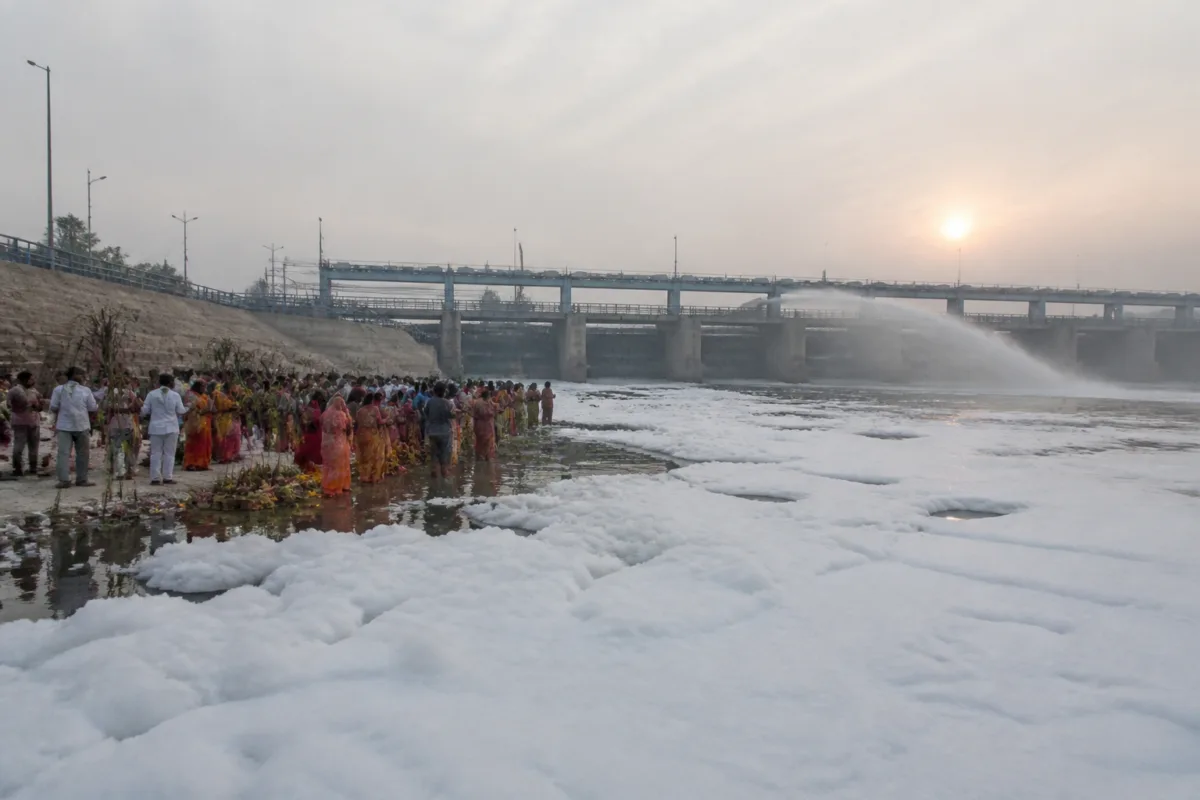
The return of thick Yamuna foam during Chhath Puja at Delhi’s Kalindi Kunj barrage has exposed the gap between managing the river’s appearance and addressing the pollution that produces it. While Delhi Jal Board and Irrigation and Flood Control Department teams sprayed chemical defoamers ahead of gatherings, the recurrence of froth has renewed questions about whether short-term suppression can substitute for sewage and waste-control measures.
The incident occurred as thousands of devotees gathered along the riverbank in southeast Delhi to offer prayers to the Sun. The white foam, a familiar seasonal feature at the stretch, overshadowed the celebrations and became the centre of a political dispute over the Yamuna’s condition. The episode also showed how river pollution becomes most visible when public access and ritual use bring citizens close to the water.
The immediate response was operational rather than restorative. Teams from the Delhi Jal Board and the Irrigation and Flood Control Department were seen spraying chemical defoaming agents over the affected section. The Delhi Jal Board routinely uses such chemicals during winter, particularly before Chhath, to suppress the visible froth when large gatherings take place along the river.
That approach addresses the surface symptom. It does not, by itself, establish that the pollutants creating the foam have been removed. Environment activist Vikas Singh, quoted in the report, said defoamers mask pollution and that the froth returns within an hour of spraying stopping. This distinction is central to understanding the incident: the river can look temporarily clearer without its underlying water quality changing in the same proportion.
The foam is attributed to a combination of pollutants, including detergents, surfactants and dissolved organic matter. The report also identifies decaying water hyacinth, leaves and other vegetation as contributors. These materials can create the conditions for frothing when they mix with polluted water, but the visible foam is not the entire pollution story. Untreated sewage, industrial discharge and domestic waste continue to affect the Yamuna, according to the report.
The available water-quality figures underline the scale of the problem. A September assessment recorded biochemical oxygen demand, or BOD, at 30 milligrams per litre at ISBT Bridge, against a stated limit of 3 milligrams per litre. Dissolved oxygen was recorded at 2.9 milligrams per litre. Together, the figures indicate a river stretch under substantial organic pollution pressure, even though they relate to a different location from the Kalindi Kunj barrage and do not constitute a complete assessment of the affected site.
BOD measures the amount of oxygen required to break down organic matter in water. A high reading means that the water contains a heavier organic load and that oxygen is being consumed in the decomposition process. Dissolved oxygen, by contrast, indicates the oxygen available in the water. The two figures reported from ISBT Bridge therefore provide a more substantive picture of water quality than the presence or absence of foam alone. They also show why treating the visible surface cannot be treated as equivalent to cleaning the river.
The political dispute following the incident reflected this difference between public claims and measurable outcomes. Delhi AAP chief Saurabh Bharadwaj accused the BJP government of failing to make adequate arrangements for Chhath and challenged Chief Minister Rekha Gupta to drink one litre of water from the affected stretch. Bharadwaj also questioned government claims about cleaning the river and raised concerns over dead fish reportedly found in the Yamuna.
The BJP responded by asking the AAP and Congress to account for their years in power. Party spokesperson Praveen Shankar Kapoor described the foam as unfortunate and alleged that neither party had established even one sewage treatment plant for cleaning the river during its tenure. Kapoor said the Rekha Gupta government had initiated sewage treatment plant projects and other measures, and that a permanent solution to the recurring foam problem would be visible by next year.
These competing claims point to an institutional problem that extends beyond one administration or one festival. The responsibility for the river is distributed across departments and agencies dealing with sewage, drainage, flood control, water supply, industrial discharge and municipal waste. A visible intervention at one barrage can be organised quickly, but a lasting reduction in pollution depends on whether waste entering the river is intercepted, treated and monitored across the system.
The distinction matters because a river is not cleaned at the point where pollution becomes most visible. Foam may gather at a barrage, but its causes can involve discharges and waste flows upstream, the composition of the water, the presence of detergents and organic matter, and the performance of sewage-treatment infrastructure. The report does not provide a complete account of the treatment capacity, operating status or discharge compliance of the relevant facilities. It therefore cannot establish whether the proposed sewage-treatment projects will deliver the permanent improvement promised by the BJP spokesperson.
The incident also exposes a weakness in festival-period river management. Deferring foam before a major gathering may reduce the immediate visual impact and help authorities manage public perception, but it does not answer whether devotees are being brought into contact with water that meets acceptable quality standards. Nor does it explain how officials communicate risks when chemical spraying is taking place near a public religious gathering. The supplied report does not state whether water-contact advisories, testing results for the Kalindi Kunj stretch or public-health instructions were issued.
For residents, the practical concern is therefore larger than the spectacle of white foam. The river’s condition affects the safety and dignity of people who use its banks, the credibility of official cleaning claims and the public cost of repeatedly deploying temporary interventions. It also creates a recurring cycle: pollution becomes visible before a major event, agencies suppress the symptom, the event passes, and the underlying questions return with the next season.
The water-quality data cited in the report make that cycle difficult to dismiss as a cosmetic or isolated problem. A BOD reading ten times the stated limit at ISBT Bridge is a signal of severe organic pollution at that measurement point. The reported dissolved oxygen level of 2.9 milligrams per litre adds another warning about the river’s capacity to support aquatic conditions. However, the figures should not be overextended: they do not establish the exact water quality at Kalindi Kunj on the day of Chhath, nor do they identify the contribution of each pollutant source.
That limitation is important for accountability. A credible clean-up assessment would need to connect visible conditions with location-specific water testing, sewage inflow data, treatment-plant performance and discharge monitoring. The supplied report records the foam, the departmental spraying and the September measurements, but it does not provide that full chain of evidence. What it does establish is that the temporary response has not prevented the recurring spectacle and that the river’s broader pollution burden remains serious.
The next test is whether the sewage-treatment plant projects and other measures cited by the government produce measurable changes rather than only seasonal relief. The BJP spokesperson said a permanent solution would be visible by next year. That makes the next reporting cycle significant: the relevant question will not simply be whether foam appears during another festival, but whether pollution indicators, sewage interception and dissolved oxygen show improvement at the affected stretches.
The Yamuna’s latest foam episode confirms a structural distinction that Delhi’s river policy must confront. Suppressing foam can change what citizens see for a few hours. Cleaning the river requires controlling what enters it, proving that treatment systems work and publishing water-quality evidence that can be checked at the locations where people gather. Until those outcomes are demonstrated, the white surface at Kalindi Kunj will remain a recurring reminder that visibility and remediation are not the same thing.

