


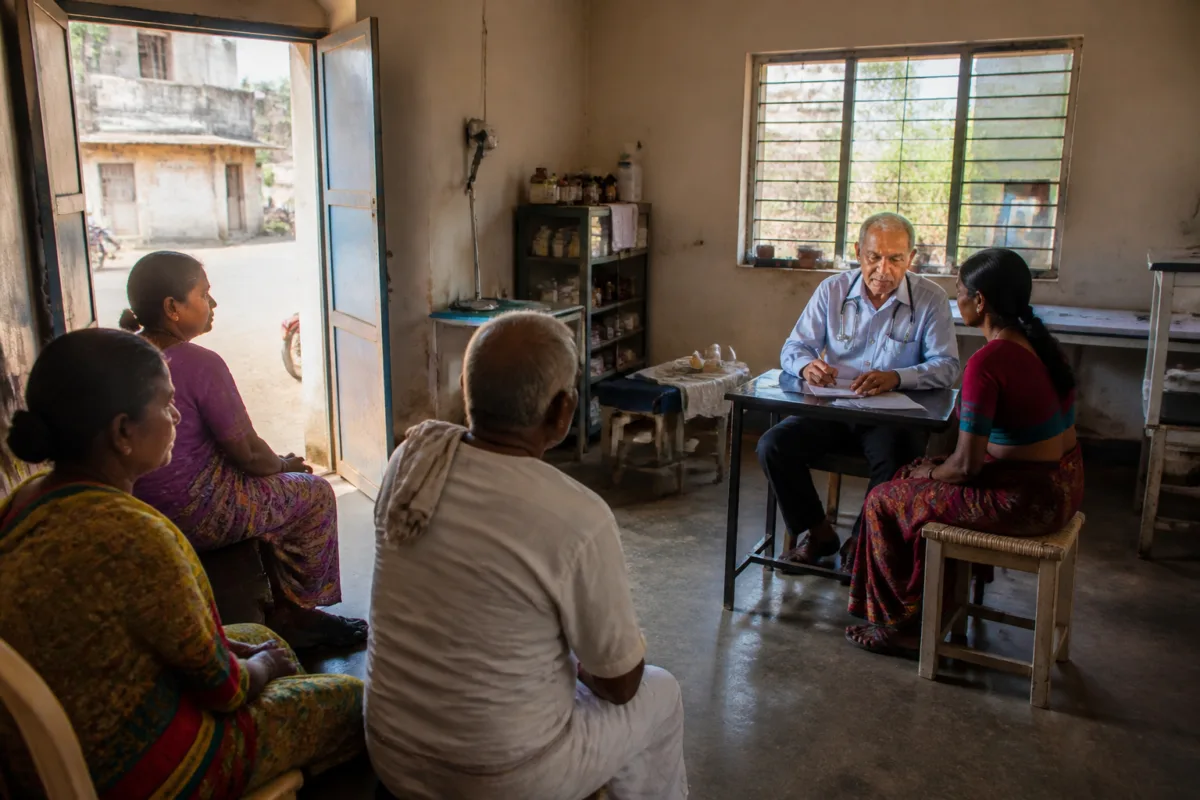
Dr B Ramana Rao’s Guinness World Records recognition is being celebrated as an individual achievement, but the 2,777 Sundays behind it also reveal a persistent feature of healthcare access in Karnataka: rural communities continue to depend on services that are often sustained by individual commitment rather than reliable institutional presence. Rao, who runs a clinic at T Begur in Nelamangala, completed 53 years and 74 days of consecutive voluntary weekly medical service on November 1, according to the Guinness World Records entry cited by Deccan Herald.
The record is based on the longest-running voluntary weekly medical service by a single doctor. Rao has examined and treated more than 33 lakh patients over the 2,777 Sundays, according to a statement from Karnataka Deputy Chief Minister G Parameshwara’s office. Parameshwara felicitated the doctor at a programme held at the rural clinic and said Rao had continued serving patients travelling from different parts of the state.
That combination of longevity, geography and patient volume makes the episode more than a ceremonial record. It offers a view of how healthcare is experienced outside major urban centres, where access is shaped not only by the availability of hospitals but also by distance, affordability, continuity and trust. The supplied account does not establish how many patients travelled from particular districts, what conditions were treated, or how the clinic was financed. It does, however, establish that patients from beyond the immediate village have repeatedly reached the facility over decades.
### A clinic as a rural access point
Rao established the clinic in a village with the stated aim of taking healthcare to rural communities. Its location matters. Nelamangala is closely connected to Bengaluru’s expanding metropolitan region, yet rural settlements in and around the corridor do not necessarily experience the same concentration of medical facilities as the city’s established urban neighbourhoods. A clinic in T Begur can therefore function as a local access point for communities that may otherwise need to travel to larger towns or Bengaluru for consultation.
The distinction between urban and rural healthcare is not simply about whether a hospital exists. It is also about the reliability of the first point of contact. A weekly service operating on a fixed day can create predictability for patients, particularly where medical expenses, transport costs and lost wages make repeated journeys difficult. The source material does not provide comparative travel times or costs, so the precise burden on patients cannot be quantified here. The record nevertheless illustrates how a consistent local service can become embedded in the routines of a large patient community.
The figure of more than 33 lakh patients over 2,777 Sundays also requires careful reading. It is an aggregate attributed to the deputy chief minister’s office, and the report does not provide a year-by-year breakdown, the number of consultations per Sunday, or the method used to count patients. It should therefore be understood as the reported cumulative reach of the service, not as a measure that can independently explain the clinic’s workload or clinical outcomes.
Even with those limitations, the duration is significant. The service has continued for more than five decades, spanning major changes in Bengaluru’s urban growth, Karnataka’s health infrastructure and the cost structure of medical care. The continuity suggests that the clinic has remained relevant to its users across generations. It also raises a difficult institutional question: when a service becomes indispensable to a community, should its survival depend primarily on one person’s willingness and ability to continue?
### The affordability question
Parameshwara used the felicitation to express concern about the growing commercialisation of healthcare. He said access to treatment was increasingly determined by a patient’s ability to pay. That statement places Rao’s voluntary service within a broader debate about the cost of medical care, although the supplied report contains no data on local consultation fees, household health spending, insurance coverage or out-of-pocket costs in Nelamangala.
The contrast is still clear at the level of principle. A voluntary clinic lowers, or may remove, one direct financial barrier to consultation. But a patient’s total cost of receiving care includes more than the consultation itself. Travel, medicines, diagnostic tests, follow-up visits and time away from work can all influence whether treatment is completed. The source does not say which of these services Rao’s clinic provides or how patients meet those additional costs. It would be inaccurate to treat the record as proof that the wider affordability problem has been solved.
Nor does the account establish whether the clinic operates alongside government primary health centres, referral hospitals or other public health facilities. That missing institutional map is important. A voluntary doctor may complement public provision by offering an accessible first consultation, but the long-term pathway for patients requiring tests, specialist treatment or hospitalisation remains unknown from the available material.
### What the record reveals about public provision
The central lesson is not that voluntary medicine can replace public healthcare. The record instead shows how gaps in formal systems can become visible through the exceptional continuity of individual services. If patients travel from different parts of Karnataka to a rural clinic, the reasons could include trust in the doctor, the cost of care, convenience, the absence of nearby alternatives or some combination of these factors. The report confirms the travel pattern in broad terms but does not identify the specific cause.
This distinction matters for governance. A public health system is designed to provide continuity through institutions, budgets, staffing and referral protocols. A personal service depends on an individual, making succession and capacity difficult to plan. Rao’s achievement demonstrates remarkable continuity, but it also exposes a form of fragility: a community’s access point may be stable only as long as a particular practitioner remains able to provide it.
The story also underlines the importance of location in healthcare planning. A village clinic can serve as essential social infrastructure even when it is not a large hospital and does not attract the same attention as major medical facilities. For residents, accessibility may be determined by whether a trusted doctor is available within a manageable journey, not by the size or technological sophistication of the nearest institution.
The source does not provide details of staffing, equipment, operating hours beyond the weekly service, clinical specialisations or referral arrangements. Those details would be necessary to assess the clinic’s role within Karnataka’s health system. They would also help distinguish between a primary consultation service and a more comprehensive medical facility. Without them, the record can demonstrate reach and continuity, but not clinical capacity or system-wide performance.
### A measure of service, not a substitute for data
The Guinness recognition supplies a precise duration: 53 years and 74 days, or 2,777 consecutive Sundays. That precision is useful for documenting the record. It does not, by itself, measure health outcomes, quality of care or the degree to which the clinic reduced avoidable travel and expenditure for patients.
Similarly, the reported total of more than 33 lakh patients indicates scale but not distribution. The figure does not show whether the same patients returned repeatedly, how many consultations occurred during each period, or whether demand increased as nearby settlements grew. These are not objections to the achievement; they are necessary distinctions when a personal record is used to understand a public system.
What the available evidence does establish is narrower and important: a rural clinic has provided a weekly voluntary service for an extraordinary period; the service has reportedly reached more than 33 lakh patients; and people from different parts of the state have travelled to it. Together, these facts point to sustained demand for accessible and affordable medical attention outside major institutional centres.
The larger urban question is how rapidly growing metropolitan regions can prevent healthcare access from becoming more unequal as development spreads beyond municipal boundaries. Nelamangala’s connection to Bengaluru makes the issue especially relevant to the wider metropolitan system. Urban expansion can bring roads, housing and commercial activity without ensuring that everyday social infrastructure keeps pace. The supplied report does not assess that expansion or its effect on healthcare demand, but Rao’s clinic provides a human-scale example of why access cannot be measured only by the presence of major hospitals in a city.
Dr B Ramana Rao’s record therefore deserves recognition on two levels. It documents an exceptional individual commitment, and it provides a prompt to examine the institutional conditions that made such a service valuable for so many years. The facts currently available confirm the duration and reported reach of the clinic, while leaving unanswered questions about patient profiles, referrals, financing, clinical services and the public facilities around it. Those questions will determine whether the story remains a celebration of service or becomes a fuller account of how Karnataka’s rural and metropolitan healthcare networks actually function.

