


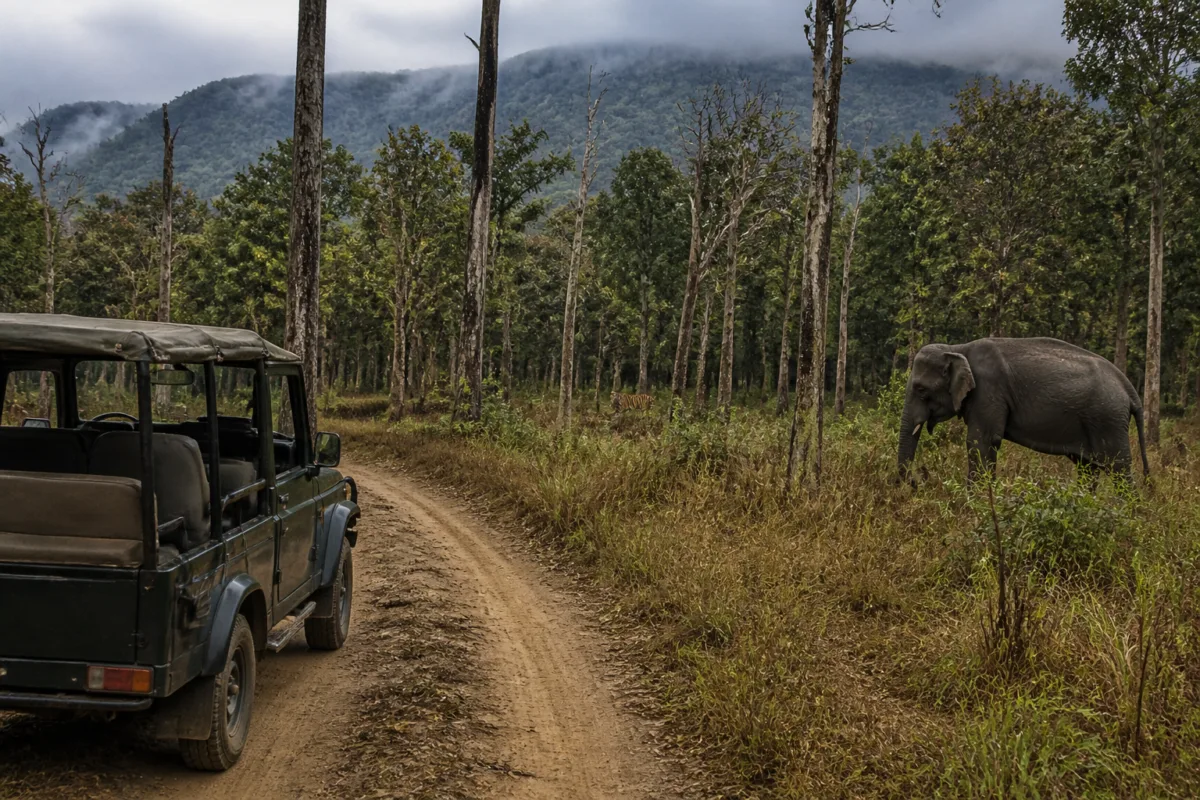
A reported incident involving Tamil Nadu Social Justice Minister Vanniyarasu inside the Mudumalai forest landscape has renewed questions about whether forest rules are applied consistently to ministers, officials and other visitors. The report, published by Dinamalar, alleges that the minister got out of a vehicle during a forest safari and moved towards wildlife, including a tiger and an elephant, before sharing a video of the episode on social media.
The incident is reported to have taken place during a government function in Mudumalai on the 10th. Dinamalar said the minister participated in the event in the Nilgiris district and later went on a safari in the forest area. According to the report, a video posted as a reel showed conduct that local environmental and social activists described as a violation of forest safety norms. The report did not include an official response from the minister, the Tamil Nadu Forest Department or the state government.
That absence of an official account is important. The available report establishes that a video was circulated and that several local voices criticised the conduct shown in it. It does not establish whether a formal complaint was filed, whether forest officials opened an inquiry, whether any notice was issued or whether any provision of wildlife law was invoked. These are the administrative steps that would determine whether the episode remains a public controversy or becomes an enforcement matter.
The broader issue is not simply the behaviour of one visitor in a forest. It is the way access is managed when the visitor is a minister or senior official. Dinamalar quoted nature activist Sivasubramaniam of Gudalur as saying that ministers and senior officials visiting the Nilgiris sometimes pressure forest officials to take them into protected areas around Mudumalai and Masinagudi. The report did not provide records or specific examples to substantiate that broader allegation, but it places the current controversy within a recurring concern raised by local observers: whether VIP presence can weaken ordinary operating protocols.
Protected forests depend on rules that reduce disturbance and prevent dangerous proximity between people and animals. In the account carried by Dinamalar, the reported decision to leave the vehicle and follow or chase wildlife is the central concern. Former forest ranger Ganesan, quoted from Pandalur, said local residents were aware of forest rules and criticised the reported conduct by a public representative. He also questioned whether forest officials present during the visit failed to intervene.
That question goes to institutional responsibility. A forest rule is effective only when visitors are informed about it, officials are empowered to enforce it and violations receive a consistent response. Dinamalar quoted Nilgiris Documentation Centre representative Dharmalingam Venugopal of Kotagiri as saying that visitors, including ministers and VIPs, should not get out of vehicles inside Mudumalai and that forest officials should explain the rules before such visits. His account presents the issue as one of both individual conduct and administrative preparation.
The report also highlights the safety dimension. Activist Amsa of Pandalur said it was unclear whether the reported conduct reflected the minister’s lack of awareness or negligence by forest officials. She added that the outcome could have been different if an elephant or tiger had attacked the minister. This is not a prediction about what would have happened; it is an argument for treating wildlife proximity as a public-safety issue rather than merely a matter of etiquette or online controversy.
The video’s circulation changes the governance question as well. Dinamalar quoted environmental activist Belliappan of Manjoor as saying that the minister’s Instagram post made the reported conduct more visible and was itself inappropriate. Another activist, Sajeevan of Aruvankadu, said that conduct by a minister could influence how members of the public view the practice of disturbing wildlife. The report attributes these concerns to the activists; it does not provide evidence that visitors have already copied the behaviour.
The concern about imitation, however, points to a difficult feature of contemporary forest management. A private breach of a rule can remain limited to one location. A public video can turn the same behaviour into a model of what appears permissible. That is especially significant when the person shown is a minister and when the video is presented through a social media format designed for rapid circulation. The administrative response therefore has two parts: determining what happened and communicating clearly what conduct is prohibited.
Dinamalar’s report calls for restrictions on visits by ministers and officials who travel to the Nilgiris for inspections or government programmes. The available material does not specify what new restrictions the state government is considering, whether such a policy already exists, or how VIP movement is currently authorised in Mudumalai and Masinagudi. It also does not provide details of the applicable permit process, the number of officials involved in the visit or the exact location where the video was recorded.
Those gaps matter because accountability depends on documentation. An inquiry would need to establish the route taken, the identities and responsibilities of the accompanying officials, the instructions provided before the visit, the conduct visible in the video and the applicable forest regulations. It would also need to determine whether the reported actions caused disturbance to animals or created a direct safety risk. Without those details, the public debate can identify a serious concern but cannot settle the legal or administrative question.
The report contains no numerical data on wildlife encounters, tourist violations, forest patrols, permits or enforcement actions in the Mudumalai landscape. It therefore cannot support a conclusion about whether violations are increasing or whether VIP visits are more problematic than ordinary tourist activity. What it does show is a conflict between the symbolic role of a public representative and the operational requirements of a protected forest: the person expected to model compliance is alleged to have acted in a way that activists consider incompatible with it.
This is also a question of institutional hierarchy. Forest officials may be responsible for enforcing rules on the ground, but their ability to do so can depend on the status of the visitor and the authority of the visit. If officials are expected to brief every visitor and intervene when safety rules are breached, those duties must apply during ministerial and official tours as well as during public safaris. If the rules differ for official visits, that distinction should be documented and publicly understood rather than left to informal discretion.
The state government’s response will determine the next stage of the matter. Dinamalar quoted activists calling for an investigation by Chief Minister M.K. Stalin, action under wildlife protection law and directions to senior officials. At the time of publication, the report did not say that such an investigation had been ordered or that any legal action had been initiated. It also did not record an apology or explanation from the minister.
The evidence currently available confirms a reported video, a reported forest visit and criticism from named local activists and a retired forest ranger. It does not yet establish the final legal status of the incident or the official account of what occurred. The developments that deserve monitoring are therefore concrete: whether the video is examined by the Forest Department, whether officials issue a factual account, whether an inquiry or notice follows, and whether the government introduces clearer protocols for ministerial and VIP visits to protected forest areas. The larger lesson is straightforward: forest rules retain credibility only when access, safety and enforcement are governed by the same standards for everyone.

