


India’s fossil fuel import bill could fall by Rs 9.6 lakh crore a year by FY2035 if the country accelerates electrification across transport, buildings, industry and agriculture, according to a new study by research firm Climate Compatible Futures. The projection is not simply an energy-sector promise. It is a test of whether India’s cities, power networks, public transport systems, buildings and industrial clusters can be reorganised quickly enough to replace imported fuels with reliable electricity and other domestic energy sources.
The report, titled Decoupling from Fossil Fuel Imports: An Accelerated Electrification Scenario for India, estimates that annual fossil fuel imports could cost Rs 7.4 lakh crore by FY2035 under its accelerated pathway, compared with Rs 17 lakh crore projected under the current trajectory. The resulting annual saving would be more than Rs 9.6 lakh crore. By FY2045, the study projects that direct fossil fuel imports could fall to zero, against an estimated annual import expenditure of Rs 23.3 lakh crore under a business-as-usual scenario.
These are scenario-based projections rather than guaranteed outcomes. The report uses FY2025 fuel prices for its import expenditure estimates and says the pathway depends on technology adoption, affordable finance, dependable electricity supply and the availability of sustainable bioenergy feedstock. Its central argument is that electrification must extend beyond renewable power generation and change how energy is consumed across the economy.
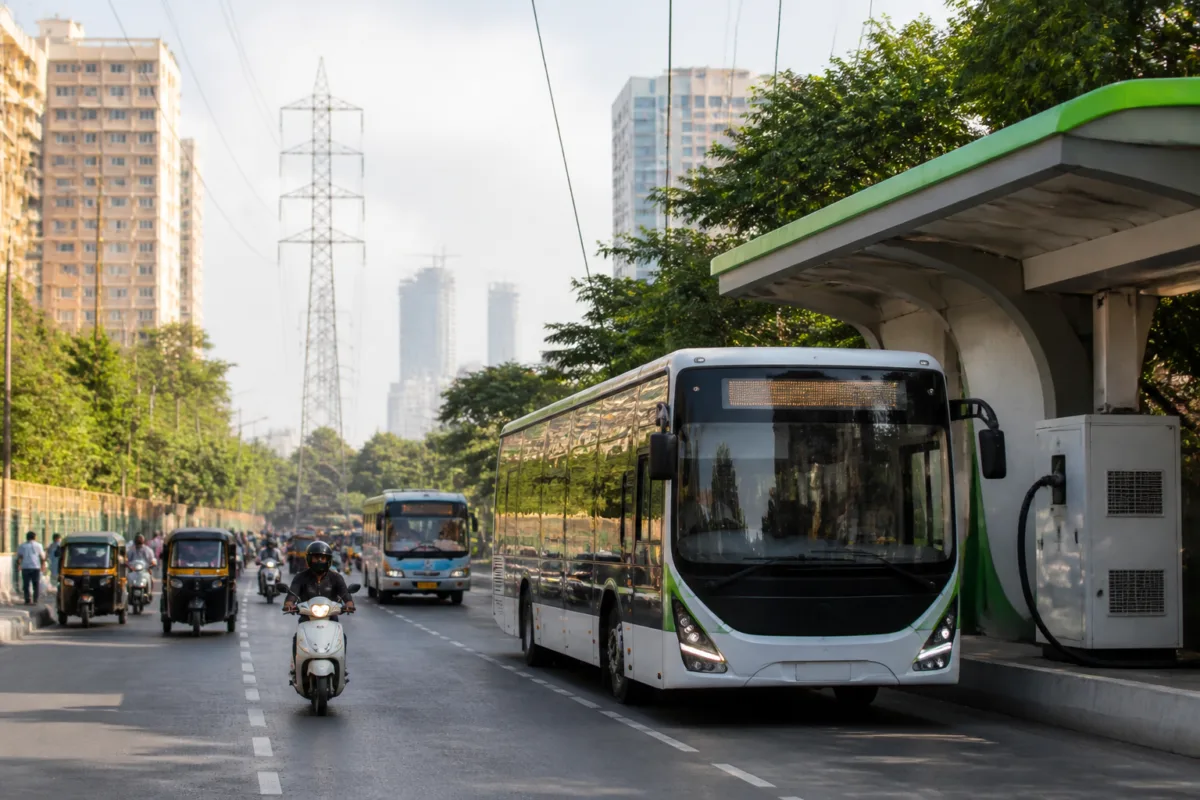
That distinction matters for urban India. The largest near-term opportunity identified by the study is transport, a sector that connects household budgets, public infrastructure, logistics and the country’s exposure to crude oil prices. The report estimates that 45% of transport fuel demand could shift away from fossil fuels by FY2035 through electric two-wheelers, three-wheelers, buses, cars, urban fleets and delivery vehicles. By FY2045, that shift could reach 93%, with electricity, green hydrogen and bioenergy replacing much of the petroleum currently used.
The urban implications are particularly significant because the transition is not limited to private electric cars. Two-wheelers, three-wheelers, buses, delivery vehicles and urban fleets are all included in the proposed shift. These modes serve a much wider section of the population and are closely connected to public transport operations, last-mile mobility, commercial activity and municipal service delivery. However, the report does not provide a city-by-city implementation plan or identify the investment required for charging infrastructure, fleet replacement or grid upgrades in individual urban regions.
The residential and commercial sectors are another important part of the pathway. Climate Compatible Futures estimates that 44% of fuel demand in these sectors could move away from fossil fuels by FY2035. The proposed pathway envisages phasing out LPG and natural gas in homes and commercial establishments by FY2045 through electric cooking, appliances and efficient cooling systems.
This would make electricity reliability and affordability central to the transition. Replacing a gas connection or LPG cylinder with electric equipment changes not only the source of energy but also the infrastructure required inside buildings and across distribution networks. The study identifies efficient cooling systems and electric appliances as part of the transition, but it does not establish how the costs would be distributed among households, commercial establishments, utilities or public programmes.
The report also links electrification to sectors that are often treated separately from urban policy. Agriculture could shift 47% of its fuel demand away from fossil fuels by FY2035 through electric irrigation pumps, farm machinery and dependable rural electricity supply. Industry could shift 28% of its fuel demand by FY2035 and 61% by FY2045 through electric boilers, heat pumps and furnaces, as well as green hydrogen for steel and chemical manufacturing.
For micro, small and medium enterprises, the study recommends concessional finance and cluster-based technical support to manage the cost of switching technologies. That recommendation points to an institutional challenge: electrification is not only a question of installing renewable generation. It requires financing mechanisms, technical capacity, equipment supply chains and coordinated planning for industrial areas where multiple firms may need to upgrade simultaneously.
The scale of the power requirement is the clearest constraint in the report. Total energy demand under the accelerated pathway is projected to reach 15,785 billion units by FY2045, compared with 13,059 billion units under the business-as-usual scenario. The difference is partly explained by the additional 2,726 billion units required to produce green hydrogen.
Electricity’s share of total energy demand could rise from 29% currently to 54% by FY2035 and 76% by FY2045. Direct electricity, green hydrogen and bioenergy together could displace about 87% of the fossil fuel demand projected under the business-as-usual scenario by FY2045. These figures show why the transition cannot be delivered through vehicle sales or household appliance changes alone. It would require generation, transmission, distribution and storage to expand in parallel.
India already has elements of the proposed system. The report notes that 99.6% of the broad-gauge railway network has been electrified, electric vehicles accounted for 13.11% of vehicle sales in September 2026, and non-fossil sources accounted for more than half of installed power capacity. Climate Compatible Futures director Dr Manish Ram said India was already electrifying and that the key question was whether it could do so fast enough to alter import dependence.
The report’s immediate trigger is India’s exposure to external energy and currency shocks. It cites shipping constraints through the Strait of Hormuz since February 2026, which pushed Brent crude prices above $100 a barrel. India’s crude import bill rose 48% year-on-year during April-August, while the rupee depreciated nearly 8% during 2026 to a record low of 96.90 against the dollar. The country spent $174.9 billion on crude oil and petroleum products in FY2026, accounting for about 22% of its total import bill, according to the report.
This context turns electrification into a question of economic resilience as well as emissions. Imported fuel costs expose households, businesses, public transport agencies and industrial users to movements in international prices, shipping routes and currency values. The study argues that electrification can address this exposure at its source, but the savings depend on whether the electricity replacing fossil fuels is available, affordable and supported by adequate infrastructure.
The proposed policy response is a national, sector-specific electrification roadmap with FY2035 and FY2045 milestones. It calls for faster electric vehicle adoption, dedicated industrial electrification programmes and advance planning for renewable generation, transmission and storage. The report also identifies sustainable aviation fuel and alternative fuels for segments such as aviation and shipping that are difficult to electrify directly.
The zero-import scenario therefore has an important qualification. It would not mean the end of fossil fuel consumption. Industrial coal and some aviation and shipping fuels, together accounting for less than 8% of projected energy demand, would continue to be used but would be met through domestic production, according to the report. The distinction separates direct import dependence from total fossil fuel use and prevents the headline projection from being read as a complete transition away from fossil fuels.
For cities, the larger question is whether electrification can be integrated into ordinary planning and service delivery. Transport agencies would need to manage fleet transitions, distribution companies would need to plan for new demand, building systems would need to support electric appliances and cooling, and industrial clusters would need access to finance and technical assistance. The supplied study establishes the scale and direction of the proposed shift, but it does not settle how responsibilities, costs and timelines would be divided among national agencies, state governments, municipalities, utilities, businesses and households.
The evidence confirms that India’s import exposure is large enough to make electrification an urban infrastructure issue rather than a narrow climate policy. It also shows that the accelerated pathway requires more electricity than business as usual, not less energy overall. Whether the projected savings materialise will depend on the milestones proposed by the study: technology adoption, affordable finance, reliable power, expanded networks, storage, sector-specific programmes and sustainable fuel supply. Those implementation questions will determine whether electrification becomes a structural reduction in import dependence or remains a set of disconnected transitions across transport, buildings, industry and agriculture.

