


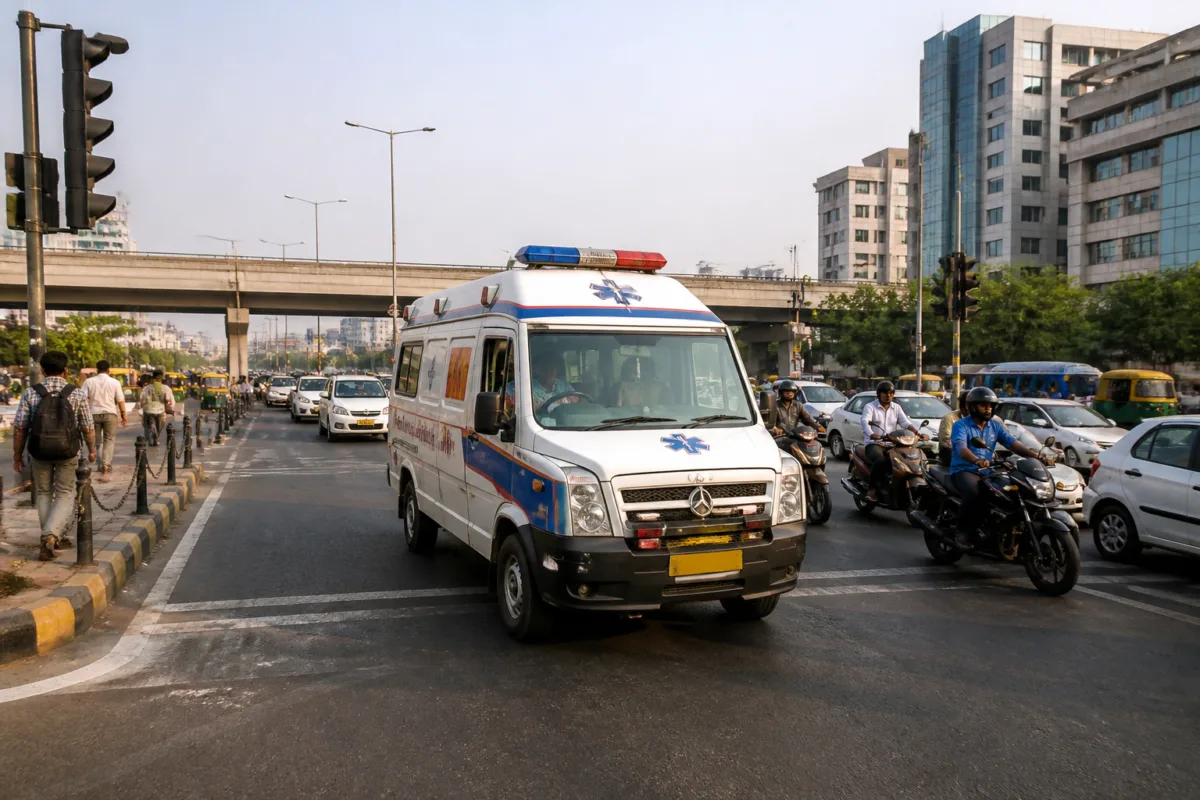
Ahmedabad’s road accidents are no longer just a question of individual driving behaviour. EMRI 108 recorded 29,971 road accident emergency calls from Ahmedabad district between January 1 and November 12, 2026—an average of about 95 calls a day, with an ambulance dispatched roughly every 15 minutes. The figures place Ahmedabad at the centre of Gujarat’s road-safety challenge and reveal how crash risk, emergency response and long-term household hardship are connected.
The numbers are part of a wider pattern. EMRI 108 services responded to 1.99 lakh road accident calls across Gujarat during the same period, with Ahmedabad district accounting for about 15% of the total. That makes the district’s road-safety burden significantly larger than a collection of isolated incidents. It also shows why an urban road-safety strategy cannot stop at policing traffic violations or responding after a collision. The system extends from road design and speed management to ambulance access, trauma treatment, rehabilitation and income security.
The available data also suggests that risk is geographically concentrated, although the locations must be interpreted carefully. Five of Ahmedabad city’s top 10 accident-related ambulance dispatch locations are on or around SG Highway. Bodakdev recorded 556 calls, followed by Bopal with 505, Gota with 490, Vaishnodevi Circle with 476 and IIM Crossroads with 466.
These figures do not represent exact crash sites. EMRI officials told the Times of India that the locations indicate where ambulances were dispatched to attend an accident. Each ambulance in an urban area typically serves a radius of 2 km to 5 km. A dispatch cluster therefore captures both the location of emergencies and the geography of emergency coverage. It can include crashes on nearby roads, incidents reported from busy junctions and calls routed through a particular response area.
That distinction matters for planning. Treating every dispatch point as a precise crash location could lead authorities to focus narrowly on individual junctions while overlooking the wider road network feeding them. At the same time, repeated dispatches around the same areas provide a useful signal for closer examination of road geometry, traffic speeds, pedestrian movement, junction design, lighting, access management and enforcement.
The pattern is not fixed. In 2025, Prahladnagar recorded the highest number of road traffic accidents in the data cited by the report. In 2026, Bodakdev occupied that position. Vaishnodevi Circle entered the top five in place of Bopal, while IIM Crossroads replaced Navrangpura. The changes indicate that road risk moves with traffic flows, development and the enforcement environment rather than remaining permanently tied to a single black spot.
This is an important institutional challenge. A road can become more dangerous as surrounding development intensifies, as new commercial activity changes travel patterns or as a corridor absorbs traffic beyond what its junctions and pedestrian facilities can safely handle. The data supplied in the report does not establish which of these factors caused the changes in Ahmedabad. It does, however, show why crash monitoring must be continuous and why last year’s priority locations cannot automatically be treated as this year’s complete safety map.
The road-safety response described by experts rests on what has traditionally been called the three Es: engineering, education and enforcement. Engineering covers the physical design of roads and junctions. Education concerns road-user awareness and behaviour. Enforcement addresses compliance with speed limits, signalling, lane discipline and other traffic rules. The report adds a fourth E—emergency response—because survival after a crash depends on how quickly victims are located, transported and treated.
The fourth element changes how the city must measure road safety. A reduction in fatalities cannot be separated from the performance of the emergency system, while ambulance demand alone cannot reveal whether roads are becoming safer or whether more people are being reached after crashes. The 29,971 calls show the scale of emergency need, but they do not by themselves provide a complete measure of crashes, injuries or deaths. They are a record of calls received and ambulance responses, with the geographic limitations identified by EMRI officials.
The data also exposes the limits of viewing road accidents only through the lens of traffic management. The report cites NCRB’s Accidental Deaths and Suicides in India data as identifying over-speeding as the dominant cause of deaths in cities such as Ahmedabad. Experts quoted in the report argue that prevention and survival depend on several systems working together. That distinction is central to urban governance: a crash may involve a driver’s speed, but the severity of its consequences can also be shaped by road design, the protection available to vulnerable users, enforcement and the time taken to reach definitive medical care.
Hospitals see the consequences that ambulance statistics cannot fully capture. Dr Sanjay Shah, a trauma specialist at Apollo Hospital, described a recent case involving a young victim whose heart and lungs were affected and who required several weeks to stabilise. He said a majority of victims are young or in the earning age, adding that long-term health conditions affect their future potential.
This is where a road collision becomes a housing, livelihood and public-health issue. A severely injured person may require specialised treatment, extended care and support after discharge. The report notes that families can face loss of a loved one, life-altering injuries, disabilities, medical expenses and loss of income. These costs are not visible in the count of emergency calls, but they determine how a household experiences the event long after the ambulance leaves.
The burden is particularly significant when victims are in their earning years. A serious injury can affect not only the victim’s mobility and health but also the household’s ability to pay for treatment, rent, education and everyday needs. The supplied material does not quantify these costs or establish how many families are pushed into financial distress. It does establish that doctors and road-safety experts see the consequences as extending well beyond the crash scene.
The annual World Day of Remembrance for Road Traffic Victims brings this wider impact into focus. Observed globally on the third Sunday of November, it recognises victims and their families. The 2026 theme cited in the report—“Remember. Support. Act”—also draws attention to responders who handle emergencies every day. For Ahmedabad, the observance provides a frame for examining both prevention and the support systems that follow injury.
The administrative question is how this evidence is converted into coordinated action. Ambulance data sits with the emergency-response system. Crash records, traffic enforcement and road engineering fall across different authorities and departments. Hospitals hold information on trauma severity and treatment. Families experience the combined outcome, but no single number in the report brings these systems together.
A citywide road-safety programme therefore needs to distinguish between three related but different measures: where emergency calls originate, where crashes occur and where serious injuries or deaths result. The report explicitly cautions that ambulance locations are not exact crash sites. Without that distinction, authorities may misdirect engineering interventions or fail to identify the routes and junctions that generate risk.
The changing top-five locations reinforce the need for regular review. Bodakdev’s position in 2026 does not mean that Prahladnagar has ceased to require attention. Similarly, the appearance of Vaishnodevi Circle and IIM Crossroads in the latest list indicates that a static list of black spots may not match the way Ahmedabad’s traffic and development patterns are evolving.
What the evidence confirms is a large and geographically concentrated emergency burden, with Ahmedabad accounting for about 15% of Gujarat’s road accident calls in the period cited. It also confirms that the burden carries consequences beyond traffic disruption: trauma, disability, medical costs and lost earning capacity. What remains unresolved in the supplied data is the precise relationship between ambulance dispatch points and crash sites, the contribution of specific road-design features, and the number of calls that resulted in severe injury or death.
Those gaps determine the next level of urban analysis. Ahmedabad’s road-safety system will need to connect emergency-response records with verified crash locations, injury outcomes, traffic movement and enforcement data. Until then, the ambulance figures provide a strong warning but not a complete diagnosis: the city’s safety challenge is distributed across roads, institutions, hospitals and households.

