


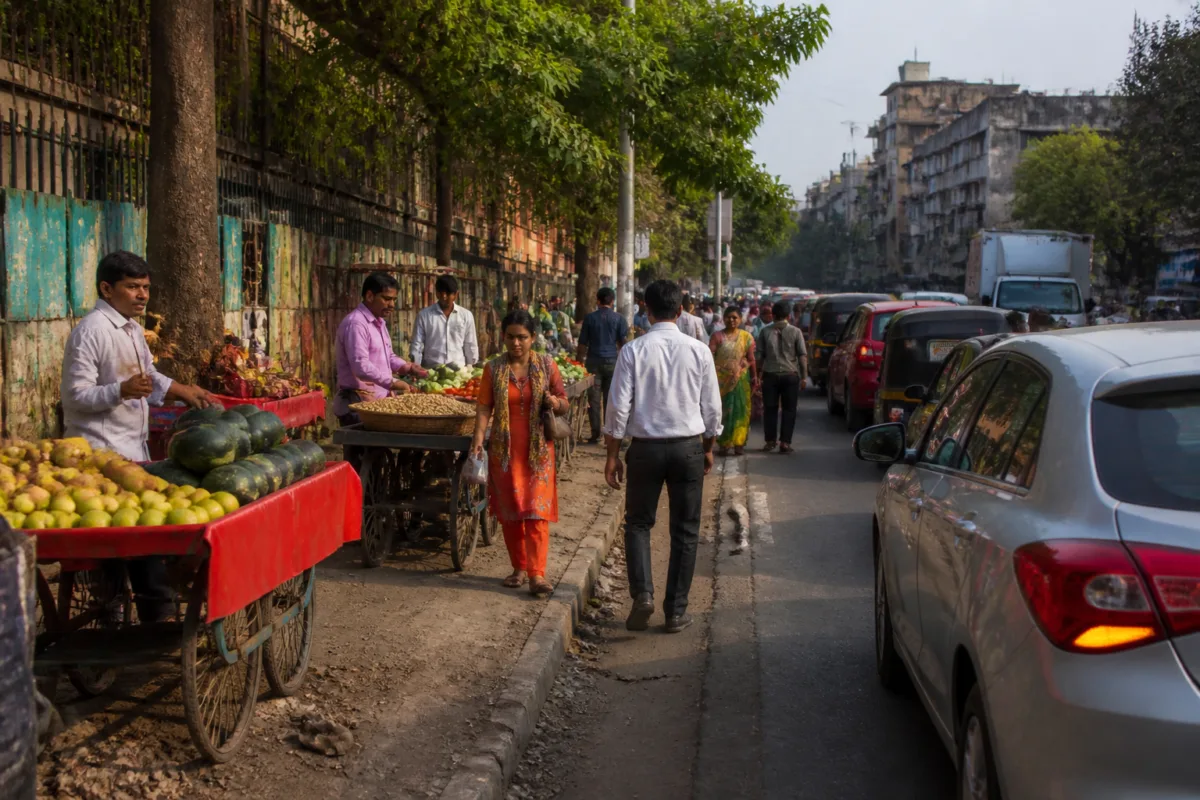
Pune’s decision to register criminal offences against five roadside vendors in Kothrud and Yerawada is not only an enforcement action. It also exposes a persistent gap in the city’s street-vending system: the civic administration is acting against obstruction on footpaths and public roads while the number of designated vending zones remains far below the demand recorded by vendors.
The Pune Municipal Corporation and Pune police said the action targeted unlicensed handcart operators accused of obstructing pedestrian movement and disrupting traffic flow. A senior PMC official said the purpose of the crackdown was to reclaim public spaces and protect commuter safety. The action followed public announcements through traditional and social media platforms asking vendors not to occupy footpaths and to comply with street-vending rules.
That sequence matters because the city’s street-vending problem is not simply a question of whether an individual vendor occupies a particular stretch of footpath. It is also a question of whether the urban administration has created a workable system in which vending can take place without blocking pedestrians, compromising traffic movement or eliminating a source of livelihood.
The report indicates that PMC routinely takes action against unauthorised vendors through fines and confiscation of materials. Somnath Bankar, head of the PMC’s anti-encroachment department, said criminal offences are registered against repeat offenders. The latest cases in Kothrud and Yerawada therefore represent the more punitive end of an enforcement process that also includes public notices, penalties and seizure of equipment.
The immediate public interest is clear. Footpaths are among the city’s most basic pieces of transport infrastructure. When they are occupied by handcarts, merchandise or other obstructions, pedestrians may be forced onto carriageways, increasing conflict with moving vehicles. The PMC’s stated justification is that such obstruction affects both pedestrian movement and traffic flow.
Citizens cited in the report have welcomed action against footpath encroachment, but they have also called for dedicated areas where vendors can operate. Samir Paranjape, a resident of Dhayari, pointed to the problem in busy shopping areas such as FC Road, JM Road and Pune’s peth areas. His position captures the two-sided nature of the issue: residents want unobstructed public space, while the continued presence of vendors indicates demand for low-cost, accessible retail and services in well-used parts of the city.
The Street Vendors (Protection of Livelihood and Regulation of Street Vending) Act, 2014, provides the legal framework within which this conflict is meant to be managed. According to the supplied report, the legislation seeks to protect the livelihood rights and social security of urban street vendors while regulating where and how vending takes place. Eligible vendors can obtain certificates of vending and operate in designated areas.
The Act also allows urban local bodies to classify areas according to the intensity and conditions of vending. Restriction-free vending zones can permit vending without the same limitations applied elsewhere. Restricted vending zones may allow vending on a time-sharing basis, while strict no-vending zones can prohibit it altogether. This framework is significant because it does not treat every public space in the same way. It expects local bodies to distinguish between places where vending can be accommodated, places where it can be managed with conditions, and places where it cannot be allowed.
The available numbers suggest that Pune’s main difficulty is not the absence of a legal framework, but the limited translation of that framework into space on the ground. PMC officials estimate that the city has around 22,000 authorised hawkers. At the same time, the civic body received 38,000 applications when it began a survey around five years ago. The difference between those figures indicates that the demand for formal recognition or regulated vending was substantially larger than the number of vendors ultimately identified as authorised.
The gap is even more visible in the number of vending zones. The administration finalised 525 zones, while hawkers sought 1,900. On the figures supplied, the approved number was only about 28% of the number sought. The report does not establish why the remaining zones were not created, whether the 1,900 locations were assessed under the statutory process, or how many vendors can be accommodated within the 525 zones. Those unanswered questions are central to understanding whether enforcement is being matched by viable relocation options.
The law’s planning benchmark adds another dimension. The report says vending plans can accommodate up to 2.5% of a ward’s or city’s total population. This provision is intended to ensure that vending is considered as part of urban planning rather than treated only as an anti-encroachment issue. However, the supplied material does not provide Pune’s ward-wise population figures, the city’s approved vending-plan capacity or the number of vendors covered by each zone. Without that information, it is not possible to assess whether the city’s 525 zones are adequate under the plan or merely an administrative allocation below actual demand.
The enforcement process also has a financial and legal threshold. Vending without a certificate or violating the conditions of a Certificate of Vending, including expanding beyond the allotted space, can attract a fine of up to Rs 2,000, according to a senior PMC official. The local self-governing body can increase the penalty. The report does not specify the offences registered against the five vendors, the exact provisions invoked, whether they held certificates of vending or the stage reached in the criminal proceedings. Those details would determine how the latest action fits within the Act’s distinction between regulated vending and unauthorised obstruction.
This distinction is important for municipal administration. A footpath can be legally required to remain clear even when a vendor has a legitimate livelihood claim. Conversely, a vendor’s presence cannot be made compliant simply through repeated removal if the administration has not completed the process of identifying, notifying and servicing suitable vending areas. The legal framework therefore places responsibilities on both sides: vendors must follow the conditions attached to vending, while the urban local body must create and manage a plan capable of accommodating legitimate vending activity.
Pune’s figures also show why a purely episodic enforcement model is unlikely to settle the issue. Public announcements may communicate restrictions, and confiscation may remove a cart from a particular location, but neither action answers where vendors should operate next. If the authorised population is approximately 22,000 and the city has only 525 designated zones, the practical question is the capacity of each zone, not just the number of zones on paper. The supplied report does not state whether zones are distributed according to pedestrian demand, market activity, public transport access or ward-level population.
The locations named in the report point to a broader planning challenge. Kothrud and Yerawada have different urban contexts, but both are affected by the competition for limited public space. The report also identifies FC Road, JM Road and the peth areas as places where footpath pressure is particularly visible because they are popular shopping destinations. These are precisely the kinds of places where vendor activity, pedestrian movement, retail demand and traffic management converge. Removing vendors from such areas without explaining the replacement arrangement may address an immediate obstruction while leaving the economic and spatial demand unchanged.
The available evidence does not establish whether Pune’s 525 vending zones are operational, evenly distributed, accessible to the vendors surveyed or equipped with basic services. It also does not state how many repeat offenders have been booked previously, how many vendors have received certificates or how many criminal cases have resulted in prosecution. These are not minor administrative details. They would show whether the city is dealing with a small number of repeat violations or a structural shortage of compliant locations.
The latest action therefore needs to be read through two institutional lenses. The anti-encroachment department is responsible for protecting public access and enforcing restrictions. The street-vending framework, meanwhile, requires a planning and certification process that recognises vending as part of the urban economy. The conflict becomes sharper when the enforcement arm is visible and immediate, while the planning side is measured through incomplete surveys, limited zones or slow implementation.
For pedestrians, the desired outcome is a continuous and usable footpath. For vendors, it is a recognised place to work without repeated seizure, fines or criminal action. For the civic body, the challenge is to make those objectives compatible through location-specific rules, capacity planning and consistent enforcement. The supplied report confirms that Pune has acted against five vendors and has publicly stated the safety and traffic reasons for doing so. It also confirms that the city’s formal vending capacity remains well below the number of zones sought by hawkers.
What remains unclear is whether the current enforcement drive is part of an expanded vending plan or another cycle of removal and reappearance. The next developments to monitor are the handling of the five cases, the status of the city’s vending survey and certificates, and whether PMC increases or revises the 525 designated zones. Until those questions are answered, Pune’s footpath dispute will remain both an enforcement problem and a planning gap.

