


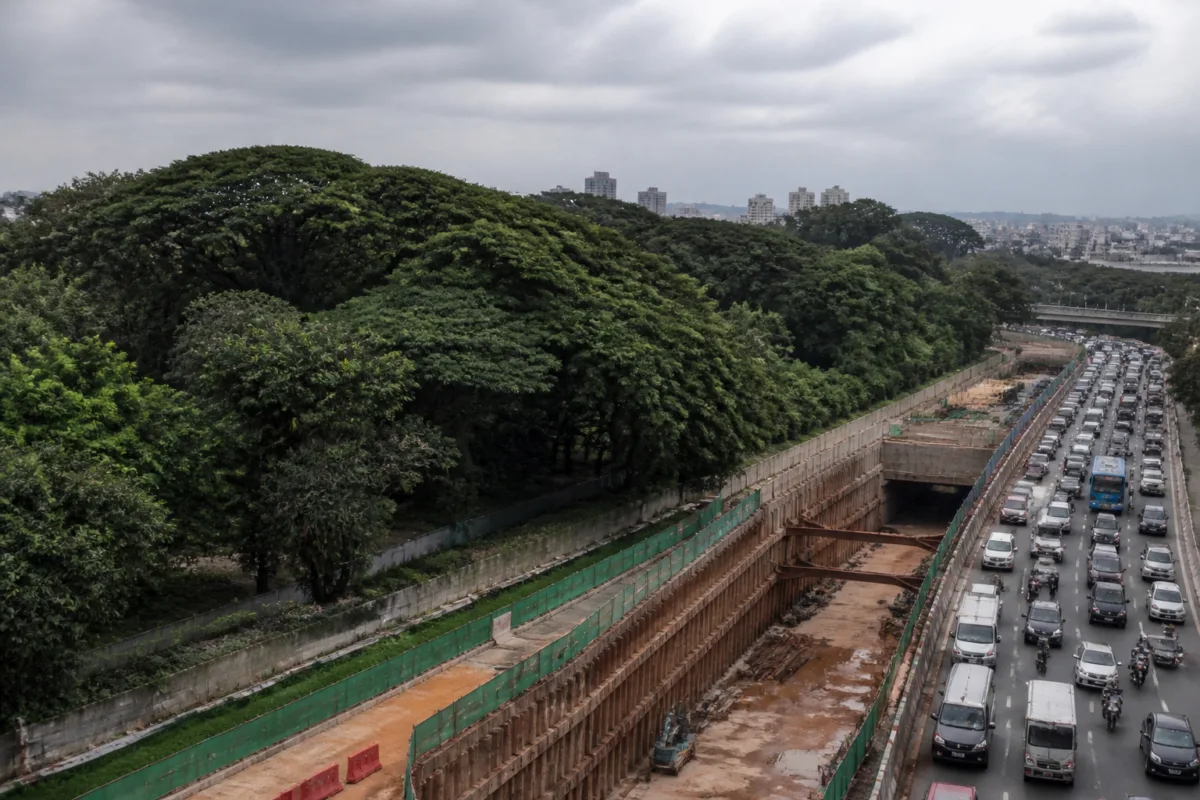
The proposed 2.22-km Hebbal short tunnel project has brought Bengaluru’s infrastructure expansion into direct conflict with one of north Bengaluru’s important ecological networks. A rapid environmental impact assessment by researchers from Azim Premji University found that 1,128 trees across 92 species could be affected, while raising doubts about whether transplantation would preserve the ecological functions provided by mature trees.
The assessment was prepared by Harini Nagendra, Seema Mundoli, Prachi Gupta and Vivek G after a field assessment on October 21, 2026. The researchers verified the tree inventory published by the Greater Bengaluru Authority (GBA), giving the proposed removal a level of ecological detail that is often missing from transport project debates. The inventory is not simply a count of trees to be cleared. It describes the age, species mix and habitat value of vegetation located around Gandhi Krishi Vigyana Kendra, the University of Agricultural Sciences and Hebbal Lake.
That distinction matters because urban trees perform functions that cannot be replaced immediately by planting new saplings. The assessment identifies mature banyans, figs and rain trees among the trees at risk. Rain trees, of which 30 were listed, provide extensive canopy cover and help mitigate the urban heat island effect. Their value is therefore linked not only to their presence but also to their size, canopy spread and location within a connected landscape.
The largest number of trees in the inventory belong to species such as paper mulberry, with 173 trees, followed by pongam with 67, Madras thorn with 63, gulmohar with 57, yellow copperpod with 45 and rain trees with 30. These figures show that the affected landscape is not a uniform plantation. It contains a range of species with different ecological characteristics, including trees that offer shade, habitat and connectivity for urban wildlife.
The proposed response from the Bangalore Development Authority (BDA), which is executing the project, is that most of the 1,128 trees would be transplanted. The researchers’ concern is that transplantation is not an equivalent substitute for retaining mature trees in place. They point to severe lopping during the process, which can reduce trees to a fraction of their existing size and diminish the ecological benefits they provide. The survival of transplanted trees is also uncertain, according to the assessment.
This is the central planning issue raised by the Hebbal project. A tree-removal decision can appear administratively manageable when the question is framed as whether individual trees will be replanted or transplanted. It becomes more complex when the assessment considers canopy, species composition, bird habitat and the relationship between several green spaces. The report presents the affected area as a functioning ecological network rather than a series of isolated roadside trees.
The network includes green spaces around Gandhi Krishi Vigyana Kendra, the University of Agricultural Sciences and Hebbal Lake. The assessment records 199 bird species in the vicinity, including the Vulnerable greater spotted eagle and the Near Threatened spot-billed pelican. It also notes the presence of Indian peafowl and the Indian roller. These records indicate that the landscape has significance beyond its visual contribution to the city. It provides habitat within a rapidly urbanising part of Bengaluru.
The bird records also help explain why the project’s impact cannot be assessed only through the number of trees directly marked for removal. Habitats depend on a combination of vegetation, water bodies, open areas and movement corridors. The relationship between the university and agricultural campus landscapes and Hebbal Lake means that the loss of mature trees could affect a broader ecological system than the project footprint alone suggests. The supplied assessment does not quantify the extent of that possible disruption, but it identifies the network as an important ecological asset.
The GBA has received more than 1,500 objections to the proposed tree removal. That response reflects a public dispute over how the project’s benefits and costs should be measured. The tunnel is a transport intervention, while the objections and the university assessment place the focus on climate, biodiversity and public environmental value. The institutional question is therefore not only whether the project can be built, but how its approval process accounts for infrastructure need alongside ecological loss.
The project is being advanced by the BDA, while the tree inventory was published by the GBA and permission to remove the trees has been sought from the relevant authority. This division of responsibilities is important. It means that project execution, urban administration and tree-removal permissions are connected but not necessarily located within one institution. For residents, the practical outcome depends on how those bodies evaluate the inventory, the objections and the proposed transplantation plan.
The evidence in the assessment also highlights a limitation in treating transplantation as a numerical exchange. If 1,128 trees are removed and a similar number is replanted elsewhere, the figures may appear balanced, but the ecological result can still be different. A transplanted tree may be smaller, may not survive or may no longer occupy the same position within a connected habitat. The researchers’ concerns about lopping and uncertain survival underline the difference between replacing a tree as an object and retaining its urban function.
That function is particularly relevant to Bengaluru’s heat and air-quality challenges. The assessment says further loss of mature trees could worsen rising temperatures, pollution and biodiversity loss. It does not provide a quantified estimate of the additional heat or pollution associated with the project, so the scale of those effects remains unestablished in the supplied material. What it does establish is that the trees form part of an existing canopy and habitat system, and that removing them could reduce the system’s current capacity.
The numbers make the planning trade-off visible. The project length is 2.22 km. The affected inventory covers 1,128 trees and 92 species. The surrounding area has recorded 199 bird species, including two conservation-significant species identified in the assessment. More than 1,500 objections have been submitted. Each number represents a different dimension of the decision: infrastructure scale, vegetation loss, biodiversity value and public response.
The concentration of several mature and canopy-forming species is also significant. Rain trees account for only 30 of the listed trees, but the assessment specifically identifies their broad canopy and role in moderating the urban heat island effect. This demonstrates why simple species counts can obscure ecological importance. A less abundant species may have a larger contribution to shade or habitat than a more numerous but smaller tree population.
For Bengaluru, the Hebbal case reflects a recurring challenge in urban infrastructure planning: projects are often evaluated through their transport or construction outputs, while the environmental systems they disturb are assessed separately. The supplied report does not establish whether alternative alignments or designs were examined, nor does it quantify the tunnel’s expected mobility benefits. It therefore cannot resolve whether the proposed ecological cost is proportionate to the project’s transport value. It does, however, identify the information that should remain central to the decision.
The immediate issue is how the authorities will respond to the verified inventory, the university researchers’ findings and the public objections. The BDA has sought permission to remove the trees and has stated that most would be transplanted. The assessment challenges the assumption that this measure can preserve the existing ecological benefits. Any final decision will therefore need to distinguish between transplantation commitments, actual survival and the retention of mature canopy and habitat connectivity.
The Hebbal project shows that urban greenery is not merely an amenity surrounding infrastructure. In this part of Bengaluru, the trees are part of a linked landscape associated with educational and agricultural institutions, a lake and a documented bird habitat. The evidence confirms the scale of the proposed intervention and the ecological value at stake. What remains unresolved is how the authorities will weigh those findings against the tunnel proposal and what conditions, if any, will govern tree removal and transplantation.

