


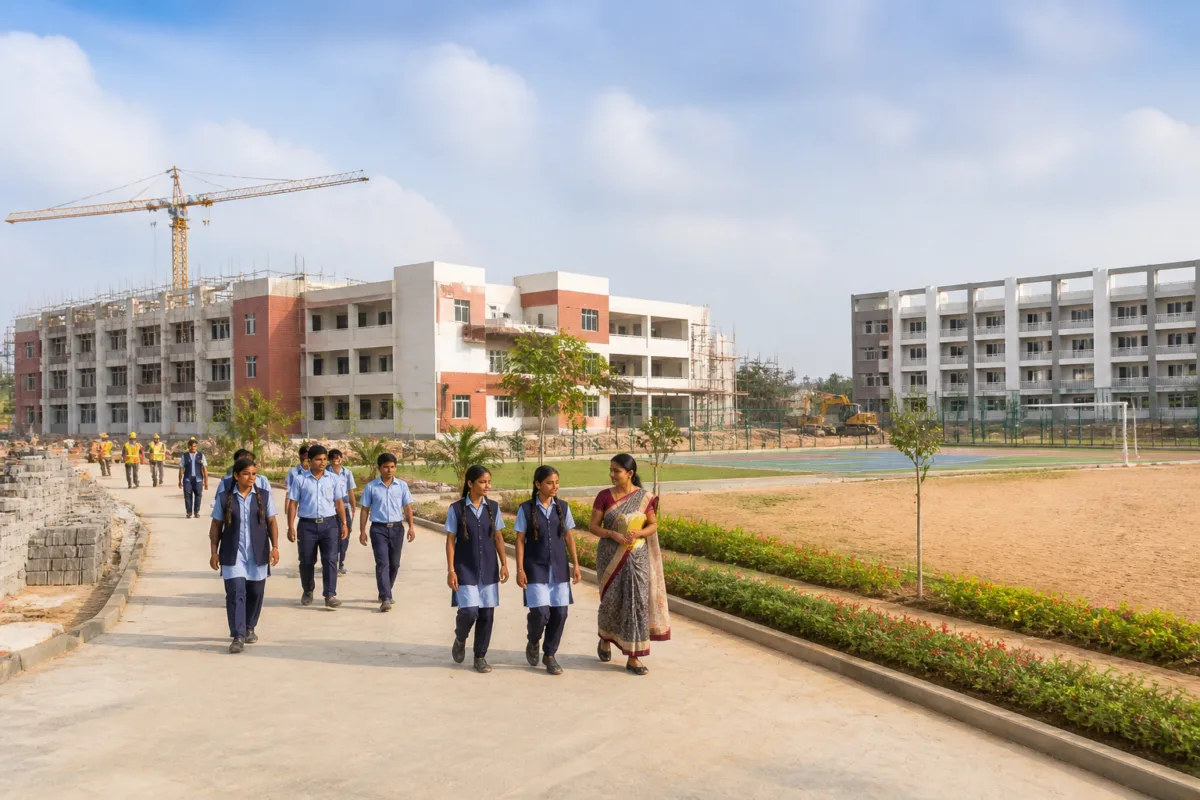
Telangana has approved 105 Young India Integrated Residential Schools as part of a public education expansion plan that will combine classrooms, accommodation, sports and co-curricular facilities, Deputy Chief Minister Mallu Bhatti Vikramarka said at an education conference in Hyderabad on Sunday.
Speaking at the School Teachers Federation conference, Bhatti said each school would be developed on 20–25 acres at an estimated cost of ₹200 crore. The institutions are planned to provide education and residential facilities to children from different communities, with the stated aim of promoting equality and improving access to quality schooling.
The announcement places school construction and public education capacity at the centre of the Telangana government’s education agenda. Bhatti said the government wanted the state’s youth to compete with students from other states and developed countries, and described education as a route to social transformation.
He also said around 100 Telangana Public Schools would follow a semi-residential model. These schools would provide transport, uniforms, textbooks, breakfast and lunch, while allowing students to return home in the evening. The model is intended to reduce the daily financial and logistical burden on families without requiring children to stay on campus.
The Deputy Chief Minister said the government was already serving breakfast to about 27 lakh students through centralised kitchens. He added that diet charges in residential schools had been increased by 40 per cent and cosmetic charges by 200 per cent. The measures are designed to support students’ nutrition and basic requirements alongside formal classroom education.
Bhatti linked children’s development to conditions beyond school, including the home environment, nutritious food, family income and social background. He urged teachers to help students and parents understand welfare schemes and ensure that eligible households receive government benefits. He cited Indiramma Indlu housing assistance, free electricity, fine rice and pensions as measures that could reduce household pressures affecting children’s education.
The address also covered staffing and administration in the public education system. Bhatti said thousands of teachers had received promotions, about 11,000 posts had been filled and transfers had been given to nearly 35,000 teachers. He urged teachers to understand the social circumstances of students and act as guides for families and communities.
The conference was attended by STF president Devarakonda Saidulu, general secretary Pochayya, former MLA Kichanna Lakshmi Reddy and Professor Vishweshwar Rao. The government’s next implementation milestones for the 105 integrated residential schools, including site selection, construction schedules and operational timelines, were not specified in the address.

