


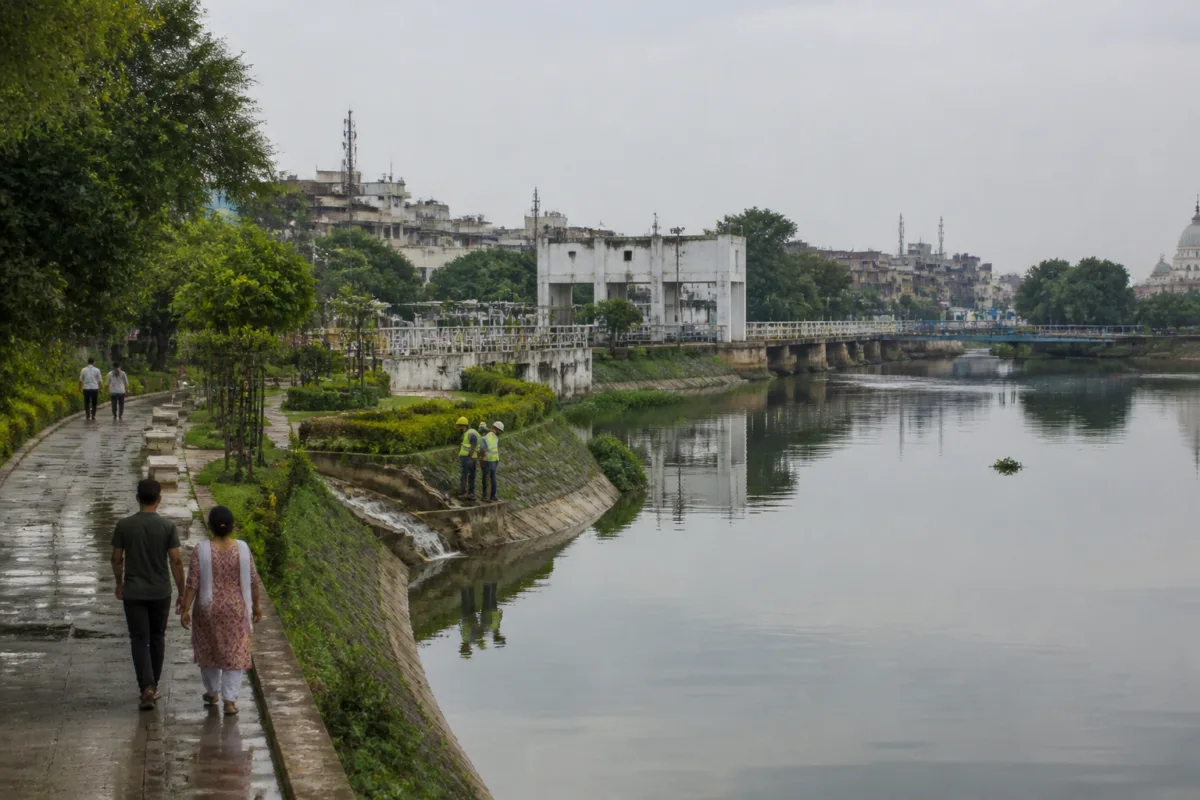
At the Gomti Utsav-2026 in Lucknow, Uttar Pradesh Chief Minister Yogi Adityanath framed the Gomti’s cleanliness and uninterrupted flow as a shared civic responsibility, while setting the river’s conservation message against the city’s unfinished task of intercepting sewage and drains. The address linked a cultural festival with a practical urban question: whether public celebration along a river can be matched by the infrastructure required to keep that river clean.
The Chief Minister said the Gomti is the “soul of Lucknow” and called for the festival to be held on the riverbank with a pledge to protect its purity. He also said work connected with river conservation had been targeted for completion by December, that new sewage treatment plants were being built and that most of them had already been completed. According to the report, drains and sewers discharging into the river are being tapped and diverted to sewage treatment plants.
These statements place sewage interception at the centre of the Gomti conservation effort. A river-cleaning programme is not defined only by the construction of treatment plants. It also depends on whether the city can identify outfalls, connect them to the sewer network, ensure that sewage reaches the treatment facilities and maintain those systems after construction. The supplied report does not provide the number, capacity or location of the new treatment plants, nor does it state how many drains have been successfully diverted. Those details will determine the difference between a public pledge and a measurable reduction in pollution entering the river.
The Chief Minister’s remarks therefore combine two different forms of river governance. One is physical and administrative: building sewage treatment plants, tapping drains and preventing untreated wastewater from reaching the Gomti. The other is behavioural: reducing single-use plastic, carrying reusable bags and avoiding the disposal of plastic near temples, rivers and other public places. Both appear in the government’s messaging, but they operate through different institutions and enforcement mechanisms.
Sewage management requires coordination between municipal agencies, sewerage authorities, contractors and treatment-plant operators. Plastic reduction depends on vendors, households, visitors, event organisers and local enforcement. The address did not specify the implementing agencies, project costs, treatment capacities or monitoring arrangements. As a result, the speech establishes the stated direction of policy but not yet the full administrative pathway through which residents can assess progress.
The focus on single-use plastic also reflects the way pollution moves through an urban system. The Chief Minister said plastic harms the environment, health and safety, can injure cattle and other domestic animals when eaten, and can obstruct river flows and contaminate water after reaching drains and rivers. He asked residents to carry bags from home or use disposable alternatives when shopping. These remarks identify a visible source of waste, but the report does not provide figures for plastic consumption, collection, enforcement action or the volume of waste reaching the Gomti.
That absence matters because public campaigns often make pollution a question of individual behaviour, while river pollution is also produced by gaps in urban service delivery. Residents may be urged not to discard waste into drains, but the city must also provide reliable collection, prevent litter from entering storm-water channels and manage waste generated by large public gatherings. Similarly, a pledge to protect the river’s purity requires functioning sewer connections and treatment systems, not only public awareness.
The timing and location of the address are significant. Gomti Utsav was held at the Central Sanskrit University campus in Gomti Nagar, and the event included an exhibition, cultural participation and the presentation of Gomti Gaurav honours to individuals associated with public, cultural and social work. The festival was presented as an opportunity for families and communities to come together, while local food, handicrafts, folk art and traditions were also promoted.
This gives the event an urban-development dimension beyond river symbolism. Public festivals can bring attention to a city’s waterways and create a platform for local producers, performers and artisans. The Chief Minister said local food and products should become part of the festival and that people involved in folk art, handicrafts and Gomti conservation should be recognised. Such programming can help make the river a civic and cultural space, but its environmental credibility depends on whether the event itself follows the standards it advocates, including waste segregation, plastic reduction and responsible use of the riverbank.
The speech also connected the Gomti festival with Ayodhya’s Deepotsav. The Chief Minister said the Ayodhya event had grown in scale and visibility and expressed confidence that it could eventually receive recognition from UNESCO if it continued to expand while retaining public faith and local traditions. The report does not indicate that UNESCO has granted or formally promised such recognition. The statement was presented as an expectation linked to the event’s future development, not as an existing status.
The comparison shows how the state government is using festivals as instruments of cultural visibility and local economic promotion. In the case of the Gomti Utsav, however, the river is not merely a backdrop. It is also the object of a public environmental commitment. That creates a higher standard for the event’s organisers and the agencies responsible for the river. A festival celebrating the Gomti can draw attention to the waterway, but it cannot substitute for pollution monitoring, sewer connectivity and operational treatment capacity.
The Chief Minister’s reference to a December deadline provides a possible administrative milestone. Yet the supplied report does not clarify whether the deadline concerns construction, commissioning, sewer interception, drain tapping or the completion of all related river-conservation works. These distinctions are important. A treatment plant that has been constructed but is not connected to the relevant drains does not deliver the same outcome as a fully operational system. Similarly, a tapped drain requires continued operation and maintenance to prevent untreated flows from returning to the river.
The report also does not establish the current condition of the Gomti in Lucknow, the number of untreated outfalls that remain, or the extent to which the new infrastructure has improved water quality. Without those indicators, residents cannot yet measure the effect of the announced work. Future public reporting would be stronger if it disclosed project-wise progress, treatment capacity, operational status, sewage volumes received, remaining untreated flows and water-quality results at identifiable locations.
The institutional question is therefore central. River conservation in a large city is rarely the responsibility of one department. It involves land use along the river, sewage and storm-water networks, solid-waste management, public-space design, enforcement and the maintenance of infrastructure. The Chief Minister’s appeal to residents and the festival committee broadens responsibility to society, but the government remains responsible for defining roles, publishing milestones and demonstrating that the infrastructure is working.
The Gomti Utsav address also reflects a familiar tension in urban environmental governance. Rivers are frequently treated as cultural assets during festivals and as drainage channels during everyday city operations. The supplied report presents the government’s intention to narrow that gap through new treatment plants and drain interception. Whether that intention produces a cleaner and more continuous river will depend on delivery after the speeches, including the completion of the promised works and their sustained operation.
What the address confirms is a policy emphasis on sewage treatment, drain tapping, plastic reduction and the use of public festivals to build support for river conservation. What it does not yet establish is the scale of the infrastructure, its operating performance or the measurable change in the Gomti’s condition. The December target, the status of the new sewage treatment plants and the eventual evidence from water-quality and outfall monitoring are the developments that will show whether Lucknow’s cultural commitment to the river has become an effective urban conservation programme.

