


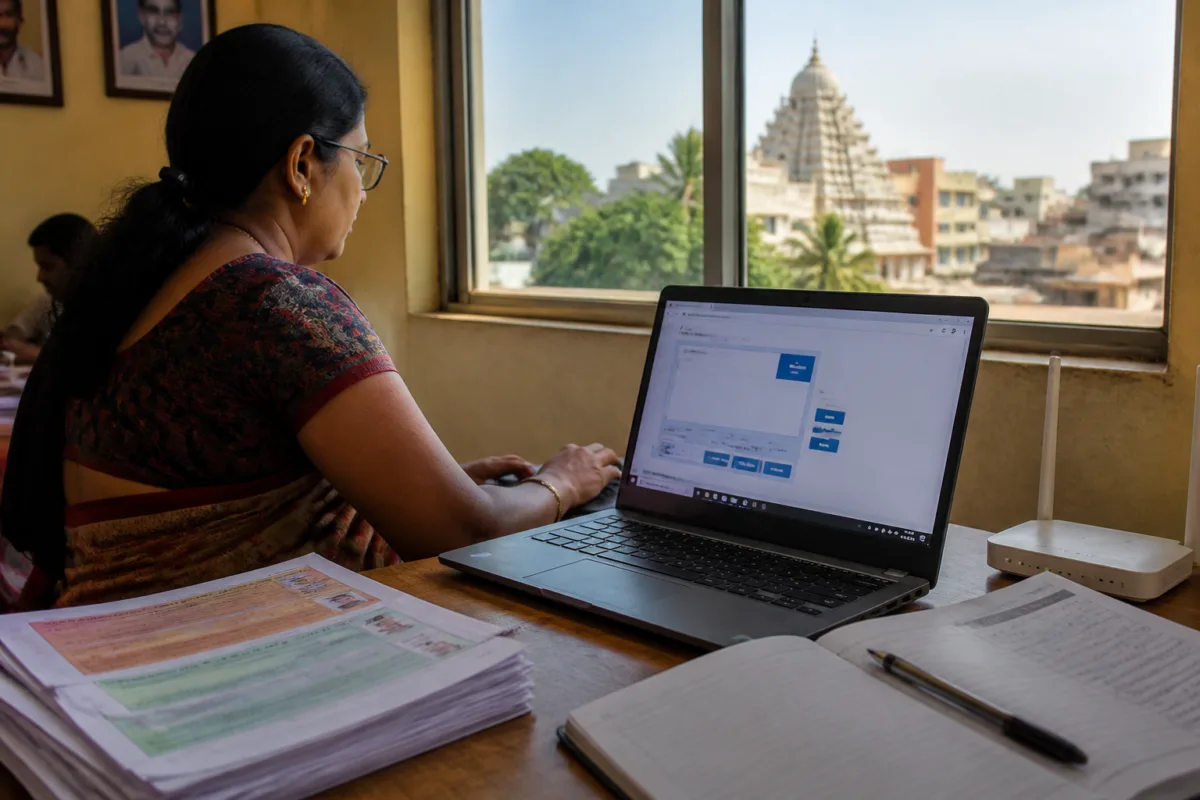
The release of OdiaSLM, a suite of small artificial-intelligence models developed in Bhubaneswar, points to a different path for regional-language technology: one built around local data, modest hardware and offline use rather than dependence on very large global systems. Its significance extends beyond the technology itself because the models are designed for schools, citizen-service centres, farmers, offices and journalists that may not have reliable internet access or expensive computing infrastructure.
The suite was developed by Odisha-based AI researcher and entrepreneur Arun Misra and includes two foundational models, OdiaSLM-60M-Base and OdiaSLM-100M-Base, along with OdiaSLM-100M-Instruct, a conversational model. According to Misra, the models were trained from scratch on more than 1.5 billion words of Odia text. The work was published on Zenodo on November 12, while the models have been released as open-source resources for academic research, students, educators and non-commercial initiatives.
That approach addresses a weakness in the way regional languages are often handled by mainstream artificial-intelligence systems. Misra said global models are primarily designed around the English alphabet and can break words from scripts such as Odia into small fragments. In his account, this affects speed, cost and grammatical accuracy, and can contribute to hallucinations, in which an AI system generates false information.
The problem is not simply one of translation. A translation-based system may allow a user to ask a question in one language and receive an answer in another, but it does not necessarily understand how words are formed, written or used in the source language. OdiaSLM’s development instead focuses on a custom vocabulary system intended to recognise how Odia words and matras fit together. Misra said this allows the models to read and generate Odia text 3.6 times faster and more efficiently than global multilingual models.
The technical design matters because computing capacity is also an access question. The conversational model is reported to weigh just over 200 megabytes and run on an everyday laptop CPU. It does not require an active internet connection or an expensive supercomputer. This creates a practical distinction between an AI system that is technically available and one that can actually be deployed in a classroom, office or service centre with limited connectivity and hardware.
For urban and rural public institutions, offline operation changes the nature of deployment. A school does not need to maintain a continuous internet connection for the system to work. A citizen-service centre can process or summarise documents locally rather than sending all information to an external cloud service. An office handling sensitive material can use the model without transferring that data outside its own device or network. These are possibilities identified by Misra, not evidence that such deployments have already taken place.
The proposed use cases also show why regional-language AI belongs within the conversation about public infrastructure. Digital public services are often assessed through portals, connectivity and backend systems, but the interface between residents and the state is equally important. If information is available only in a language that residents do not use comfortably, the existence of a digital service does not guarantee meaningful access. A local-language assistant could help bridge that gap by answering questions, summarising documents or drafting content in a language used by the intended community.
Misra specifically identified rural schools as potential users, with the model functioning as an Odia tutor in classrooms without internet connectivity. He also cited agriculture and healthcare information for farmers, document summarisation for local offices, and content support for journalists. These use cases cover different institutional needs, but they share one requirement: the system must work on basic hardware and remain usable when connectivity is weak or absent.
The models have also been trained on Odisha-specific cultural references, including the Konark Sun Temple, the Jagannath Rath Yatra, Chilika Lake and the cultural significance of Pakhala, alongside science, health and general knowledge. This local orientation is important because language systems do not operate only through grammar. Their usefulness depends on whether they can recognise the places, practices and references that shape everyday communication in a region.
At the same time, cultural familiarity should not be confused with guaranteed accuracy. The supplied report does not provide an independent technical evaluation, user-performance study or formal audit of the model’s responses. Claims about speed, efficiency and the accuracy of local knowledge are attributed to Misra. The available material also does not establish how the models perform across different dialects, specialised subjects, changing public information or sensitive health and agriculture queries.
That limitation is central to understanding the open-source decision. Making the three models available to researchers, students, educators and non-commercial initiatives can allow wider testing and adaptation. It can also distribute responsibility for improvement across an emerging ecosystem rather than concentrating development within one company or institution. However, the report does not specify the licence terms in detail, the governance process for contributions, or the safeguards for correcting inaccurate or harmful outputs.
The choice to build small models also raises an institutional question about the scale of AI infrastructure. The dominant public narrative often equates capability with larger models, bigger datasets and more powerful computing systems. OdiaSLM presents a narrower but potentially more deployable model: a system designed for one language, trained on a large corpus in that language, and intended to operate on a laptop CPU. Its value is therefore measured not only by benchmark performance but also by affordability, speed, privacy and the ability to function outside high-connectivity environments.
For Odisha’s cities, this could be relevant to the less visible layer of digital administration. Municipal offices, public information desks and service centres regularly handle forms, notices, applications and citizen queries. A local-language tool capable of summarising or drafting documents could reduce some barriers between administrative systems and residents. But the supplied evidence describes intended applications rather than a government adoption programme. No state department, municipal authority or public institution is identified as having formally deployed OdiaSLM.
The same distinction applies to education. An offline AI tutor may be useful where internet access is inconsistent, but its effectiveness would depend on curriculum alignment, teacher supervision, device availability and the quality of its answers. None of those implementation conditions is detailed in the report. The release establishes that the models are available and designed for such uses; it does not establish the scale, cost or outcomes of deployment.
The project’s wider importance lies in the relationship between language and digital sovereignty. Misra described Odia as a classical language spoken by more than 45 million people and argued that its long-term vitality in the digital era depends on having its own AI infrastructure. The statement frames language technology as more than a convenience. If digital tools are built primarily around a few dominant languages, speakers of other languages may remain dependent on translation layers, poorly adapted interfaces or systems that do not understand local context.
OdiaSLM does not by itself resolve that structural problem. A model suite must still be maintained, tested and integrated into real services. It must also keep pace with new terminology, public information and changing patterns of language use. Yet the release demonstrates a model of development that puts language-specific design, local training data and offline access at the centre of the system.
The evidence currently confirms three things: the models were developed from scratch for Odia, they were trained on more than 1.5 billion words of Odia text, and they have been released as open-source resources for specified non-commercial and educational uses. It does not yet confirm large-scale adoption, independent performance results or formal public-sector partnerships. Those will be the important indicators of whether a promising regional-language technology project becomes durable digital infrastructure for Odisha.

