


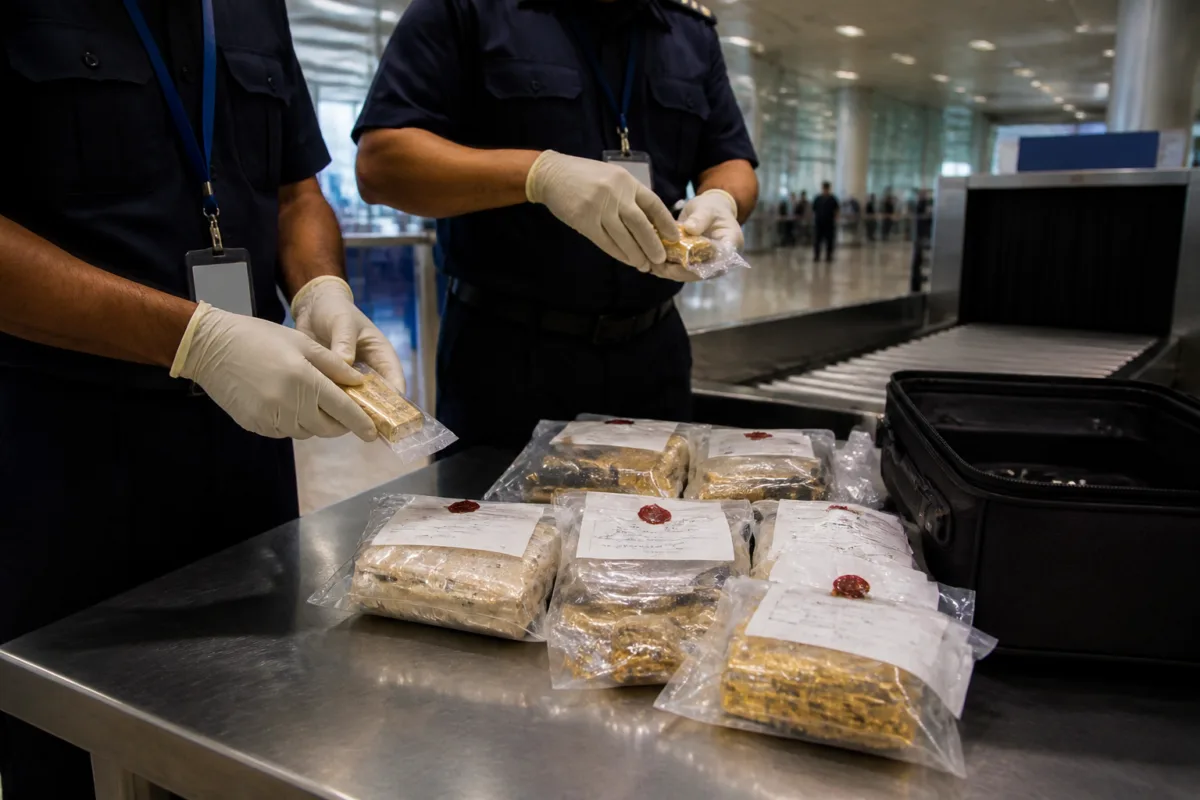
The seizure of gold worth Rs 3.21 crore from two foreign nationals arriving at Delhi’s Indira Gandhi International Airport has exposed how India’s gold-smuggling networks may be diversifying beyond the traditional Gulf routes. The case, involving passengers who travelled from Bishkek in Kyrgyzstan through Almaty in Kazakhstan, is not by itself proof of a new corridor, but it shows why airport enforcement can no longer focus only on familiar departure points such as Dubai, Abu Dhabi, Sharjah and Muscat.
Customs officials intercepted the two passengers at Terminal 3 on November 12. According to the report, eight packets attached to their bodies contained 2.31 kg of gold, valued at Rs 3.21 crore. Both passengers were arrested. The seizure has drawn the attention of investigating agencies because the route links Bishkek, Almaty and Delhi rather than following the more frequently monitored Gulf-to-India pattern.
The immediate question is not simply where the gold was found. It is how international airport networks are being used to move high-value goods, how enforcement agencies identify changing routes and whether the people carrying the gold represent the wider organisation behind the operation. The report says agencies are examining the source of the gold in Kyrgyzstan and whether an organised network was involved.
That distinction matters. A passenger arrested at an airport is often the most visible part of a smuggling chain, but not necessarily its controlling layer. Customs officials cited in the report describe a wider structure involving financiers based abroad, air passengers acting as carriers, local receivers and illegal melting facilities that put the gold into circulation. This makes airport interception an important point of detection, but not the end of the enforcement problem.
The Kyrgyzstan case also demonstrates why route intelligence must keep pace with the geography of international travel. The report cautions that it would be premature to call the Bishkek-Almaty-Delhi route entirely new. In September 2023, agencies seized approximately 5.5 kg of gold from a passenger who had arrived in Delhi from Dushanbe. That earlier seizure suggests that Central Asian connections have appeared in enforcement records before, even if they remain less prominent in public reporting than Gulf routes.
The larger pattern remains concentrated around established air corridors. According to the Directorate of Revenue Intelligence’s Smuggling in India report for 2024-25, 43.7 per cent of all gold-seizure cases were linked to air routes. Across the country, 3,005 gold-smuggling cases were recorded during the period, involving 2,600 kg of seized gold and 533 arrests. These figures show the scale of the enforcement challenge, while also indicating that airports are a major operational front in the effort to control illicit gold imports.
Delhi’s airport is particularly important in this system because it is both a major international gateway and a high-volume connection point for passengers arriving from West Asia, Central Asia and other global regions. The report records several recent seizures at the airport. On October 26, two passengers arriving from Sharjah were found with gold worth Rs 47.38 lakh. In September, passengers arriving from Dubai were linked to the seizure of 6.5 kg of gold.
These cases do not establish that every passenger from a particular country or city presents a heightened risk. They do, however, explain why customs agencies use route-based intelligence alongside passenger profiling, physical checks and examination of concealment methods. As smuggling networks alter their itineraries, enforcement must assess connections and travel patterns rather than rely only on historically established hubs.
The policy and economic background is equally important. The report states that the government raised the import duty on gold from 6 per cent to 15 per cent in May 2026. A higher legal import cost creates a larger gap between the price of gold entering through formal channels and the economics of bringing it in outside the customs system. The World Gold Council has warned that high duties can encourage informal imports.
That warning does not establish that the November seizure was caused by the duty increase. The report does not provide evidence directly linking the two facts. It does, however, identify the tariff structure as part of the environment in which smuggling operates. When a product carries substantial value in a small physical quantity, even a significant duty differential can become an incentive for organised operators to use concealed shipments and paid carriers.
Demand adds another layer, particularly during the wedding and festival seasons when gold purchases traditionally rise. The report notes that this demand can create a market for smugglers, but it also makes clear that there is no evidence connecting the current seizure directly to seasonal demand. This distinction is important for understanding the case: broader market conditions may shape the opportunity, but they do not explain the specific operation without further investigation.
The enforcement challenge therefore spans three linked spaces. The first is the airport, where concealed gold can be detected and seized. The second is the international logistics chain, where the source, transit points, financiers and carriers must be identified. The third is the domestic market, where illegally imported gold may be melted, distributed and sold through local networks. A seizure at Terminal 3 addresses the first point. The investigation must establish whether it can reach the other two.
This is also an institutional coordination issue. Customs is responsible for detecting and seizing goods at the border, while the Directorate of Revenue Intelligence investigates larger smuggling patterns. The report indicates that agencies are now examining the source of the gold and the possible presence of an organised network. The outcome of that investigation will determine whether the case remains an isolated interception or becomes evidence of a wider route and network.
The available data points to a continuing reliance on air travel for gold smuggling, but it does not show how many cases involved repeat routes, how much gold entered undetected or how the seized quantity compares with overall legal imports. Those gaps limit what can be concluded from seizure figures alone. Arrests and recoveries measure enforcement activity; they do not provide a complete estimate of the underlying trade.
For Delhi, the urban significance lies in the airport’s role as a regulated gateway through which global mobility, trade and illicit commerce intersect. The same connectivity that supports legitimate passengers and businesses can be exploited by networks moving compact, high-value goods. That makes airport security not only a question of passenger screening but also of customs intelligence, international cooperation and follow-up investigations beyond the terminal.
The IGI seizure confirms that gold-smuggling investigations must account for routes outside the traditional Gulf corridors. It does not yet prove that Kyrgyzstan has become a major new source or that the Bishkek-Almaty-Delhi route is an established network. Those questions remain with the investigating agencies, which are examining the gold’s origin and the possible involvement of organised operators.

