


The Chhath economy is becoming a significant seasonal force across India, with the Confederation of All India Traders (CAIT) estimating that festival-related activity could generate more than Rs 65,000 crore in trade this year. The estimate, reported by Jagran, places Delhi’s share at about Rs 12,000 crore, Bihar’s at Rs 20,000 crore and Jharkhand’s at Rs 7,000 crore, with the remaining Rs 26,000 crore spread across other states. The numbers point to more than a religious celebration: they reveal how a festival organised around rivers, ponds and temporary ghats activates a wide network of urban markets, services, transport systems and small producers.
The report says around 11 crore people across the country are observing Chhath. Bihar, Jharkhand and eastern Uttar Pradesh remain the principal centres of the festival, but the economic geography of Chhath now extends well beyond those regions. Delhi-NCR has become an important market because of its large Purvanchal population. Communities from Bihar and eastern Uttar Pradesh also support festival activity in Uttar Pradesh, West Bengal, Madhya Pradesh, Chhattisgarh, Rajasthan, Gujarat and Maharashtra.
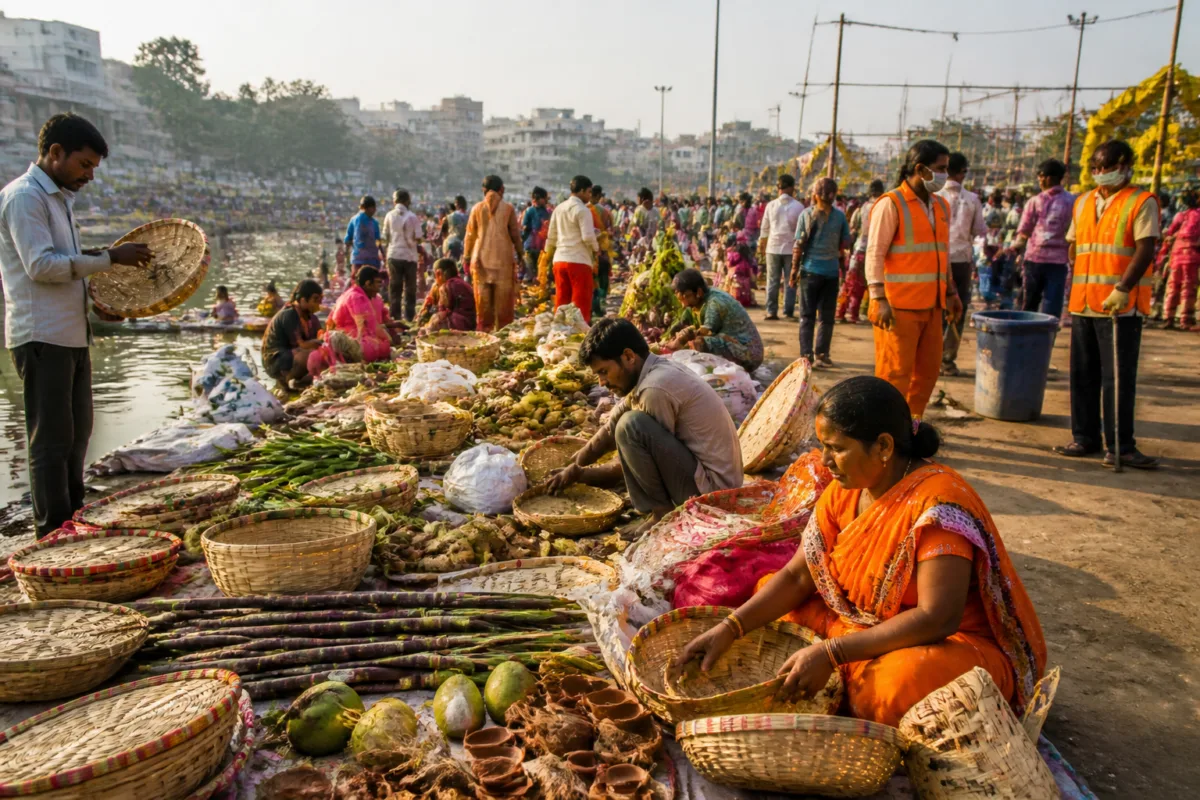
That spread matters for the way urban economies are understood. A festival may be rooted in particular cultural traditions, but its spending is distributed through neighbourhood markets and service providers. In Delhi, the activity is not confined to major retail centres. It reaches local vendors selling bamboo products, fruit, clay lamps, clothing, flowers and ritual materials, as well as transport operators, caterers, tent suppliers, lighting contractors, sanitation workers and security personnel involved in temporary public arrangements.
The CAIT estimate is part of what the report describes as a special study of India’s traditional economy. The study examines spending and trade during festivals and wedding celebrations. The figures are therefore an estimate of economic activity rather than a reported government measurement or an audited account of transactions. That distinction is important. The estimate indicates the scale of the market associated with Chhath, while the supplied report does not establish the methodology, data sources or boundaries used to calculate the total.
Even with that limitation, the distribution provided by CAIT offers a useful view of how the festival’s economic chain works. The three named states and Delhi together account for Rs 39,000 crore of the reported total. The other Rs 26,000 crore is attributed to activity in the remaining states. This division suggests that the festival’s economic significance is concentrated in regions with strong cultural participation but also dispersed through migrant networks and urban markets elsewhere.
The most visible part of this chain is the sale of materials used in the rituals. Bamboo workers supply soop, daura, baskets and other handmade products. Potters sell lamps, traditional stoves, vessels and other clay items. Leaf plates and related products support cottage industries. These are low-scale, labour-intensive activities whose connection to a major festival is often visible only at the neighbourhood level. The report identifies traditional artisans and bamboo-based families as direct beneficiaries of the seasonal demand.
Agricultural producers and wholesale traders form another part of the chain. Bananas, coconuts, sugarcane, seasonal fruits, vegetables and other farm products are purchased in large quantities. Demand also rises for jaggery, rice, wheat flour, ghee, milk, traditional sweets and the ingredients used to prepare thekua. The festival therefore links urban consumers to agricultural supply chains, with local markets acting as the point where cultural demand becomes commercial activity.
Clothing, flowers, garlands, incense, camphor, decorative goods and other worship materials add further layers. The report also refers to women entrepreneurs and small traders as participants in this economic network. It does not provide a separate estimate for their share of the activity, but their inclusion is significant because festival markets often combine household production, informal retail and temporary enterprise rather than operating through large organised businesses alone.
Chhath economy and the cost of temporary urban infrastructure
The economic activity associated with Chhath also depends on public-space management. Rituals take place at rivers, ponds and specially developed temporary ghats. These sites require arrangements for cleanliness, lighting, security and crowd management. State governments and local bodies spend on such facilities, according to the report, creating demand for contractors, service providers and workers while also preparing public spaces for intensive short-term use.
This is where the festival becomes an urban governance issue. A temporary ghat is not simply a religious site. It is a public facility that has to handle concentrated footfall, changing mobility patterns, waste, lighting requirements and safety concerns. The supplied report does not provide details of the budgets, agencies, tenders or operating standards involved in these arrangements. It does, however, identify the basic administrative functions that make the festival possible in cities: sanitation, illumination, security and access to the water edge.
The arrangement also shows the limits of measuring a festival only through retail sales. The reported Rs 65,000 crore estimate includes a broad range of trading and service activity, but the supplied material does not clarify whether public expenditure on ghats is included, how transport revenues are calculated, or whether informal and household transactions are measured in the same way as recorded retail sales. The number is best read as an indicator of the festival’s economic reach, not as a complete accounting of its urban costs and benefits.
The relationship between cultural activity and municipal administration is particularly visible in Delhi-NCR. The region’s large Purvanchal population has created demand for Chhath markets and public arrangements outside the festival’s traditional heartlands. Local authorities must respond to that demand in places where water bodies, open spaces and neighbourhood roads may serve multiple functions throughout the year. The report identifies Delhi as a Rs 12,000 crore market, but does not specify how much of the estimate relates to retail, services, public arrangements or household spending.
The geography of migration helps explain why the market is distributed across cities. People who have moved from Bihar and eastern Uttar Pradesh carry the festival into new urban settings. Their cultural practices create demand for familiar goods and services, while local traders adapt by stocking seasonal products. In this process, a festival becomes a bridge between regional identity and urban commerce. Markets in cities outside Bihar and Jharkhand participate not because they are traditional centres of Chhath, but because their residents and consumers sustain the demand.
This pattern has implications for how local economies are represented in policy. Conventional measures often focus on large firms, formal retail or permanent infrastructure. Chhath-related activity highlights a different economic structure: small traders, artisans, farmers, transport providers, temporary workers and local service operators connected by a short but intense demand cycle. The supplied report does not quantify employment generated by the festival, but it describes a chain that reaches several occupational groups at once.
The festival’s emphasis on bamboo, clay, leaves and agricultural produce also gives the market a material dimension. CAIT national general secretary and Chandni Chowk MP Praveen Khandelwal described Chhath as an example of cultural and spiritual traditions supporting local economic development. He linked purchases from artisans, potters and farmers to the wider idea of strengthening domestic production. These are statements made by a trade body representative and should be understood as an advocacy interpretation of the estimate, rather than as an independently verified assessment of economic impact.
The report also presents Chhath as associated with cleanliness, simplicity, social participation and respect for nature. Those values intersect with the practical demands placed on cities during the festival. Water bodies and public spaces become focal points for large gatherings, making waste management and maintenance especially important. Yet the supplied material does not provide data on waste volumes, water quality, crowd sizes at individual sites or the performance of municipal arrangements. Those gaps prevent a fuller assessment of whether the economic scale is matched by adequate public infrastructure.
What the available figures establish is the breadth of the market, not its net economic outcome. A large turnover figure does not by itself show how much income remains with producers, how much is captured by intermediaries, or how costs are distributed among local bodies, traders and households. Nor does it reveal whether artisans receive sustained benefits after the festival season. The report identifies the groups connected to the activity, but it does not provide price data, profit margins, household income changes or a comparison with previous years.
That makes the Chhath economy an important subject for better urban data. A more complete assessment would need to distinguish retail turnover from public expenditure, seasonal earnings from permanent employment, and consumer spending from value retained by local producers. It would also need to map how temporary markets affect traffic, waste, public-space use and the operation of nearby neighbourhoods. None of those measurements is supplied in the report, so they remain outside what can be concluded from the current estimate.
The immediate evidence nevertheless supports a clear conclusion. Chhath is no longer economically confined to the places where its largest rituals originated. Through migration, local markets and temporary urban infrastructure, it activates a multi-state network connecting agricultural products, handmade goods, informal commerce and civic services. Delhi-NCR’s reported Rs 12,000 crore share illustrates how a culturally specific festival can become part of the economic life of a large, diverse metropolitan region.
The next question for governments and city administrations is not whether the festival has economic significance; the reported estimates and the range of participating sectors make that evident. It is how that significance should be measured and supported without losing sight of public-space capacity, sanitation, safety and the livelihoods of the smallest participants in the chain. The available report establishes the scale and reach of the activity, while the distribution of gains, the cost of civic arrangements and the long-term effect on local producers require further evidence.

