


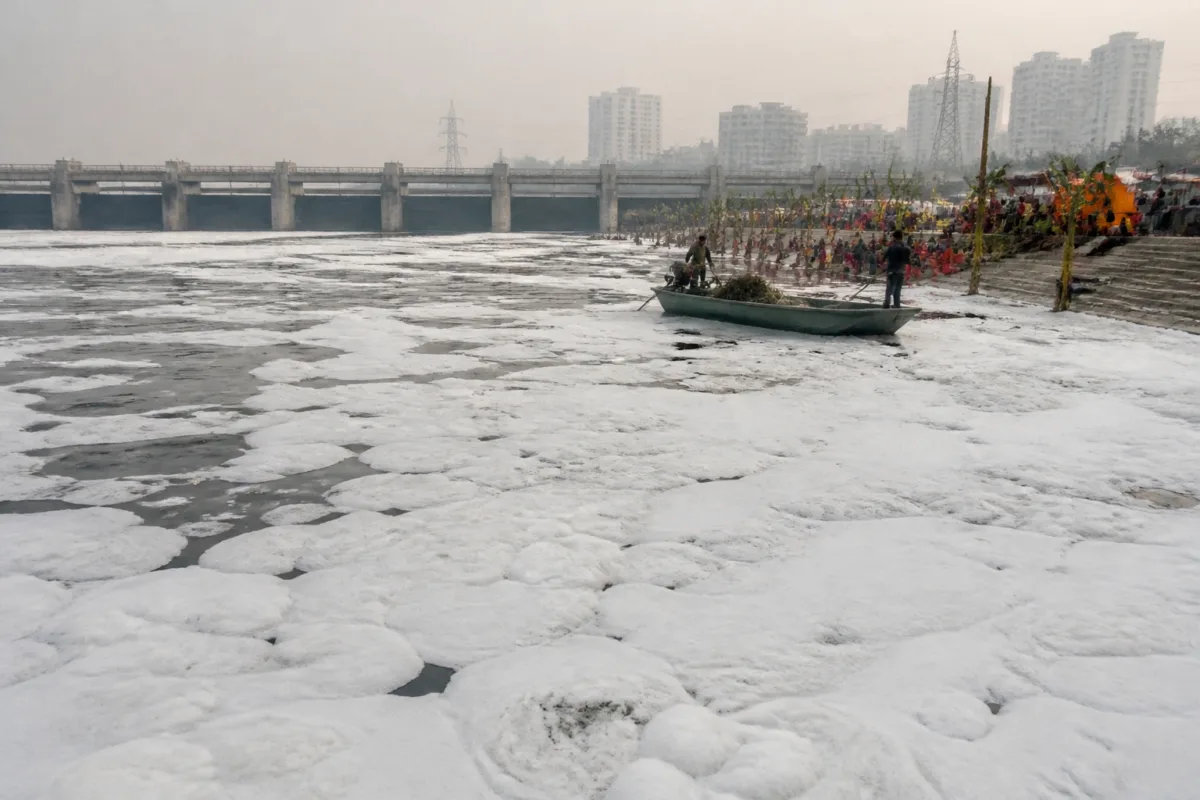
Yamuna pollution has again become the defining public issue around Chhath in Delhi, where devotees are expected to enter the river for the ritual while toxic-looking foam is being removed through chemical spraying near Kalindi Kunj and the Okhla barrage. The immediate spectacle is seasonal, but the underlying problem is not: every year, a religious gathering turns the condition of the river into a visible test of whether government claims about cleaning it can be matched at the water’s edge.
The report by Jagran describes a contradiction at the centre of Delhi’s Chhath preparations. The festival places unusual emphasis on purity, cleanliness and observance over four days. Yet at Kalindi Kunj, one of the locations associated with the celebrations, the Yamuna was reported to be covered with poisonous foam. Devotees were described as preparing to offer arghya while standing in polluted water. The result is not simply an environmental image or a political talking point. It is a direct collision between a public ritual, a polluted urban waterway and the administrative responsibility to make public spaces safe for use.
That collision explains why the Yamuna returns to the headlines at the same time every year. Chhath creates a concentrated public encounter with the river. Thousands of devotees are expected to gather at the ghats, with many standing in water up to their waists while offering prayers to the Sun. The condition of the river, usually experienced through distant views, smells or reports, becomes physically unavoidable. The festival therefore acts as what the report calls an annual public audit of river cleanliness and government claims.
The phrase is important because it shifts attention from the visible foam to the institutions responsible for the river’s condition. A surface clean-up can change what a visitor sees for a few hours, but it does not by itself establish whether the water is safe, whether the pollution load has been reduced or whether the source of the contamination has been addressed. The supplied report records anti-foaming chemical spraying from boats, but does not provide test results, details of the chemical used, the duration of its effect or an assessment of whether the treatment changes the water’s suitability for human contact.
This gap between appearance and condition is central to the Yamuna story. The report says that boats were being used to spray chemicals near the Okhla barrage and that six boats were involved, according to allegations cited from the Aam Aadmi Party. It also reports that foam was being removed ahead of Chhath. But the article does not establish whether the operation was a routine municipal intervention, an emergency measure, or part of a broader river-cleaning programme. Nor does it provide an official technical explanation from the agency carrying out the work.
That absence matters because the public sees an intervention without necessarily seeing its administrative basis. There is a visible problem, a visible response and a visible political dispute, but little public information in the supplied material about the chain of responsibility. The report does not identify the department conducting the spraying, the authority supervising the ghats, the water-quality standards being applied or the monitoring system that would show whether conditions improved after the operation. Without those details, the clean-up remains an event rather than an accountable process.
The political contest has intensified the visibility of the problem. Opposition leaders, including AAP Delhi convenor Saurabh Bhardwaj and Anmol Panwar, criticised the BJP government over the foam and the chemical spraying. The report also says that AAP alleged a BJP spokesperson had announced during a television debate that he would take a dip at Kalindi Kunj, but did not arrive there. The BJP’s response is described as a political counterattack, although the supplied article does not provide the full text of that response.
This exchange illustrates how river pollution becomes politically useful without necessarily becoming administratively clearer. Each side can point to the river as evidence against the other: one side highlights the polluted water and the failure of cleaning claims; the other can focus on the current administration’s responsibility for the condition of the ghats and river. The public argument becomes immediate because the pollution is visible. Yet the central operational questions remain less prominent: who measured the water, who authorised the intervention, what results were recorded and what happens after the festival ends?
The timing of the controversy also shapes the way the river is governed. Preparations accelerate before the festival, when the presence of devotees and media attention creates pressure for a rapid visual response. The report refers to foam removal and chemical spraying before Chhath, suggesting that the administration is responding to an approaching deadline. This is a familiar governance pattern in urban infrastructure: a recurring public event concentrates action into a short window, while the underlying system is judged through a temporary improvement in appearance.
Such a pattern can produce a mismatch between event management and environmental management. Event management focuses on access, cleanliness at the ghats and the immediate experience of visitors. Environmental management requires longer-term monitoring and control of whatever is causing the river’s degraded condition. The supplied report does not identify the source of the foam or provide evidence about the wider pollution system. It therefore cannot establish whether the treatment near Kalindi Kunj is addressing a cause, containing a symptom or only dispersing what is visible on the surface.
The institutional issue is further complicated by the fact that the Yamuna is not merely a ceremonial site. It is a major urban environmental asset running through the capital, but its public meaning changes depending on the season. During Chhath, it becomes a place of worship and a high-footfall public space. That creates obligations that extend beyond routine river maintenance. Authorities must manage access, crowd movement, sanitation and public communication while also ensuring that the water conditions are accurately assessed and clearly communicated.
The report’s evidence shows the scale of the public encounter, even though it does not provide a precise attendance figure. It says thousands of devotees are expected at the ghats and that worshippers will stand in the river to offer arghya. The four-day structure of Chhath means that the issue is not limited to a single moment. River conditions, ghat arrangements and public-health messaging become relevant across several days of ritual activity.
The same evidence also shows why visual pollution has such political force. Foam floating on the river can be seen by devotees, journalists and political representatives. It creates a direct comparison between official claims and lived experience. The report says that the city was also facing hazardous air pollution after Diwali, placing the Yamuna controversy within a wider period of environmental stress. However, the supplied material does not provide air-quality readings or water-quality measurements, so the relationship between the two pollution episodes cannot be quantified from this report.
What can be established is narrower but significant. Delhi’s river pollution remains sufficiently visible during Chhath to require emergency-looking interventions. Devotees continue to approach polluted water for a religious ritual. Political parties continue to use the river’s condition to challenge one another. And the administration’s response, as presented in the report, is focused on removing or suppressing foam immediately before a major public gathering. These facts point to a recurring governance problem even without additional data on the river’s chemistry or pollution sources.
The most important information missing from the public-facing account is therefore not another political statement. It is a verifiable operational record. That record would need to show the measured condition of the water, the authority responsible for the response, the chemicals used, the purpose and duration of the treatment, and the status of the river after the festival. The supplied article does not contain those details, so it would be inaccurate to claim that the spraying made the water safe or that it failed technically. It is also not possible from the report to determine whether the foam was reduced because of chemical treatment or because of other conditions.
This distinction is essential for urban accountability. A river-cleaning programme cannot be assessed only by whether foam is absent from a photograph on a festival morning. It must also be assessed through the quality of the water, the continuity of monitoring and the ability of public agencies to explain what they have done. If the only visible measure is surface treatment before a high-profile event, the public may receive a cleaner-looking river without receiving a clear account of river health.
Chhath makes that accountability unavoidable because citizens are not passive observers. They arrive at the ghats, enter the water and perform a ritual that depends on trust in the public environment. The report describes devotees as stepping into polluted water in the belief that their faith will protect them. That framing captures the human consequence of administrative uncertainty: citizens must make personal decisions in a setting where official information about the water’s condition is not presented in the supplied account.
The larger urban question is whether Delhi treats the Yamuna as a river that must be continuously governed or as a public image that must be repaired before important occasions. The annual recurrence of foam, political confrontation and emergency clean-up suggests that the festival is exposing a persistent weakness rather than creating a new one. The immediate response may manage the appearance of the ghats, but the public test will continue until authorities can demonstrate the river’s condition through transparent monitoring and sustained action.
For now, the evidence confirms a recurring cycle: polluted water becomes visible before Chhath, chemical spraying is reported near the Okhla barrage, devotees prepare to gather at the ghats, and political parties trade accusations over responsibility. What remains unestablished in the supplied material is whether the intervention changes water quality or merely removes the most visible sign of pollution. That is the question Delhi’s river authorities will need to answer beyond the festival deadline.

