


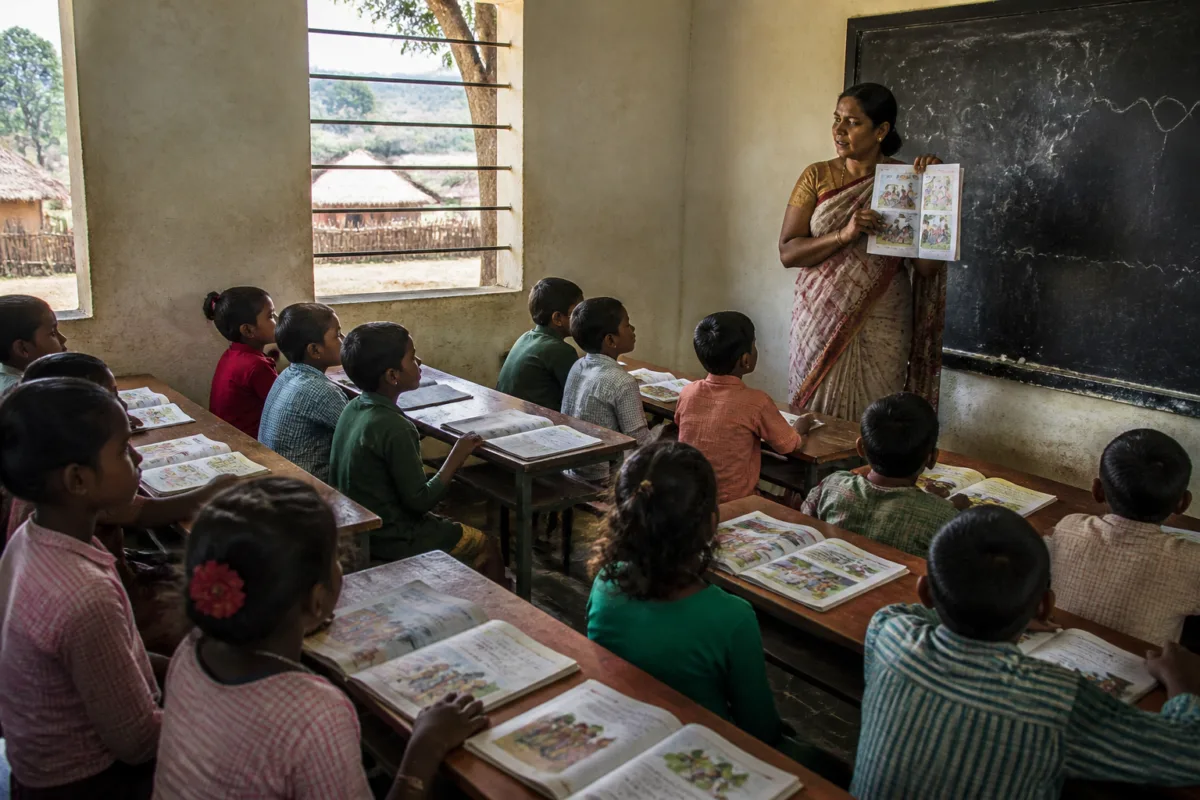
Telangana tribal education faces a problem that begins before a child falls behind in a lesson: the language used at home may disappear at the school gate. The UNESCO report ‘Bhasha Matters: State of the Education Report for India 2025 on Mother Tongue and Multilingual Education’ links unfamiliar teaching languages to early comprehension breakdowns, long-term learning loss and falling participation among tribal children. Its central finding is stark: access alone is not translating into retention or learning.
The report cites UDISE+ 2023-24 figures showing gross enrolment ratios of 95.2 per cent for Classes VI to VIII, falling to 76.9 per cent for Classes IX and X and then to 48.7 per cent for Classes XI and XII. These figures do not, by themselves, establish that language is the only cause of attrition. But they show the point at which the education system is losing a substantial share of students, while the report identifies language, distance, transport, accommodation and seasonal migration as connected barriers.
For a child who speaks Gondi, Kolami or Lambadi at home, the transition into a classroom where neither the teacher nor the textbook uses a familiar language can be more than a curriculum challenge. It can affect whether the child understands the first explanation, participates in class, receives help and develops the confidence to continue. UNESCO’s formulation is that most tribal children enter school speaking a tribal mother tongue, while instruction begins in the dominant state language or, increasingly, in English. The report describes the resulting comprehension breakdown as a source of long-term learning loss.
This shifts the policy question from whether children are enrolled to whether the school is capable of teaching them. A school may be physically available and still be functionally inaccessible if the language of instruction is not understood. That distinction matters particularly in tribal regions, where the report says schools may also be located far from habitations, transport may be unreliable and hostel accommodation may be inadequate.
The language issue is therefore part of a wider delivery chain. A child travelling a long distance to school may face one set of barriers on the road and another inside the classroom. A child affected by seasonal migration may experience disrupted attendance. A girl may face additional difficulties because of unsafe travel routes, limited residential facilities and reduced academic support outside school. When these pressures overlap, language can become the first point at which the system fails to convert attendance into learning.
Telangana’s existing textbook landscape illustrates the gap between formal multilingual provision and the languages children may actually use. The state has developed 274 textbook titles across eight languages for Classes I to X. The distribution includes 48 titles each in Telugu and English, 43 each in Hindi and Urdu, and eight in Bengali. The report’s concern is not that multilingual publishing is absent, but that tribal languages remain poorly represented, particularly in learning technology and digital resources.
That distinction is important for education administration. Producing textbooks in several widely used languages is not the same as building a teaching system around the full linguistic diversity of a region. The relevant question is whether children can find a teacher who understands their home language, whether learning materials reflect that language and whether the system can support instruction when the child moves between a tribal language, Telugu, English or another school language.
A public discussion organised by the Telangana Education Commission in May 2025 brought this tension into sharper focus. During a discussion on English-medium education in government schools, Prof. Padmaja Shaw of the English and Foreign Languages University questioned why debates on mother-tongue education often overlook tribal children whose first language is neither Telugu nor English. She asked whether teaching tribal children in Telugu could amount to the same linguistic imposition as teaching them in English, while also questioning why children from disadvantaged communities should be denied access to the English-medium education available to wealthier families.
The point is not a simple choice between English and a regional language. For tribal children, the first institutional language encountered may already be different from the language spoken at home. Treating Telugu as an automatic substitute for mother-tongue instruction can obscure the actual classroom experience of children who speak Gondi, Kolami or Lambadi. At the same time, limiting disadvantaged children to only one language could restrict access to opportunities associated with English. The policy challenge is to build a pathway that does not make comprehension the price of entry into a wider linguistic world.
UNESCO’s recommendations place responsibility across several parts of the education system. It calls for preference to be given to teachers proficient in children’s home languages, particularly in tribal regions, and for multilingual competence to be recognised as an asset in recruitment and promotion. This moves the issue beyond teacher availability in the narrow sense. The question is whether recruitment rules and deployment practices identify language ability as a functional requirement for teaching in a particular community.
The report also recommends improving multilingual textbooks and investing in language technology, offline educational resources and community-developed materials for lesser-used languages. The reference to offline resources is significant because the report identifies limited connectivity and restricted access to devices in remote communities. Digital education cannot solve a language gap if children cannot reliably access the technology, or if the available content does not exist in the languages they understand.
Funding is another institutional question. UNESCO calls for dedicated allocations within central and state education schemes, including Samagra Shiksha, to support multilingual teacher recruitment and learning materials. Without identifiable funding, multilingual education can remain a general principle rather than an operational responsibility. Recruitment, textbook production, teacher training, translation, technology and community participation require different administrative actions, even though they are linked in the classroom.
The enrolment figures underline why this cannot be treated only as a primary-school language issue. The reported decline from 95.2 per cent in Classes VI to VIII to 48.7 per cent in Classes XI and XII suggests that the transition through the education system is where the pressure becomes most visible. The supplied material does not establish how much of that decline is attributable to language, nor does it provide a district-wise comparison. It does, however, identify language as one element in a cluster that includes distance, transport, hostels, migration and gendered safety concerns.
That evidence points to a planning problem as much as a classroom problem. School location, residential facilities, teacher recruitment and the design of learning materials are usually handled through different administrative processes. For a tribal child, they combine into one experience of whether school is reachable, understandable and worth continuing. A language policy that ignores transport or hostel conditions will not address the full access problem; an infrastructure response that ignores language may improve physical availability without improving learning.
The larger question for Telangana is whether its education system recognises linguistic diversity at the point where public services are delivered. The state’s eight-language textbook provision demonstrates an existing capacity to produce differentiated materials, but the report indicates that this capacity has not adequately reached tribal languages or learning technology. The gap is therefore not simply between policy and implementation; it is also between the languages counted by the system and the languages spoken by children inside it.
The UNESCO report confirms that tribal education cannot be assessed only through school availability or initial enrolment. Its evidence connects falling participation in higher classes with a set of barriers, including unfamiliar teaching languages and inadequate support infrastructure. What remains unclear from the supplied material is the district-level distribution of these barriers and the precise contribution of each factor to attrition. The next test will be whether teacher recruitment, textbook policy, offline learning resources and dedicated funding are redesigned around the languages and conditions of the communities the system is intended to serve.

