


Assam’s road-safety crisis is no longer defined only by how many crashes take place, but by how deadly those crashes have become. Centre figures cited by the Times of India show that more than 27,000 people died on the state’s roads between January 2018 and July 2026, while the number of recorded accidents nearly doubled over the period. The figures point to a system in which road users are increasingly exposed to severe outcomes even when the annual accident count does not rise consistently.
More than 78,000 road accidents were recorded in Assam during the eight-and-a-half-year period. On the figures supplied, that is roughly one death for every three recorded accidents. The highest toll came in 2025, when 16,026 accidents claimed nearly 4,000 lives. That year was a sharp departure from the preceding pattern, in which recorded accidents generally remained within a relatively narrow band while deaths gradually increased.
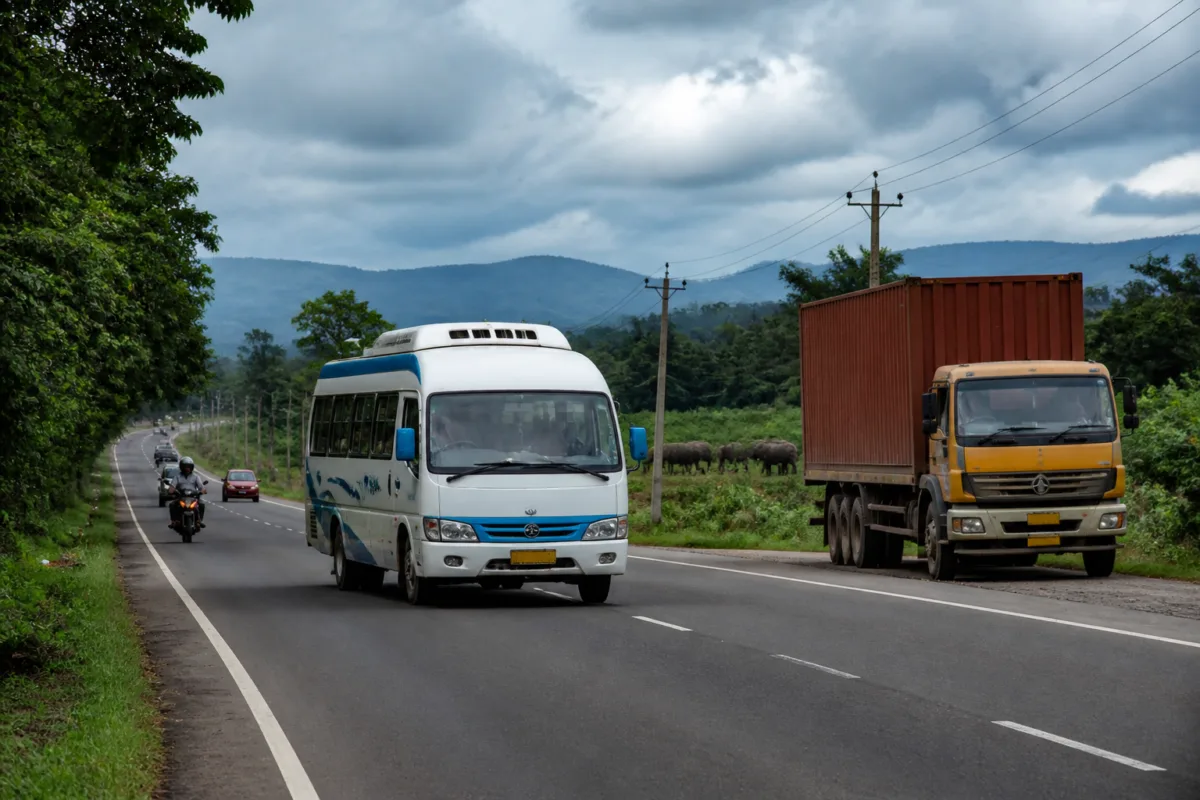
The immediate human cost was again illustrated by five major accidents in 2026 that had killed 45 people at the time of the report. The deadliest was a head-on collision between a minibus and a container truck in Kaziranga, in which 23 people died. Such incidents bring attention to individual locations and vehicles, but the longer series of figures suggests that the problem extends beyond isolated crashes. It involves the interaction of road design, vehicle mix, traffic exposure, enforcement, emergency response and the quality of official reporting.
The trend becomes clearer when the annual death figures are separated from the accident count. Assam’s daily road death toll rose in 2019 before falling to 7.2 in 2020, when Covid-19 restrictions sharply reduced movement. Deaths fell by 19% that year to 2,629. The decline was therefore closely associated with fewer vehicles on the road rather than an identifiable structural improvement in road safety.
After the lockdown period, deaths returned to higher levels. The toll rose to 3,036 in 2021, slipped marginally to 2,994 in 2022, and then increased to 3,296 in 2023 and 3,351 in 2024. From the 2020 low to the 2025 peak, deaths increased by 49%. The sequence indicates that as normal travel resumed, the factors associated with serious road trauma also returned or intensified.
The accident data, however, do not move in the same way. Between 2018 and 2024, the number of recorded accidents stayed between 6,600 and 8,400 a year. Assam recorded 8,248 accidents in 2018 and 7,848 in 2024, meaning the later figure was actually lower. Yet the number of deaths increased over much of the same period. This is the central finding in the data: the roads were not necessarily registering more crashes every year, but the crashes that were recorded were becoming more lethal.
Deaths per 100 recorded accidents rose from 36 in 2018 to 44 in 2023. In practical terms, roughly four out of every 10 recorded accidents in 2023 were associated with a death. This is not a measure of the probability that every crash will kill someone; it is a fatality-to-accident ratio based on the reported figures. Even with that limitation, the movement is significant because it shows that the fatality burden cannot be understood through crash frequency alone.
The figures also raise an important question about what is being counted. The report notes that the number of recorded accidents more than doubled over the full period, while deaths rose by only 16% from 2018. One possible explanation is wider recording of minor accidents rather than a genuine doubling of serious crashes. The supplied data do not establish which explanation is correct. Deaths, which are harder to under-report, remain a more dependable yardstick for understanding the severity of the road-safety problem.
The sharp increase in recorded accidents in 2025 complicates the picture further. The state reported 16,026 accidents that year, more than twice the 7,848 recorded in 2024 and equivalent to about 44 accidents a day. In the first seven months of 2026, 9,758 accidents were recorded, or about 46 a day. These numbers could indicate a substantial deterioration, improved registration, or a combination of both. Without information on reporting procedures, road coverage, vehicle exposure and the classification of accidents, the data cannot by themselves explain the sudden change.
What they do establish is that road deaths have remained persistently high. The annual toll after 2020 did not return to the lockdown-era level. It crossed 3,000 in 2021, stayed near that mark in 2022 and rose further in 2023 and 2024. The 2025 peak therefore appears within an already elevated fatality pattern rather than as an entirely isolated event.
This distinction matters for governance. A road-safety administration that focuses only on the number of crashes could conclude that the problem was stable between 2018 and 2024 because accident totals remained within a limited range. A system that tracks deaths per crash, however, would see a worsening outcome. The two indicators answer different questions: accident counts describe the volume of reported incidents, while deaths reveal the consequences when those incidents occur.
The figures also point towards the importance of crash severity. A head-on collision involving a minibus and a container truck, such as the Kaziranga accident cited in the report, carries a high risk of multiple deaths because of the relative size and mass of the vehicles and the possibility of several occupants being involved. The supplied report does not identify the specific causes of that collision, so no conclusion can be drawn about speed, road geometry, driver behaviour, vehicle condition or enforcement. But the scale of the death toll demonstrates why road-safety policy must look beyond preventing collisions to reducing the consequences when collisions occur.
That institutional responsibility is distributed across several parts of the urban and regional transport system. Roads are planned, built and maintained by public agencies; traffic rules are enforced by authorities; vehicles are regulated through registration and fitness systems; and injured people depend on emergency medical response. The figures supplied do not detail the performance of any one agency or identify a single cause. They instead show the outcome that the combined system is producing: thousands of deaths over several years and a rise in fatality intensity.
The Assam data also expose the limits of headline comparisons. Saying that crashes nearly doubled captures the scale of the 2025 and 2026 accident figures, but it does not explain whether the increase reflects more dangerous roads, more traffic, better reporting or a broader definition of recorded accidents. Saying that fatalities rose by nearly a third captures the long-term deterioration, but it does not reveal which road users were most affected or where the deaths occurred. Those questions would require more detailed official data than is included in the supplied report.
For citizens, the most consequential finding is simpler. The risk is not adequately represented by the number of reported accidents on its own. A period with fewer or stable accident counts can still become more dangerous if each crash is more severe. Assam’s increase in deaths per 100 recorded accidents between 2018 and 2023 is therefore a critical indicator, especially when read alongside the rise in the annual death toll after the 2020 lockdown.
The next stage of public scrutiny should focus on whether the 2025 surge is sustained, how the 2026 figures are finally recorded, and whether official agencies can distinguish reporting changes from a real increase in crashes. It should also examine the location, road type, vehicle category and victim profile associated with fatal accidents. The supplied figures confirm the scale and persistence of the crisis, but they do not yet explain its precise causes.
What is already clear is that Assam’s road-safety challenge is not simply a story of more vehicles or more collisions. It is a story of a transport system in which the consequences of recorded crashes have become increasingly severe. Any credible assessment of the state’s roads will therefore have to measure not only how often accidents occur, but also why so many of them end in death.

