


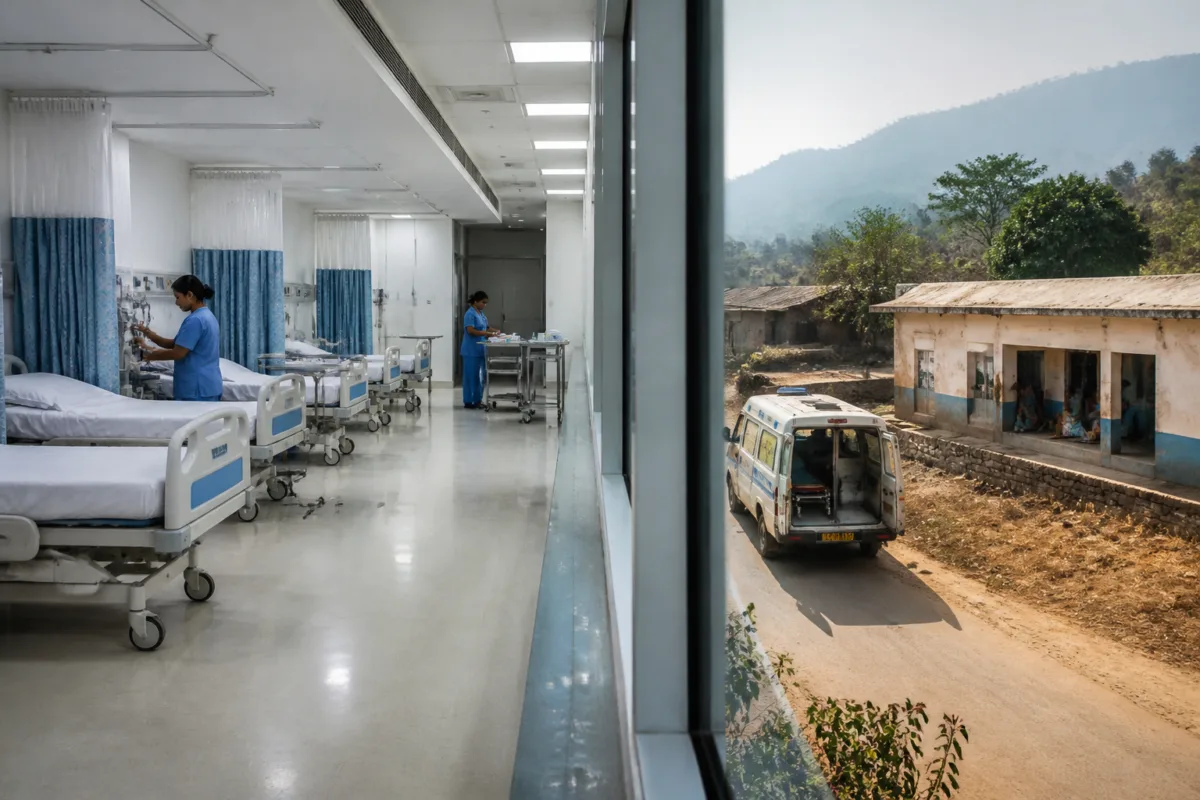
India’s 23.5% C-section rate conceals a sharply unequal maternal healthcare system in which a woman’s income, location, education and choice of hospital can substantially influence whether she undergoes surgical delivery. A South Asia-wide study has found that caesarean deliveries are far more common among urban women, patients using private facilities and households at the top of the wealth distribution, while disadvantaged women face the opposite risk: inadequate access when emergency surgery is genuinely needed.
The study, titled ‘Trends and Determinants of Cesarean Section Deliveries in South Asia: A Comparative Study of Medicalisation and Socioeconomic Disparities’, was published in the latest issue of Health and Population: Perspectives and Issues. It was conducted by Sameer K Jena and Liza K Gouda of Fakir Mohan University, Odisha; Moatula Ao of the University of Hyderabad; and Jitendra Gouda of the Directorate of Census Operations, New Delhi.
Its central finding is not that caesarean delivery is inherently undesirable. C-sections can be lifesaving when complications make vaginal delivery unsafe. The concern raised by the researchers is that the procedure is not distributed solely according to medical need. Instead, the pattern suggests that the organisation and accessibility of healthcare services can shape childbirth outcomes before clinical considerations are fully accounted for.
The national average therefore provides an incomplete picture. The study found that around 35% of urban births in India were through C-sections, compared with 19.6% of rural births. The difference of more than 15 percentage points indicates that place of residence is closely associated with the type of childbirth care a woman receives.
This urban-rural gap has two possible dimensions within the evidence presented by the researchers. Urban women may have greater access to hospitals, specialists and facilities capable of performing planned or emergency surgery. At the same time, the lower rural rate may reflect shortages in timely emergency obstetric care rather than a uniformly lower need for C-sections. In other words, a low rate is not automatically evidence of better or safer care.
The facility-level figures make the divide more pronounced. Private hospitals recorded a C-section rate of 47.5%, while public facilities reported a rate of 14.3%. The gap between the two types of institutions is not a minor variation around a common pattern; it points to two substantially different childbirth environments operating within the same health system.
The study does not establish that every C-section in a private hospital is medically unnecessary, nor that every public-facility birth is appropriately managed. It does, however, show that hospital type is strongly associated with the likelihood of surgical delivery. That makes facility-level monitoring important, particularly when national averages can conceal large differences between providers.
Income produces an even wider separation. According to the study, 41.9% of women from the wealthiest households underwent a C-section, compared with only 8.4% of women from the poorest households. The difference is more than fivefold. Economic status appears to influence not only whether a woman can reach a facility, but also the kind of facility she uses and the range of interventions available to her.
Education and access to healthcare were also identified as important factors. The researchers said that these conditions shape childbirth experiences, linking the procedure to broader inequalities in information, service access and household resources. A woman’s decision-making environment is therefore connected to the structure of the health system around her: where care is located, what services are available and how counselling is provided.
These findings reveal why the C-section rate must be read as a distributional indicator rather than only as a national health statistic. India’s overall rate of 23.5% sits between sharply different experiences. A woman in an urban private hospital and a woman in a rural public facility may encounter very different thresholds for surgery, very different levels of emergency preparedness and very different forms of counselling, even though both are included in the same national figure.
The South Asia comparison adds regional context but does not erase India’s internal disparities. Bangladesh recorded the highest C-section prevalence among the countries studied, at 44.5%, followed by the Maldives at 42.6%. India’s 23.5% rate was lower than both, but the study’s focus is that a lower national rate can still contain serious inequality. Country-level comparisons are useful only when they are combined with an examination of who receives the procedure and under what conditions.
The policy challenge is therefore divided into two related but different problems. In settings where surgical delivery is used without sufficient medical justification, women may face avoidable risks. The researchers identified infections, excessive bleeding, longer recovery periods and complications in future pregnancies as potential risks associated with unnecessary interventions. For newborns, early or unnecessary C-sections may increase the risk of breathing problems.
In underserved areas, however, the danger may come from the absence or delay of a medically necessary operation. The study cautioned that disadvantaged women, particularly in rural areas, may not receive timely access to emergency C-section services when complications arise. A lower rate in such locations cannot be interpreted without asking whether the system has the capacity to respond when a birth becomes complicated.
This creates a difficult governance problem for health administrators. Monitoring only the overall rate could encourage an overly simple target: reducing C-sections everywhere. That would risk treating appropriate emergency surgery and potentially avoidable intervention as the same phenomenon. The researchers instead called for the procedure to be performed at the right time and for the right medical reasons.
Their recommendations point towards a differentiated health-system response. Private hospitals require stronger monitoring and accountability, particularly because their reported C-section rate was substantially higher than that of public facilities. Public institutions require improved emergency obstetric care so that rural and poorer patients are not left without timely access to surgery when it is needed. Both systems require evidence-based clinical decision-making and regular review of facility-level rates.
Counselling is another part of the proposed response. The study recommended improving counselling for pregnant women and their families, recognising that childbirth decisions are made within households as well as hospitals. Better information cannot compensate for missing infrastructure, but it can help patients understand the medical reasons for an intervention and distinguish clinical necessity from economic or institutional pressures.
The institutional lesson is that safe maternal care depends on more than the presence of a hospital building or the availability of a surgical procedure. It depends on whether facilities can provide the right intervention at the right time, whether patients can reach them, whether clinical decisions are monitored and whether public and private providers are held to comparable standards of accountability.
The figures also show why urban expansion does not automatically produce equitable healthcare. Urban women recorded a much higher C-section rate than rural women, but the study does not present that difference as proof that urban care is uniformly better. Cities may offer greater access to hospitals and specialists while also creating conditions in which interventions are more frequent. Rural areas may have lower intervention rates while facing more severe shortages during emergencies. The two sides of the gap represent different forms of inequality.
The same tension is visible in the income figures. The wealthiest women recorded a 41.9% C-section rate, while the poorest recorded 8.4%. The higher rate among richer households may reflect access to private facilities and greater availability of surgical services. The lower rate among poorer households may reflect reduced access, delayed referrals or an inability to reach emergency care. Without examining the medical circumstances of individual births, the rate alone cannot determine which procedures were necessary. It can, however, identify where closer scrutiny is needed.
For policymakers, the study shifts the question from ‘Is India’s C-section rate too high?’ to ‘Who is receiving C-sections, where, and with what level of medical justification and emergency readiness?’ That is a more useful administrative question because it links the procedure to the distribution of facilities, household resources and institutional responsibility.
The evidence confirms a two-sided problem: possible overuse in some private and economically advantaged settings, alongside possible under-access in rural and poorer communities. The study does not provide a single national solution or establish that every gap represents inappropriate care. It does show that India’s average rate masks major differences by residence, facility type and wealth.
The developments that deserve monitoring are therefore facility-level C-section rates, the quality of emergency obstetric services in public institutions, access in rural areas, counselling practices and the accountability mechanisms applied to private hospitals. The broader measure of progress will not be a lower or higher national percentage by itself, but whether women can receive safe and medically appropriate childbirth care irrespective of income, education or place of residence.

